Las Vegas on the Levant
“It became necessary to destroy this town to save it.”
- Unnamed U.S. Army major explaining the obliteration of Bien Tre, South Vietnam, to AP reporter Peter Arnett, February 7, 1968
They say a picture is worth a thousand words.
This picture left me speechless.
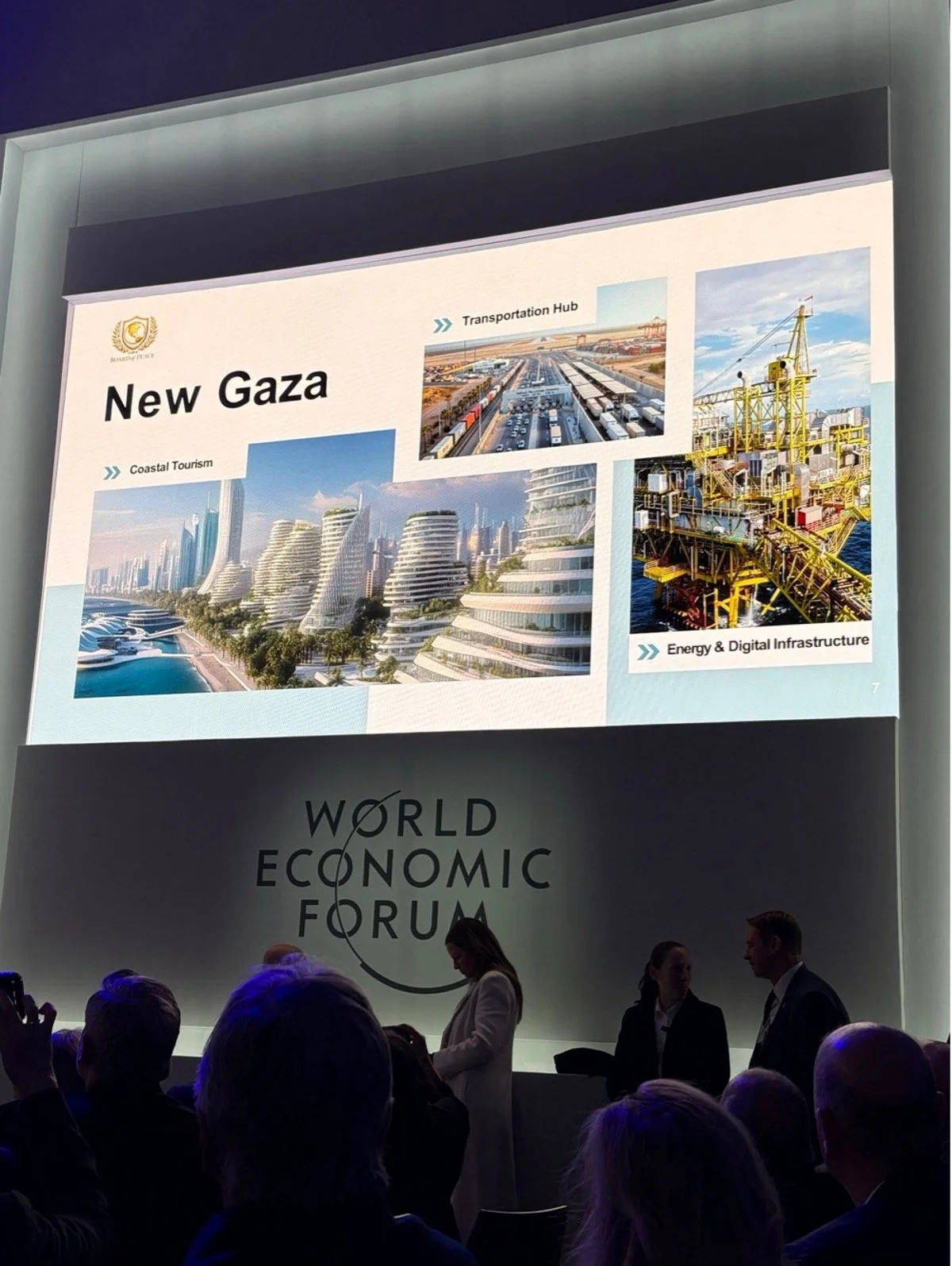
It is, as the sign says, a schematic for the New Gaza, which Jared Kushner presented at last week’s World Economic Forum in Davos, Switzerland. Kushner was speaking for the Board of Peace, the recently formed organization of which his father-in-law, Donald Trump, is chairman for life. A permanent board seat can be had for $1 billion.
When I say I found the image distasteful, I don’t want anyone to infer that my revulsion is merely aesthetic. I certainly find it ugly, but as the Romans used to say, de gustibus non disputandum est (“matters of taste are not to be disputed”); and if you like gold bathroom fixtures, well, good for you. But its garishness is not just an affront to my personal sensibilities; it mocks the land on which it will be built, the devastation which preceded it, and the people it seeks to eradicate culturally once they have been removed physically. That is to say, its ugliness doesn’t just lie on the surface – on the hideous buildings, the swank beaches, and the rich tourists it seeks to attract. It goes deep into the soil of Palestine in its effort to divert us from the devastation of the old Gaza that paved the way for the New Gaza.
REUTERS/Hatem Khaled
Those of us old enough to have witnessed urban renewal in American cities in the 1950s and 1960s will remember the razing of slums, displacement of residents, and gentrification of neighborhoods. In hindsight, most of these efforts have been criticized as misguided, and several of the housing projects were subsequently dismantled, although the urban reformers of the day believed they were doing the right thing.
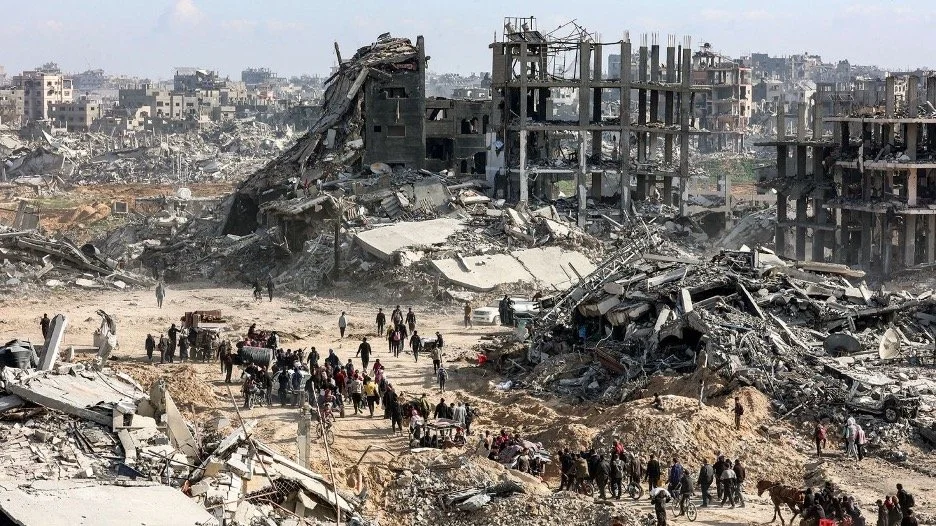
But the urban renewal of the Gaza Strip is something else entirely. This is a real estate deal designed by real estate dealers, and there is a lot of money to be made. The Israelis and Hamas handled the land clearance, always the most difficult part of assembling large parcels of land for development. More than 90 percent of housing units have been destroyed in Gaza since Opctober 7, 2023; over 71,000 people have been killed; and virtually all of the 2+ million residents of the Gaza Strip have been displaced, most of them more than once.
Who are these people? Over 99 percent are Palestinians, primarily refugees from the 1948 resettlement and their descendants. They are overcrowded and impoverished (almost half the people – and 70 percent of young people – are unemployed). They are young (almost half the population is 14 or under), and they have one of the highest fertility rates in the world. They are literate (more than 97 percent of the people can read and write). And there are more child amputees in Gaza than anywhere else in the world.
Last year, President Trump announced that the U.S. would “take over” the Gaza Strip, "level the site" and rebuild it. He spoke of the United Sates “owning that piece of land” and creating “the Riviera of the Middle East.” His plan calls for evicting the current residents, leveling the place, and starting from scratch. He would disperse them to camps in different Middle Eastern countries. Asked if the Palestinians would have a right to return, he responded, "Why would they want to return?"
Why indeed? The New Gaza is not for them. Reminders of genocide are not good for business.