One Man’s Dream is Another Man’s Nightmare
“I still have a dream. It is a dream deeply rooted in the American dream. I have a dream that one day this nation will rise up and live out the true meaning of its creed: We hold these truths to be self-evident, that all men are created equal.”
- Martin Luther King, Jr., August 28, 1963.
August 28th, 2025. Today is the 62nd anniversary of the March on Washington. Of all the events I have missed in my life, this is the one that saddens me most. Instead, I had spent that summer with two high-school friends laying pipeline across the Jicarilla Apache Nation Reservation in northwestern New Mexico. It was a summer job before our freshman year in college, and we couldn’t wait for it to be over.
Meanwhile, 250,000 people of all colors and walks of life, from across the country, arriving by car, bus, and on foot from across the country, gathered at the Lincoln Memorial to protest for (for, not against) freedom and jobs. The last speaker of the day was a 34-year-old Baptist minister named Martin Luther King, Jr., who gave the most important speech of his life, which has forever after been known, simply, as “I Have a Dream.” (You can watch it here.)
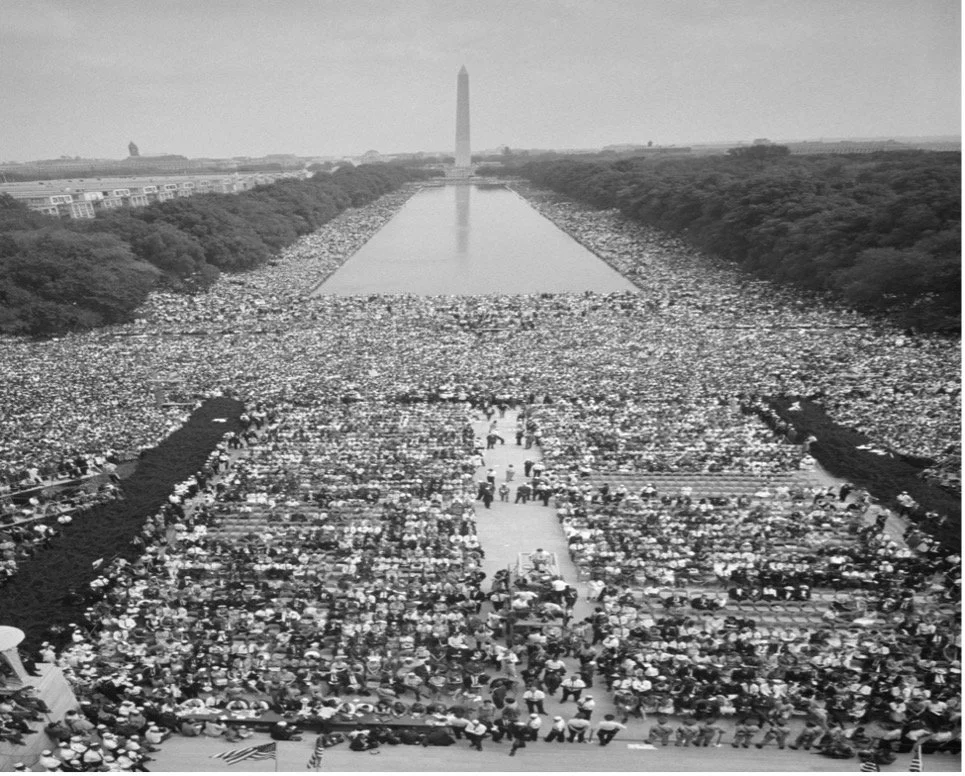
Warren K. Leffler
Although I did not know it at the time, I had not completely missed that speech, for on a freezing weekend in February, Dr. King had come to a small boys boarding school in central Massachusetts and, in the course of that visit, had spoken to the school’s students, faculty, and neighbors, giving what turned out to be an early and still-unpolished draft of what he would later say in August. Those words changed me in ways I’m still discovering.
While King’s speech was the centerpiece of the March on Washington, there were thousands of others who made the day happen. Most importantly, perhaps, and least remembered, is a man named Bayard Rustin, one of the great organizers of his time.
Bayard Rustin was a living definition of diversity. Black, gay, a pacifist, a Quaker, and one courageous human being. He was absolutely committed to non-violence and had persuaded King to do away with armed guards, despite the constant threats on his life. Rustin was not visible at the march because Sen. Strom Thurmond of South Carolina outed his homosexuality on the Senate floor, but he handled all security matters.
“Bayard was absolutely adamant that this was going to be a peaceful day,” recalled Joyce Ladner years later, “and all the press, before we planned the march, was virtually hysterical, you know, that they’d have to call in the National Guard, that if all these black folks came to Washington, there would be riots. And Bayard was determined that not only would the march be peaceful, but that it would go beyond that, that it would police itself, and that it would be absolutely non-violent” (State of Re:Union (Dec. 3, 2010) called “Bayard Rustin – Who is this Man?”, recently discovered by my daughter Gayley).
For weeks, Rustin trained groups of Washington police, black and white, in non-violent crowd control, and the result was a remarkably peaceful and joyful day.
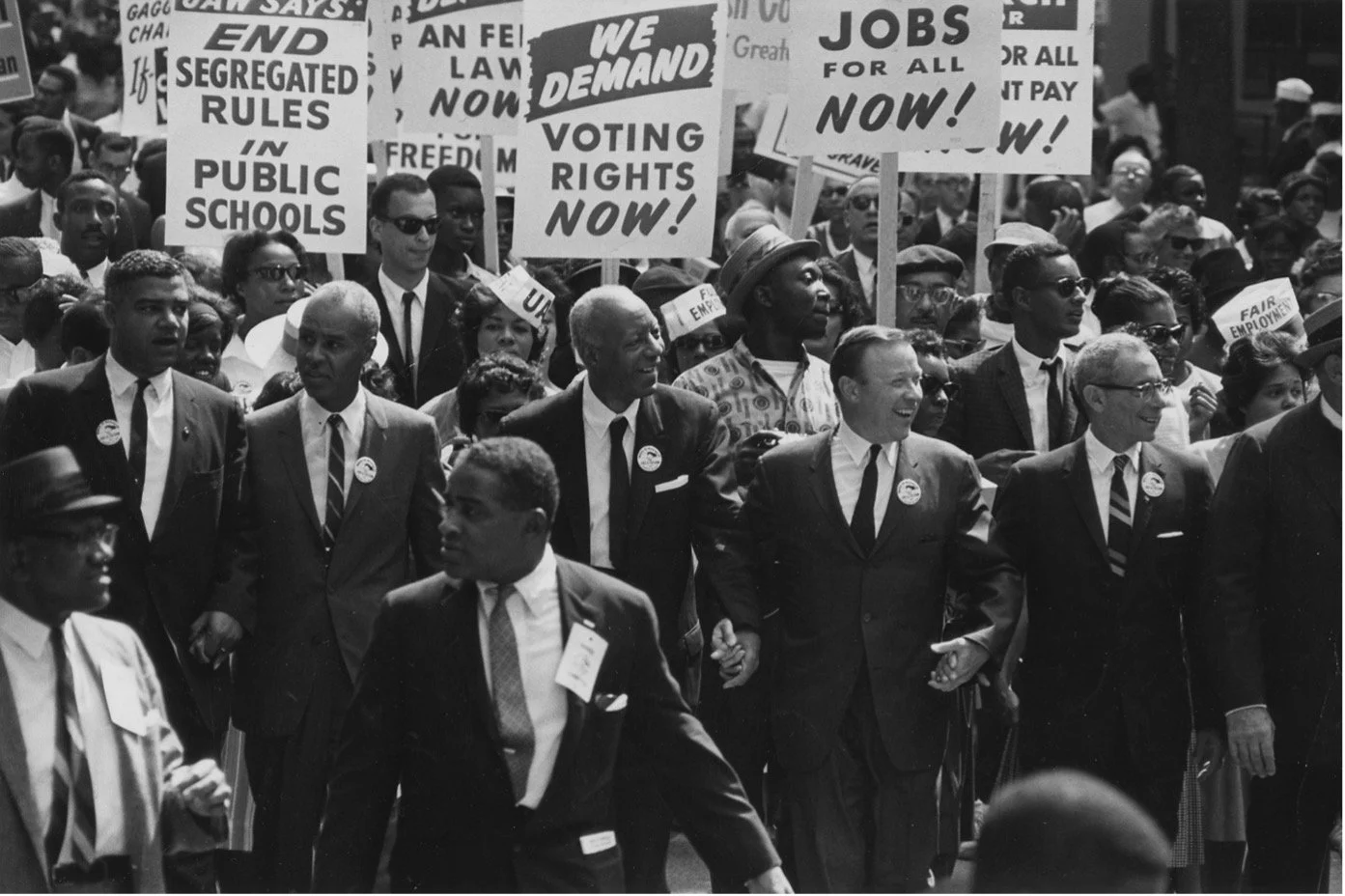
Rowland Scherman
The march led to the passage of the Civil Rights Act of 1963 and the Voting Rights Act of 1965, now under assault from courts, executive orders, and cynical gerrymandering efforts. It also brought out the ugliness of the racism it opposed when, fewer than three weeks later, the Ku Klux Klan bombed the 16th Street Baptist Church in Birmingham, Alabama, killing Addie Mae Collins (14), Cynthia Wesley (14), Carole Robertson (14), and Carol Denise McNair (11).
Today, August 28, 2025. Can you imagine Donald Trump looking down from his helicopter on 250,000 protesters, most of them poor and working class, black and white together, marching resolutely to the Lincoln Memorial, where a gay Black pacifist is handling security? King’s dream is Trump’s nightmare.
Where does an event like this – peaceful, joyful, diverse, unified, determined – fit into Trump’s rewriting of America’s past? His history is not big enough to hold it. But America’s is.
That day 62 years ago does not yet reflect who we are as Americans. But it shows who we can be. It is beyond time to reclaim that dream and to make it a reality.
This country was founded on disobedience. For what is our Declaration of Independence but a declaration of disobedience? Resist.