Out Among the Angels

The moons have mythical names: Calisto, Europa, Io and Ganymede, whom Homer called the most beautiful of the mortals, the four largest moons orbiting around Jupiter. Last night they were joined by Juno, the solar-powered spaceship NASA launched almost five years ago, which went into orbit a few minutes before midnight. After traveling 1.7 billion miles at speeds up to 1650,000 mph, Juno arrived at the precise spot the scientists in Pasadena had programmed. Sometimes it’s easy to feel discouraged about the fate of the earth and the future of its people, who treat both the earth and each other with such carelessness. Where America is embarking on an ugly election campaign to elect a leader the majority of voters abhor. Where we build walls and fences topped with razor wire to keep out the undesirable, and where ISIS celebrates the slaughter of innocents.

But think also of the things of which we are capable when we set free our imaginations, follow our sense of wonder and expand our horizons. When we come together around a project – which will take years to complete – to explore the outer reaches of our solar system.

None of this solves the problems we face daily. It doesn’t stop the killing or feed the hungry. It doesn’t relieve the anxieties of the fearful or open the hearts of the angry or tear down the walls that keep us apart.

But today I think of Juno, out beyond the heavens, touching what Lincoln called “the better angels of our nature.”


Trump, the Uniter!

“A lifelong Republican, my complete and utter disgust at Donald Trump moved me to write a check to Hillary Clinton! It will be the first election, during the 45 years of my marriage, that my wife and I will pull the same lever.” We read so much (including, it’s fair to say, from me) about Trump the divider, the relentlessly negative bully who mocks anyone who gets in his way. The two-sentence note above from a college classmate got me thinking differently. Here, for example, is a couple who have been married for 45 years and never once agreed on their presidential candidate – until Trump brought them together.

And think of all the other people he’s unifying: Latinos, African Americans, women, young people – large numbers of whom are put off by Trump's nasty, divisive, demagogic rhetoric. He even united me with an old Republican friend I hadn’t seen in decades.

One other thing about my friend’s note: despite their longstanding political differences, he and his wife are still married after 45 years. They like each other even though he’s a Republican, she’s a Democrat. Forty-five years ago that wasn't so unusual.

Indeed, isn’t that how it’s supposed to be in a democracy? Oren Hatch and Ted Kennedy, senators of vastly different opinions, were close friends for years. Ronald Reagan and Tip O’Neill amiably tried to work through their disagreements over amber-colored libations.

Different groups joining together in search of a consensus – isn’t that what the founders had in mind for America?

Who knows? Maybe Donald Trump is the consensus we’ve been waiting for.

Radical Islamist Christian Judaic Terror

Radical Islamist Terror. Why won’t Barack Obama say those three words? His failure to do so, I read, is why we are forever vulnerable to attack from radical Islamic terrorists. And his failure to do so keeps alive all the whispered conspiracy theories about his background, his motivations, his true beliefs. It’s clear that many of the terror groups with whom the U.S. is engaged are driven at least in part by their Islamic identity. Scott Atran, a French and American anthropologist and a leading authority on terrorism, contends that, however brutal and repugnant ISIS is to us and most Muslims, it speaks directly to people who “yearn for the revival of a Muslim Caliphate and the end to a nation-state order the Great Powers invented and imposed.”

But, he notes, “what inspires the most lethal terrorists in the world today is not so much the Koran or religious teachings as a thrilling cause and call to action that promises glory and esteem in the eyes of friends.” Or, in the case of lone-wolf mass killers, an outlet for their murderous anger.

If Islam provides a rationale for terrorism, why not just say so? And then why not also say that the Baptist pastor who said from the pulpit that “the tragedy [of Orlando] is that more of them didn’t die” speaks for Christianity? Or the KKK practices Protestant terror? Or the Revolt, which seeks the creation of a Jewish kingdom based on religious laws and expulsion of all non-Jews from Israel, Jewish terrorism? After all, that’s what they are.

But it is also what they are not. These groups want us to believe they speak for their religions. But they don’t, and Obama is right to say so.

The Language of an Empty Suit

“When I use a word,” Humpty Dumpty said, in rather a scornful tone, “it means just what I choose it to mean – neither more nor less.” “The question is,” said Alice, “whether you can make words mean so many different things.”

“The question is,” said Humpty Dumpty, “which is to be master – that’s all.”

Lewis Carroll, Through the Looking-Glass

A lot of the attacks on Donald Trump miss the point. By labeling him a racist, a misogynist, a nativist, they play into his strength, which is character assassination, and very few people can play that game like the presumptive Republican nominee.

Trump may well be all those things, and then again he may not. And that is the dangerous point. He is whatever he pleases to be, whatever he thinks will get him the most attention and the most adoration from his base. A racist? Don King endorsed me. A misogynist? “I’ve hired a lot of women for top jobs.” A nativist? “And you know, the Latinos love Trump and I love them.”

Most of us choose words to try to make our meaning clear. But Trump uses words that send a message and enable him to him to deny it at the same time – such his infamous description of Gonzalo Curiel, the U.S. District Judge overseeing two class-action lawsuits brought against the defunct Trump University: “The judge, who happens to be, we believe, Mexican, which is great.”

Here is a sentence (it’s actually not a sentence, but never mind) that means nothing, can easily be denied (“I never said I believed”), and isn’t true (Judge Curiel was born in Indiana). Trump, the straight talker, attacks by innuendo – and we all know where he is going.

This is the language of demagoguery: "Make the lie big, make it simple, keep saying it, and eventually they will believe it."

Earth’s Old and Weary Cry

We don’t have time to mourn the dead. Tragedies such as the carnage in Orlando should bring us together to grieve for those who died, to pray, however we pray, for the wounded, and to support those whose lives have been devastated. But we don’t have time. Too quickly we turn human tragedies into political events, into opportunities to advance our own agendas, to reinforce our hardening divisions. Yes, I believe we must ban assault weapons and pass sensible gun laws. But I don’t need an email from moveon.org asking me to sign a petition before the dead have even been identified.

I believe we need to confront the evil that is ISIS. But I don’t think we need calls for the president to resign because he won’t say, “radical Islam,” two words that have become, like so much else these days, politically loaded.

I believe it matters that the victims were gay and that they were killed celebrating life in a nightclub called Pulse. But more importantly, they were people whose lives ended horrifically and unexpectedly.

We should stop and grieve together for those people, at least for one day, and not just rewrite Monday’s speech to score a point. This is a time to put our differences aside and come together.

Today is the birthday of William Butler Yeats, the Irish poet and revolutionary. On this morning’s Writer’s Almanac, Garrison Keillor read a Yeats poem. It’s called The Sorrow of Love; its last stanza seems applicable to today.

And now the sparrows warring in the eaves, The curd-pale moon, the white stars in the sky, And the loud chanting of the unquiet leaves, Are shaken with earth's old and weary cry.


Converging Lives

This morning’s paper brought news of the sudden death of Dennis McCullough, a doctor who pioneered the “slow medicine” movement, which seeks to let elderly patients live out their last days as they wish to, instead of as the recipients of well-meaning medical interventions – what my mother called “heroics” – aimed at prolonging their often-lonely and anguished lives. He chronicled his own path to enlightenment in his book, My Mother, Your Mother. I recognized the name. Dennis McCullough was my classmate at college, where we had a nodding acquaintance. Raised by a single mother on welfare in a poor mining community on Michigan’s Upper Peninsula, he went on to captain Harvard’s hockey team and graduate from Harvard Medical School. He died in Bar Harbor, Maine, just down the road from where I write, where he had come to a conference of community nurses to talk about slow medicine.

His description of his mother crying out, near the end of her life, “Why is dying so hard?” reminded me of my own mother asking, in both bemused wonder and exasperation, “How did I get to be so old?” She no longer wanted to be “encouraged” to walk painfully down the hall, to eat food she’d never liked, to be awakened when all she wanted to do was live in her dreams. As my sisters and I came to understand that, we watched her anger turn into acceptance, and we had some of our best moments together in the little time she had left.

I wish I’d known Dennis McCullough better. I think Mum will like him.

A Government of Laws?

The judge, who happens to be, we believe, Mexican, which is great.” This sentence (well, actually it’s not a sentence, but never mind) tells much about the presumptive Republican nominee, who made the comment in a rambling rant against Gonzalo Curiel, the U.S. District Judge overseeing two class-action lawsuits brought against the defunct Trump University

First, what’s up with the “we”? I’m guessing it’s both the royal we and the deniability we (“Hey, I never said I believed”).

Then there is the stereotype with faint praise, a favored rhetorical device of the candidate. Suffice it to say that the state of relations between Donald Trump and Mexicans is not “great”. It’s also hard to imagine Trump saying such things about others. “Rudy Giuliani, who we believe is Italian” or “Sheldon Adelson, who we believe is Jewish” or “Barack Obama, who we believe is . . .” OK, maybe that’s the exception.

Third, the conflict of interest. Much has been made of the potential conflicts presented by the Clinton Foundation – and rightly so – but what about the Trump Organization? Has anyone asked Trump how he plans to separate his personal interests from the public trust? He certainly hasn’t done so in this campaign in which he’s been a walking billboard for his businesses. Now he’s threatening a federal judge over Trump University, one of his most egregious enterprises.

Fourth, the personal attack accompanied by the bullying threats. “Wouldn’t that be wild if I am president and come back and do a civil case?”

And last, but hardly least, the statement is untrue. Judge Curiel was born in Indiana.

Alexander and David

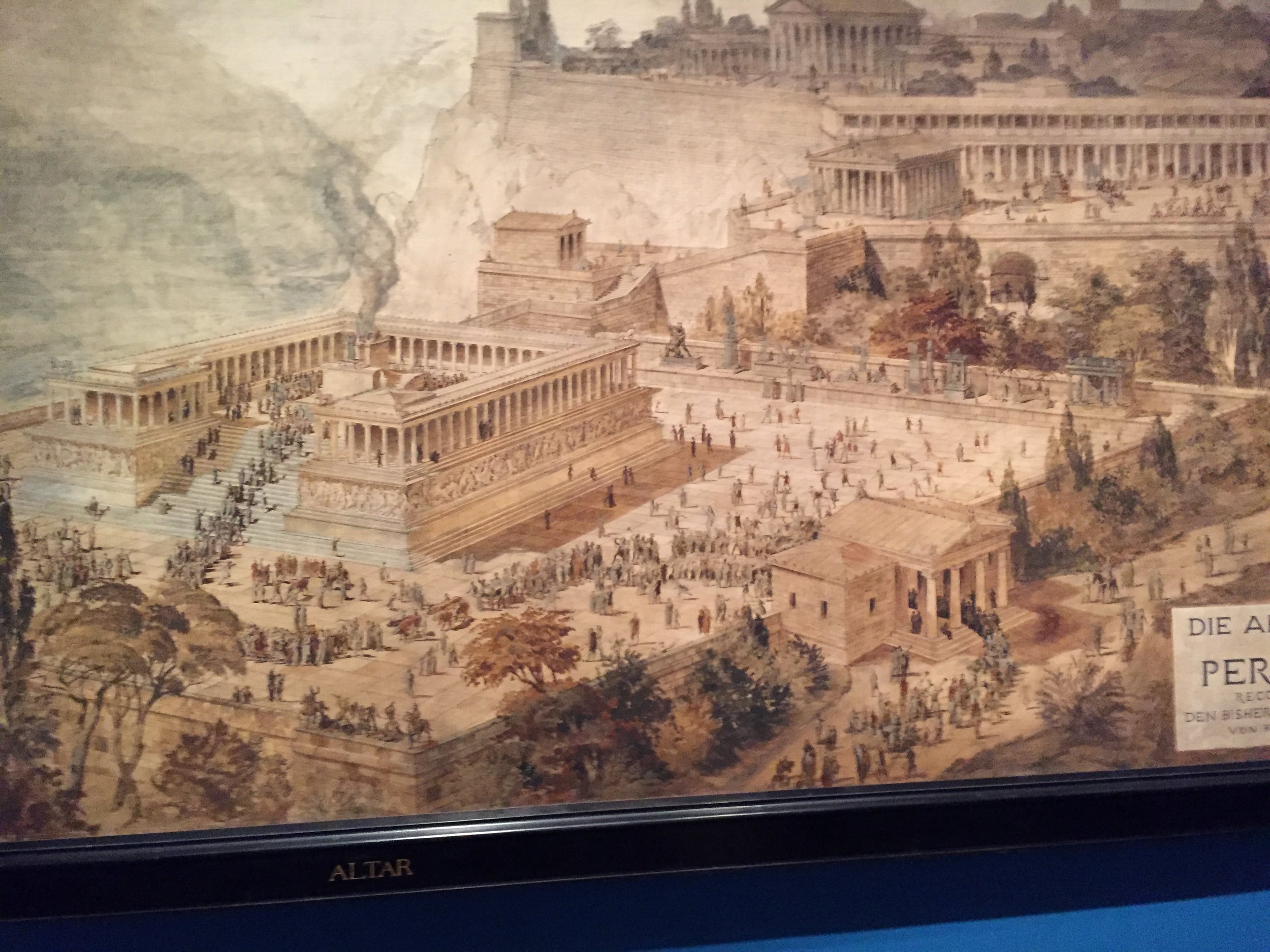
The Altar at Pergamon (Met Exhibit) To enter the Metropolitan Museum of Art you walk across the David H. Koch Plaza to the museum’s entrance, which stirs questions about the relationships of art and money and power. Such questions resonate forcefully at the current Pergamon show, whose 264 works of art span the classical world from the reign of Alexander the Great (336-323 BC), whose empire stretched from India to Gibraltar, to the suicide of Cleopatra three centuries later.

Athena at Pergamon (from the Met)

Pergamon, once a major city in Asia Minor, known for its massive altar and a library that rivaled Alexandria’s, disappeared over a history of conquests and sackings until its buried remains were discovered and excavated in the late-19th century. Some of the works of stone and metal are intact, but most are fragmented, the remnants of a civilization that vanished. The artworks exalt the deeds of the powerful – and enable their subjects to bask in the reflected glory. Later, as the growth of empire produced unprecedented wealth, the newly rich commissioned private pieces that, while wondrously crafted, seem devoid of meaning beyond the decorative.

I saw little hint of art as subversive of power – no Guernica to question the glory of the empire or reveal the suffering of ordinary people. And yet the monuments of Pergamon, with their the smashed noses and broken torsos, ultimately capture, not the immortality of the rulers but the evanescent ambitions of men.

Ozymandias

I met a traveller from an antique land

Who said: “Two vast and trunkless legs of stone

Stand in the desert . . . Near them, on the sand,

Half sunk, a shattered visage lies, whose frown,

And wrinkled lip, and sneer of cold command,

Tell that its sculptor well those passions read

Which yet survive, stamped on these lifeless things,

The hand that mocked them, and the heart that fed:

And on the pedestal these words appear:

‘My name is Ozymandias, king of kings:

Look on my works, ye Mighty, and despair!'

Nothing beside remains. Round the decay

Of that colossal wreck, boundless and bare

The lone and level sands stretch far away.

Percy Bysshe Shelley, 1792 - 1822


Talking Past Each Other

“What we’ve got here is failure to communicate,” Cool Hand Luke. “I’m so glad I would kiss the captain’s feet . . . now my child can actually play in the park.” Eukeysha Gregory, after the arrest of 120 gang members in the “largest gang takedown” in New York City history.

In a speech a friend sent me, conservative writer Heather MacDonald excoriated the Black Lives Matter movement for “the current frenzy against the police” and the ensuing rise in urban crime, calling it a smokescreen to evade the “taboo topic” and “uncomfortable truth” of black-on-black crime. Since Macdonald can be a poster woman for the unapologetic right – opposing food stamps and welfare, minimizing campus rape, defending religious profiling and torture – I was reflexively prepared to dismiss her arguments.

But I can’t.

Yes, there’s much to disagree with. She paints with a broad brush, simplifying and vilifying a complex movement. And she ignores the personal experiences of a legal system riddled with racial injustice described by Ta-Nehisi Coates (Between the World and Me), Michelle Alexander (The New Jim Crow) and Bryan Stevenson (Just Mercy).

So who’s right? For Eukeysha Gregory, black-on-black crime is not a taboo subject. Nor was it for my late friend, Charity Hicks, who witnessed “a generation of young [Detroit] men so marginalized they would kill you without thinking about it.”

If we talk only to those with whom we agree, we end up choosing sides and standing in judgment above the fray. Our political purity is intact, although our neighborhoods may be burning. If we really want solutions, we need to open our minds and our hearts.


The Terrible Tyranny of Tastelessness

Should a man be held accountable for the actions of his valet? This 19th-century question is hardly one I expected to be asking in the 21st – until I read Anthony Senecal’s Facebook rants, in which, among other things, he called for the president and first lady to be dragged from the “white mosque” and hanged. Senecal, who was recently the subject of a bizarrely fawning profile in The New York Times, was Donald Trump’s butler at Mar-a-Lago for years; and many of his Facebook themes – demonizing Muslims, Obama’s citizenship, incendiary language, racism – resonate with the boss's campaign.

Trump’s spokeswoman disavowed Senecal’s “horrible statements,” saying he “has not worked at Mar-a-Lago for years” – apparently overlooking that, at Trump’s insistence, he gives daily tours at the mansion and serves as its unofficial historian. Trump has yet to tweet on the matter.

These revelations came simultaneously with news that George Zimmerman will auction off his Kel-Tec PF-9 pistol. What he advertises as “a piece of American History” is the gun he used to kill Trayvon Martin in 2012.

In the war against political correctness, the pendulum has swung way too far; it’s time to reflect on what gave rise to the movement in the first place. It began as an effort to address the offensive stereotyping long endured by minorities and the powerless. Whatever its excesses, it arose out of respect and empathy, two traits now in short supply. It is, as Jeeves, a wiser, more civil butler, understood, a matter of good taste.

The Klanbake Convention

Thinking of traveling to Cleveland in July, I did a little research on that city’s first Republican convention and the election that followed. The three-day event took place in June 1924 and produced the first-ballot nomination of Calvin Coolidge, who had succeeded to the presidency on the death of Warren Harding less than a year before. It was the first Republican convention at which women had equal representation, and the only hint of disgruntlement was the defection of Senator Robert LaFollette, who ran – and won almost 5 million votes – as a third-party Progressive.

In contrast to the civil Republican convention, its Democratic counterpart in New York’s Madison Square Garden was a disaster. It required 16 days and 103 ballots to nominate the little-known-nor-long-remembered John W. Davis. The preconvention favorites, Al Smith and William Gibbs McAdoo, bowed out after a stalemate driven largely by the power of Ku Klux Klan, which had resurfaced as a vehicle for white working-class anxieties over the perceived threats posed by immigrants, African Americans, and the growing political power of Catholics and Jews.

1924 presidential election

After knocking off Smith, the Catholic governor of New York who had denounced lynching and racial violence, thousands of hooded Klansmen – including hundreds of delegates – held a rally at which a speaker denounced the "clownvention in Jew York," while the crowd hanged Smith in effigy and set fire to a cross.

That was the “Klanbake” convention, and surely such a thing could never happen today.

Coolidge was elected easily – although he failed to carry a single southern state.


American Soul

With Donald Trump, who is the sort of demagogue the founders feared, now the leader of the Republican Party, it’s time to examine our “exceptional” credentials. And it’s not just Trump who reveals a country at odds with its self-image. In New York, the Democratic Assembly Speaker is on his way to prison, with the Republican Senate leader close behind. In Chicago, a judge pronounced the former Speaker of the House a “serial child molester.” In two new books, Bryan Stevenson’s Just Mercy and Michelle Alexander’s The New Jim Crow, the authors describe a nation with the highest rate of incarceration in a world that includes Russia, China and Iran; where one of every three native-born black men will go to jail; where three times as many mentally ill people are in prison as in a hospital; where economic disparity and voter repression proceed unabated.

I’m happy that Trump will be the nominee. Not just because the singularly repugnant Ted Cruz has departed, at least for now. Not because I think Trump will be trounced in November, because I fear he won’t. But because the overarching American myth on which we have been nourished for generations is unraveling before our eyes – and it should, for while it may have reflected our aspirations, it does not describe our reality.

We now have a candidate who appeals to the basest parts of our national character, and if that doesn’t galvanize the rest of us to get involved, I don’t know what will.

“Let’s Do the Numbers”

From a talk this week by David Miliband, head of the International Rescue Committee and former British Foreign Secretary:

  • 20 million refugees have fled their country in fear of persecution for racial, ethnic or political reasons.
  • 40 million people are internally displaced within their country.
  • 200+ million migrants have left their country in search of a better life.
  • 1% of all refugees went home last year.
  • 17 years is the average duration of exile.
  • 86% of refugees and displaced people are in poor countries.

With states collapsing, particularly in the Middle East and Africa, the increase in horrendous violence and disrespect for humanitarian law, and “the absence of legal routes to hope and dignity,” this is a crisis no wall can contain. Globalization isn’t just a political policy, it’s an international reality; and “America First” code language is not the answer – particularly if you consider these numbers from Steve Phillips’ Brown is the New Black:

  • In the last 50 years, people of color have increased from 12% to 37% of the U.S. population.
  • Latinos have grown from 9 million to 54 million; Asians from 2 million to 18 million.
  • Our population increases by 8,000 people a day, 90% of whom are non-white.

Clearly these are unsettling numbers for the dwindling white majority – even if they are a fulfillment of America’s self-image: a melting pot; a nation of immigrants; a land where all men are created equal and anyone can grow up to be president. Maybe it’s a cause for celebration instead of fear. And it seems a good time to recognize how much we have in common with the rest of the world.

Anzac Day

One-hundred-one years ago today began the Gallipoli campaign, a devastating eight-month battle that produced over half-a-million casualties and yet remains the defining national myth for both sides: Turkey and Australia and New Zealand. Such is war, a time of carnage and valor – and the central reality of human history. “If we were to take any random hundred-year period within the last five thousand years,” writes Caroline Alexander in the introduction to her new translation of the Iliad, “we would find on average ninety-four of that hundred to have been occupied with large-scale conflicts in one or more regions of the globe.”

By chance, I was reading her words when an old friend sent me “My Vietnam Song,” his 46-year journey home from Vietnam, where he had arrived as a Marine 2nd lieutenant not long after his college roommate had been killed. It’s a moving story of his struggle to understand himself and make sense of his war, a poignant antidote to today’s reflexive “Thank you for your service,” five words he never heard. Achilles would understand, writes Alexander. Far from “glorifying war’s destructive violence,” the Iliad “makes explicit the tragic cost of such glory, even to the greatest warrior.”

“I am tired and sick of War,” said William Tecumseh Sherman, a warrior who scorched the earth from Atlanta to the sea. “Its glory is all moonshine. It is only those who have never fired a shot nor heard the shrieks and groans of the wounded who cry aloud for blood, more vengeance, more desolation. War is hell.”

And it endures.