Two Questions
The line between refugee and emigrant may be legally simple to draw, but not here on the ground, where the preponderance of those walking have come from Syria, a collapsed state, both ungovernable and unlivable.
Read MoreThe line between refugee and emigrant may be legally simple to draw, but not here on the ground, where the preponderance of those walking have come from Syria, a collapsed state, both ungovernable and unlivable.
Read MoreThey left home 50 days ago, Ali said, and for the last 15 days they walked – mostly in the woods and often in heavy rain – across Macedonia, Serbia and Hungary to the Austrian border. In the forest, Ali’s 16-month-old daughter got a nasty rash, which grows steadily worse. Yet, like other refugees we met, the Jasams, with astonishing resilience, seem never to despair.
Read MoreThe streets around the camp are filled with a chaos that has spawned individual acts of great kindness, frustrated and at times ill-mannered responses, and bewilderment.
Read MoreThe small road out of town, which led ultimately to Vienna, was lined with discarded clothes and plastic water bottles. We followed it until we came to a police roadblock. When we suggested we would like to take the scenic route to Vienna, we got an emphatic one-word reply: “Closed.” Now we knew for sure where the refugees were, but they have very big policemen in Hungary, so we took the highway to the border.
Read MoreThey keep coming and coming, groups of men, mostly young, families with small children – some walking, others being carried – and grandparents. They are heading to the last opening along the border, a rail line that crosses into Hungary, a country racing to erect a high 109-mile razor-wire fence, at the small town of Roske. Half a mile north, a temporary city of tents had been erected on farmland, and dozens of buses lined the one-lane road.
Read MoreAt the Belgrade airport we were told we could drive our Serbian rental car anywhere in eastern Europe – except Kosovo. But Kosovo, I noted, is not on the map. That’s because it is part of Serbia, said the Hertz man, as he sketched its approximate borders with his pen. Then how will we know when we get there, I asked? Oh, you’ll know, he said. They’ll stop you. They don’t like us very much. For DeWitt Sage, a documentary filmmaker, and I, who have come here to try to comprehend the refugee situation threatening to overwhelm Europe, it was a jolting reminder that the Balkans, which is now the pathway for refugees fleeing by the hundreds of thousands from Syria, Afghanistan, Eritrea and elsewhere, was not long ago itself the scene of brutal ethnic warfare – of sieges, bombardments and genocidal executions that unleashed centuries of hatred in what seemed an endless war. In 1999 NATO air forces bombed Novi Sad, the city on the Danube where I write, so massively that it took four years to restore the river.
It is a reason for hope that peace, however fragile, has returned to the Balkans less than two decades later; and it is a reason for despair that this area is now the passageway to Europe for those fleeing atrocities so horrific they seem unprecedented in their scope and barbarity.
What it is not is a passing phenomenon. According to the UN Refugee Agency, 42,500 people are forced from their homes every day. They will go somewhere.
In his famous 1968 essay, “The Tragedy of the Commons,” Garrett Hardin used the metaphor of a pasture in which all farmers are free to graze their cattle. “Each man,” he wrote, “is locked into a system that compels him to increase his herd without limit – in a world that is limited. Ruin is the destination toward which all men rush, each pursuing his own best interest in a society that believes in the freedom of the commons. Freedom in a commons brings ruin to all.” Six years later he produced “Lifeboat Ethics,” which is unflinching in its misanthropy and yet has been much on my mind. Using the metaphor of a lifeboat, Hardin argues that it is suicidal for those in the boat to respond from the heart – because those still in the water will eventually overwhelm and sink the boat. “Complete justice. Complete catastrophe.”
While Hardin would surely resonate with many of our presidential candidates, it is in Europe where his argument and his imagery seem most poignant – where images of boats crammed with desperate people and a small Syrian boy dead on a beach have moved many to tears but, with hundreds of thousands in or heading toward Europe, produced few ideas about what to do.
As Germany prepares for 800,000 refugees and Hungary builds a 110-mile fence, we watch, from afar, the unfolding of one of the most agonizing stories of our time. For someone who has recently been in a lifeboat, Hardin’s image will not go away.
Perhaps somewhere deep in the Amazon rainforest or the jungles of New Guinea there exists a yet-undiscovered community of people living in blissful harmony and governing themselves by consensus. I hope so, because government today seems to slant inexorably toward oligarchy.
Read MoreEpilogue. “Even Butter Wouldn’t Bring It Back” On September 18th the crews of Restive and Sparky will gather in Marion for the presentation of the Bavier Trophy to Sparky’s crew for their courage and seamanship during a rescue at sea one late afternoon in early July.
Excerpts from two letters capture something of the bond that grew between the crews.
July 8th Dear Rob
It’s been a week since you took us aboard Sparky from our life raft. . . .So thank you, Eric – for being strong and helping us aboard, thank you for understanding some of our emotions as you took us in. Thank you, Jack – for being so strong, for hugging me from the raft over the lifeline, and, later, for your sense of the ridiculous, helping re-attach me to reality and the present, and not the rescue. Thank you, Nancy – for your warmth, generosity, nursing, and selflessness. Thank you, Bob – for applying your seamanship skills perfectly at the right time for Restive’s crew – and for cooking, cleaning, and loving each of us.
And Rob, thank you. You exemplify the essence of being a skipper, of helping others in need, under all circumstances – from the mundane to the extreme. Cool-headed, experienced, strong, thoughtful, skillful and prepared. Thank you.
George
August 21st Dear Jamie,
Hearing the account from your perspective and the thoughts and conversations of the Restive crew prior to and during the rescue was fascinating! I assume that your experience that day will stay with you for a the rest of your lives, and as strong as your lifelong friendships with these extraordinary men have been in the past, this experience will create a bond that few people ever enjoy.
Know this is from our heart – we will never forget the calm, courageous, caring, thoughtful, gentlemanly men that we had the honor of meeting on July 1, 2015. You all have affected our lives in a most wonderful way. The crew of Restive showed us how to handle adversity with the utmost of grace and courage, and we will never forget any of you.
Warmest regards, Nurse Nancy and Bob
And finally this:
August 28th James,
I came back yesterday from a three-day sail on Restive with George to Block Island, Tarpaulin Cove and back to Jamestown, and it was great fun. Needless to say, the food was superb, matched only by the wine and company. I did have to toss out the French toast, which was still in the oven. Even butter wouldn't bring it back.
Fred
Thank you all for the wonderful responses to this series, which is now available in its entirety at: www.jamesgblaine.com.
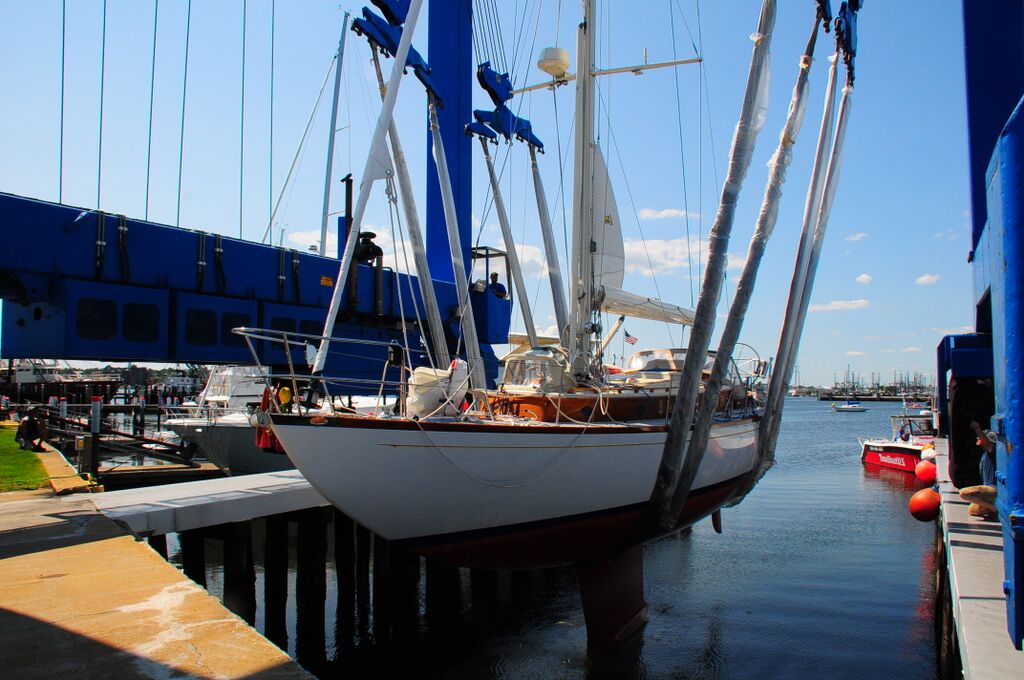
Part 23. Restive’s Fate Because Restive immediately began taking on much more water than they had anticipated, the salvage crew “began to harvest whatever materials they needed” to try to save the boat. They also managed to get the engine started and pumped water continuously until they arrive at Fairhaven the next afternoon. “It appears,” wrote David, “the salvage crew experienced many – if not every – adverse, unpleasant and even life-threatening condition and challenge we imagined, only short of having Restive actually sink.”

Efforts to take Restive under motor to Brooklin, Maine, where she was built, failed when she began leaking significantly almost immediately. She was hauled at Jamestown Boat Yard, where a flange on top of the lower rudder bearing was discovered to have been sheared off.
Musing on the possibility of repairing Restive at sea, Dave wrote: “To fix something in an emergency, you really need three things: the right materials, a way to shape them to your needs, and a way to attach them together.
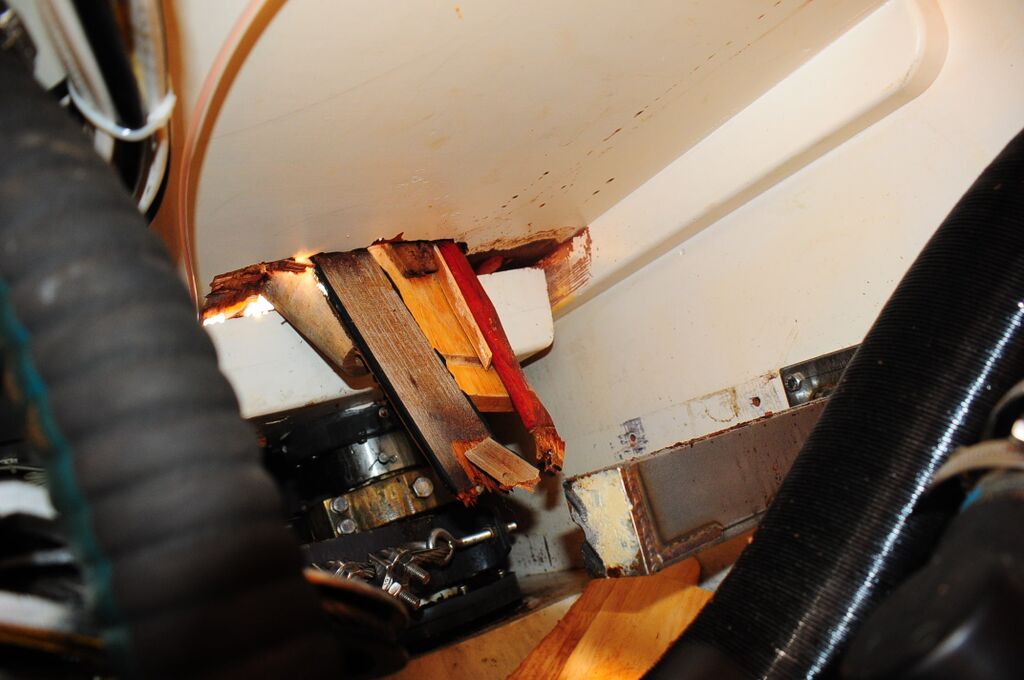
At that moment, I was looking at Restive not as a fine yacht, but as a floating lumberyard, filled with different types and shapes of wood. What I needed was something to hold the wood together, and three-inch deck screws would have been just right. But we didn't have deck screws or anything else with the requisite strength and ease of use.
“I want to follow that up with another thought. When do you start breaking stuff to save yourself or others? If we did have deck screws, who would smash the first set of drawers to get lumber? Fireman and salvage crews don't hesitate. They are there to save the house or the boat, and aren't afraid to chop through a door or rip up a teak deck to do their job.”
Restive will be back on the water next month.

Part 22. Tears It turns out that captains aren’t the only grown men who cry. As we awoke aboard Sparky on the final day of our journey, much of the morning’s talk centered on the events of the day before. When we got within cellphone distance of shore, Fred called his wife and daughters, who were still under the impression that he was out for a leisurely sail with old friends.
“I don’t know what it is,” said the man on whose physical strength we had so heavily relied. “I can talk about what happened with everyone here, but when I try to describe it to my family, I start crying.”
The next morning David and I drove back to Maine. We stopped at the Kennebunk Service Plaza, where a young and very nervous trainee took our orders under the watchful eye of her mentor.
“Explain this to me,” said David, as we downed our 486-calorie breakfast sandwiches with 11 grams of saturated fat and 1,037 milligrams of sodium. “I wanted to encourage her, but when I tried to tell her what a good job she was doing, I burst into tears.”
As for me, I held out until I read this comment on my website a month later:
“I'm glad four of my oldest friends (and Dave) are finally safe, very sad about George's beautiful Restive. A wonderful story of seamanship and friendship.
"’It would be difficult to describe the subtle brotherhood of men that was here established on the seas.’*
“But you did.”
*From Stephen Crane’s The Open Boat.
Part 21. “Those in Peril on the Sea” The sea has many voices, many gods and many voices. (T.S. Eliot, The Dry Salvages)
As such things go, the North Atlantic is a relatively good place to abandon ship, and my own experience has made me more mindful of the daily, often horrific, dangers faced by others at sea. “In many parts of the world,” writes Ian Urbina, “the waters beyond national jurisdiction represent an outlaw ocean, where crimes ranging from murder and slavery to dumping and illegal fishing occur with impunity.”
The world’s ocean, whose contiguous parts are named Atlantic, Pacific, Indian, Arctic and Southern, is a vast, beautiful, dangerous and endangered place. As described by Scott Gass, its 139 million square miles cover 71% of Earth’s surface; it holds 97% of the world’s water and comprises 99% of the world’s biosphere. It has the world’s highest mountain, Hawaii’s Mauna Kea rising 33,000 feet from ocean floor to snow-capped peak; longest mountain range, Mid-Ocean Ridge, ten times longer than the Andes; deepest ravine, Challenger Deep, six times deeper than Grand Canyon; biggest waterfall, Denmark Strait cataract, which falls over two miles and carries 116 times more water per second than Congo’s Inga Falls; and largest animal ever, the 98-foot, 200-ton blue whale.
It is also a place, Urbina writes in “The Outlaw Ocean,” where “tens of thousands of workers, many of them children, are enslaved on boats” and thousands die each year, where commercial vessels devastate the world’s fishing stocks, dump oil and sludge at unsustainable rates, and emit more air pollutants “than all the world's cars.”
From a vital global commons we have fashioned a lawless global dump.
Part 20. The Law of Salvage With our heroes safely aboard Sparky, our heroine continued to take on water as the salvage crew worked to secure her for safe towing. Just finding and boarding Restive had been hair-raising enough to validate the salvage company’s “many misgivings” about making the trip at all.
You may be under the impression, as I was, that ships abandoned at sea belong to the person who finds them. But it’s not so simple. While salvage law dates back to the 6th-century reign of the emperor Justinian, no branch is “so little understood,” one scholar wrote, “as the question pertaining to ownership of distressed, abandoned, or wrecked property at sea.”
Common law recognizes four categories of goods lost at sea: wreck (boats and cargo washed ashore); flotsam (still afloat); jetsam (sunken goods thrown overboard to save the ship); and ligan (sunken goods tied to a buoy to facilitate recovery). Restive was now legally “flotsam;” and here U.S. law is clear: an owner must both abandon the property and relinquish ownership to cede rightful possession. The finder, however, is entitled to compensation “commensurate with the value of the property” – and the greater the value and more dangerous the mission, the more compensation the finder can demand.
“Sleep deprivation and sea sickness [took] a severe toll on the crew,” the salvage company subsequently reported to the insurer, “and as a result they could not sleep for fear, if they lost the rudder, they would sink before getting out of the vessel.”
Part 19. Old Friends, New Friends

It was close quarters on Sparky, where 10 of us now shared space that had previously been packed with half that number. Sparky’s crew welcomed us with a biblical generosity, if not killing the fatted calf, then giving us the first and largest servings of Trader Joe’s steaming Asian chicken stew. They, too, had had an eventful trip. Their toilet broke during the race, and on the return, the radar antenna had pulled free from the mast, forcing Rob, an ardent rock climber, to shinny up the mast and reattach it in the same high winds we had recently come through.
It’s a motley crew. Rob, the captain, left his Cranston, Rhode Island, birthplace in his late teens, heading for the oil fields of the Southwest and eventually building a successful oil-and-gas company in Midland, Texas. (“We’ve been fracking safely for 60 years.”). Jack, Rob’s childhood friend who never left Cranston, a housepainter whose left foot is curled from years of stretching out from a ladder, who told funny yet heartfelt stories in an incomprehensible New England-Irish accent – to wit: “How many potatoes does it take to kill an Irishman?” The answer, of course, is “none.”
Eric, a quiet physician and solitary sailor who has spent his career studying the human brain at the National Institutes of Health. And Bob and Nancy, relative newlyweds – Bob, the brilliant helmsman who doubled as short-order chef; Nancy, who nursed both our wounds and our psyches.
We headed toward Marion, an allegory of generosity.
Part 18. Found Amid reports of calming seas, the salvage team set off on a hired boat. “The trip out proved the weather prediction to be wrong,” according to the subsequent report. “They had an 8-to-10-foot roll with a 2-3-foot chop on top, making the trip very uncomfortable.” At 3 p.m., just over 12 hours later, they found Restive about 127 miles south of Nantucket.
“The poor sea conditions on the outboard voyage were the same on-scene. This prevented a vessel-to-vessel transfer of the salvage team. Our crew had to don diving gear, jump overboard and make a swim for the boat. One crewmember was able to pull himself up over the side with a little adrenaline from the talk of sharks in the area by the boat crew. He would rig a ladder for the second crewmember. They found the vessel taking on water.”

They also found a severely damaged rudder “flopping violently back and forth, [which] would have resulted in massive flooding in the next 6-12 hours.” Night was falling by the time they had Restive rigged for towing. As they set off, it quickly became clear that the damage was far more extensive than they had thought.
“I've given this a lot of thought,” Rob, Sparky’s captain, later wrote George, “and am convinced that the only thing that kept Restive from sinking is the tremendous strength of her hull skin. Any lesser build would almost certainly have suffered hull failure at the lower bearing block. There are very, very few boats that would have survived.”
Part 17. Night Time As we head for the Massachusetts coast 140 miles away, Restive rocks forlornly in the waves before disappearing into the evening gloom.
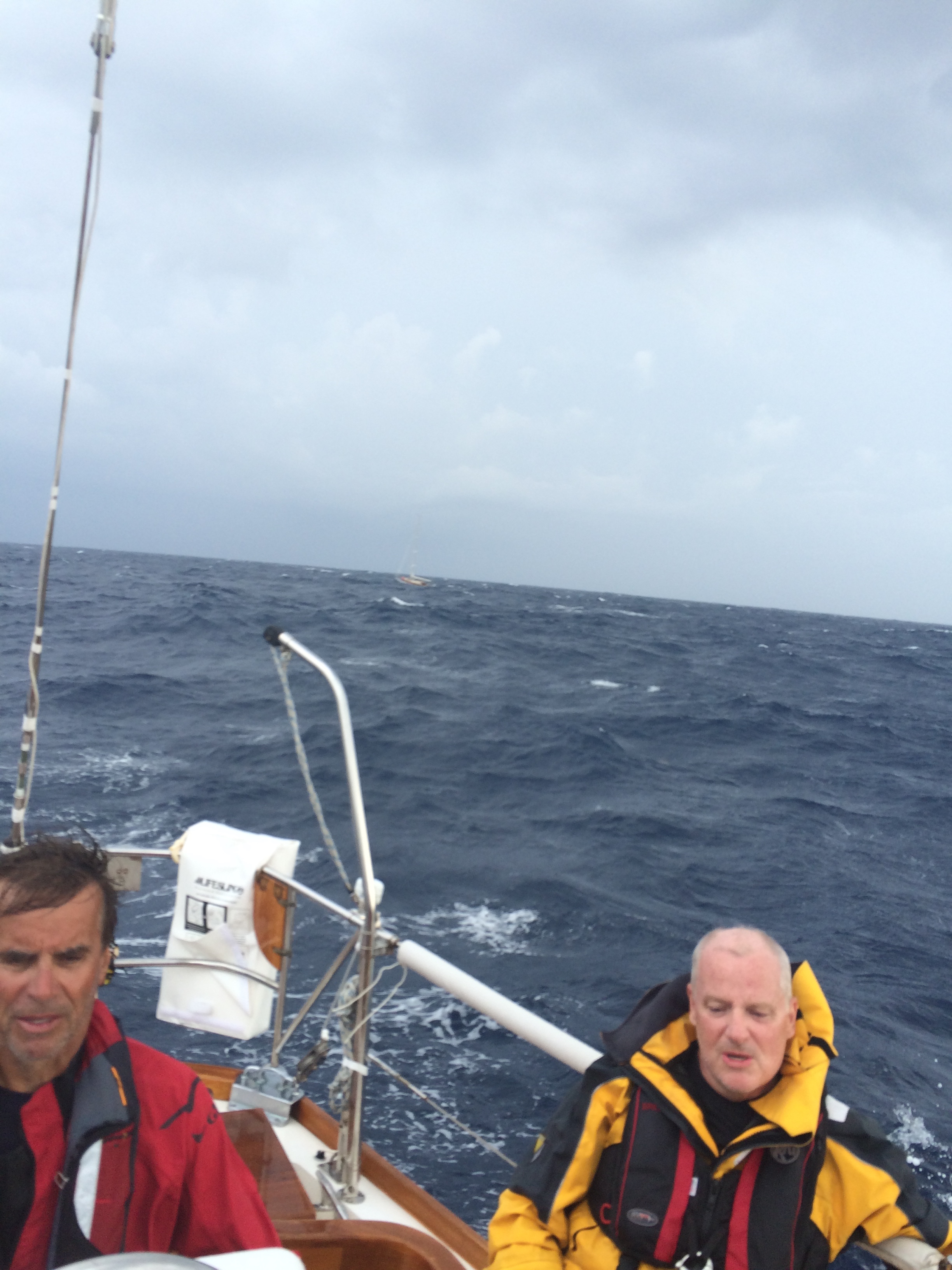
As night falls aboard Sparky, Fred, both injured and exhausted, is given the quarter berth, where he sleeps without moving – until he awakes eight hours later remembering he’d left two pieces of French toast in Restive’s oven. David and I squeeze among Sparky’s luggage in the forward bunk, listening to the waves beat loudly against the fiberglass sides, a discordant sound compared with Restive’s wooden hull. People come and go, getting dry clothes, telling stories. We feel like celebrities as they describe watching us jump into the raft. It’s a kind of theater – like being at a play, David says, where the actors come forward to interact briefly with the audience and then dissolve back onto the stage.
George can’t sleep. He gives his berth to Dave and goes up on deck, where “the full moon is almost dead astern, making a moon path along the water to Sparky – the seas churning, rough, wild, beautiful – as always . . . where I tell Rob that I am amused by myself – I have this sailing disease in a big way: I can love the ocean and the wind moments after abandoning Restive and being rescued from a life raft. Sick. He understands – he has the disease, too.”
At 02:30 that morning, Thursday, July 2nd, a salvage crew sets off from Hyannis, Massachusetts, heading for Restive’s last known coordinates.
Part 16. Why Sparky Turned Back Now safely on deck, we were embraced by Sparky’s welcoming crew, who described watching, with a combination of wonder and horror, the pantomime of five aged men leaping one by one into a circular yellow raft. Fred sustained the only visible wound, a deep and bloody gash on his shin, which would turn into a serious cellulitis infection. Providentially (like so much else about this rescue), a woman, who introduced herself as “Nurse Nancy,” appeared with bandages and disinfectant to bind Fred’s wound – after which she offered us all rum and cranberry juice.
Sparky, a 42-foot Hinckley sloop, had also been returning from Bermuda and was less than a day from her destination when she answered our call. She was already packed with a crew of five, who absorbed us seamlessly, insisting we take the bunks and get the first helpings of food, while they slept where they could (in one case, not sleeping at all) and ate what was left, as we set sail for land almost 24 hours away.
It’s hard to describe the intimacy you feel for people who have just saved your life, but this crowded boat abandoned all formalities and became an instant community of shared lives. Rob, the captain, set the tone, responding to our expressions of gratitude by invoking the camaraderie of those who sail offshore.
“When you do this kind of sailing,” he said, “you know the cavalry isn’t always coming. So when you get the chance, you try to be the cavalry.”
Part 15. The Captain “Why do you say, ‘Of course,’ George was the last off Restive?” my daughter, Annie, asked me.
“Well,” replied this former deep-water ingénue turned grizzled old salt. “It’s a tradition on the high seas for the captain to be last. He is responsible not just for the ship but for the well-being of all her passengers and crew.”
“From what I read,” she countered, “it seems like the captain is among the first to get off.”
She has a point:
George is from an older school, for whom the decision to leave Restive was nothing less than traumatic. “After all I’ve read and experienced,” he said, “I never thought I’d abandon my boat.”
His tears on finally boarding Sparky were the release from hours of unrelenting tension that come with the responsibility a captain assumes. George continues to question his decision, but, as we shall see, it was unquestionably the right one (as, believe me, I knew all along).
We leave the five mariners safely on board Sparky to write of other things. But the “Rescue at Sea” series is not over. We are still 140 miles from shore, 10 of us now on a boat fitted for five, and while we have been rescued, more remains to be told – less dramatic, but no less important – a story of courage and kindness, a story to which we will return to find out why Sparky turned back, the final day at sea, the fate of Restive. I will intersperse the sea tale with other posts over the next few weeks, and I hope you will stay tuned. Thank you for your expressions of interest. The Numbers Game
Last night’s debate was not the roller derby I’d anticipated, although the pundits are seizing on the few personal dust-ups to make it seem like a free-for-all. That’s, of course, why we tuned in – for politics as entertainment spectacle. But that’s what American politics has always been, and sometimes out of the process emerges a Madison, a Lincoln, an FDR, a Barack Obama. I thought the ten candidates, not one of whom I want to be our next president, held up well in what is a humiliating venue, and this sort of cattle show may actually prod the candidates off their scripted sound bites and give us insights into their beliefs.
Much is made of the unwieldy numbers, but why shouldn’t all 17 candidates be included? (I keep hearing about Carly Fiorina’s performance, and I was sorry to miss it). There are, however, other numbers that need closer attention:
Fewer donors. More money. Fewer voters. These numbers do not add up to a healthy democracy.
Part 14. Climbing to Safety As Sparky circled downwind of us again, we watched her crew arrange themselves to haul us on board and vowed to hang on this time. In the raft, the calm that had come over us from the time Dave discovered the compromised rudder bearings continued to prevail. I had become aware of two parallel tracks in my mind: on one, I knew there was a not insignificant chance I wouldn't survive; on the other, I was convinced that, whatever odds Vegas might be laying, I was going to make it. Somehow, that combination – neither denying the reality nor succumbing to the inevitable – kept me peaceful and focused. We were all that way. If we had not been, things might have turned out differently.
Sparky’s skipper again threw the line. Fred reached over and snared it, and each of us grabbed onto either the line or someone holding it, as Sparky’s crew hauled us slowly toward them, both vessels rocked forcefully by the sea. We came up amidships, and Fred, the closest, scrambled up the hull until Rob and Jack could grip him under both arms and haul him to safety. One by one we followed, waiting till a wave brought us close, then clambering up till we felt the grip of men who had come eight miles to rescue us.
The captain went last, hurling himself over the lifeline and landing on Jack, who pulled him over and onto his body. Safely on deck, George burst into tears.