The Numbers Game

We leave the five mariners safely on board Sparky to write of other things. But the “Rescue at Sea” series is not over. We are still 140 miles from shore, 10 of us now on a boat fitted for five, and while we have been rescued, more remains to be told – less dramatic, but no less important – a story of courage and kindness, a story to which we will return to find out why Sparky turned back, the final day at sea, the fate of Restive. I will intersperse the sea tale with other posts over the next few weeks, and I hope you will stay tuned. Thank you for your expressions of interest. The Numbers Game

Last night’s debate was not the roller derby I’d anticipated, although the pundits are seizing on the few personal dust-ups to make it seem like a free-for-all. That’s, of course, why we tuned in – for politics as entertainment spectacle. But that’s what American politics has always been, and sometimes out of the process emerges a Madison, a Lincoln, an FDR, a Barack Obama. I thought the ten candidates, not one of whom I want to be our next president, held up well in what is a humiliating venue, and this sort of cattle show may actually prod the candidates off their scripted sound bites and give us insights into their beliefs.

Much is made of the unwieldy numbers, but why shouldn’t all 17 candidates be included? (I keep hearing about Carly Fiorina’s performance, and I was sorry to miss it). There are, however, other numbers that need closer attention:

  • Thanks to Citizens United, ever fewer people are giving ever more money to political candidates. According to a New York Times report, 400 families have provided almost half the $388 million raised to date, and some candidates are completely dependent on only three or four donors – making them seem less like presidential timber than wholly owned subsidiaries of their own personal billionaires.

Fewer donors. More money. Fewer voters. These numbers do not add up to a healthy democracy.
Rescue at Seat (14th in a Series)

Part 14. Climbing to Safety As Sparky circled downwind of us again, we watched her crew arrange themselves to haul us on board and vowed to hang on this time. In the raft, the calm that had come over us from the time Dave discovered the compromised rudder bearings continued to prevail. I had become aware of two parallel tracks in my mind: on one, I knew there was a not insignificant chance I wouldn't survive; on the other, I was convinced that, whatever odds Vegas might be laying, I was going to make it. Somehow, that combination – neither denying the reality nor succumbing to the inevitable – kept me peaceful and focused. We were all that way. If we had not been, things might have turned out differently.

Sparky’s skipper again threw the line. Fred reached over and snared it, and each of us grabbed onto either the line or someone holding it, as Sparky’s crew hauled us slowly toward them, both vessels rocked forcefully by the sea. We came up amidships, and Fred, the closest, scrambled up the hull until Rob and Jack could grip him under both arms and haul him to safety. One by one we followed, waiting till a wave brought us close, then clambering up till we felt the grip of men who had come eight miles to rescue us.

The captain went last, hurling himself over the lifeline and landing on Jack, who pulled him over and onto his body. Safely on deck, George burst into tears.

Rescue at Sea (13th in a Series)

Part 13. Five Men in a Raft What, you may be wondering, do men of a certain age and standing in life carry with them when they abandon ship?

Not much. In light of the Coast Guard’s bureaucracy fixation, I didn’t want to wash up on shore without my passport. I also brought my wallet, car keys and medications. We had a knife, water and other provisions in the red “everything bag,” which we had tossed into the raft. I looked back wistfully at the mixed case of good wines, which, because of rough weather and short watches, we hadn’t even touched.

We were amazed by the raft’s sturdiness. With a cover for bad weather and a pump for high water, we felt secure against the elements, becoming practically giddy with relief. David brought us back to reality. “All we have to do now," he said, pointing to Sparky a couple of hundred yards away, “is get from here to there and then figure out how to get on board. Before dark.”

Sparky, whose crew had practiced their rescue procedure three times in anticipation, circled to get downwind of us and as close as possible. “Too fast,” George thought, worried we would be caught by her bow. But the helmsman held his course, and the captain threw us a line, which landed almost beyond our reach. Fred hauled it in, and we struggled to hold on in the heavy seas. But we felt it pulling relentlessly from our hands, until we had to let go. Sparky circled again.


Rescue at Sea (12th in a Series)

Part 12. “A Total Leap of Faith” “For me jumping into that raft was the most frightening part of the entire event. Not being able to jump without turning around and throwing myself backwards into where I hoped the raft was was terrifying. A total leap of faith.”

Fred not only hit the target; he didn’t go through its bottom. Reassured, we prepared to take our own leaps of faith. I’d like to report that we executed a series of graceful half-gainers, swan dives and cannonballs, but we too leaned as far off the stern as possible, waited for a wave to bring the raft to its closest point and leaped blindly backwards. The captain, as is traditional, went last. As we watched from below, George stepped over the railing, readied himself . . . and then hesitated, as if still uncertain about leaving the boat he loved. The wave passed on, and as we yelled encouragement from below, he timed the next wave and jumped.

With no points for style, but a perfect five for accuracy, we were all safely in the raft – although, we soon realized, still attached to Restive, whose stern rocked unnervingly above us. With a knife honed by his Boy Scout son, Dave cut the line and we drifted free . . . only to become immediately entangled in the drogue line. David, the unenthusiastic swimmer, took the knife and, legs held tightly by the rest of us, leaned far over the edge of the raft, and, with the élan of d’Artagnan, sliced through the line. We were adrift.

Rescue at Sea (11th in a Series)

Part 11. Abandon Ship It was hard at first to see Sparky through the rain, a ghostly mirage whose mast kept disappearing in the trough of a wave. As she hove to about 200 yards off our port side, her five-person crew readied themselves and waited. Dave climbed to the stern, opened the yellow casing, tossed us the ribbon-like red line, which we cleated amidship, and flung out the life raft. Although it is designed to inflate automatically on contact with water, none of us had ever done this before, and so we watched with some apprehension. (I’m told you can practice the maneuver in a swimming pool, but that just doesn’t seem the same.)

As soon as it hit the water, the amorphous blob of material began to inflate with a reassuring whoosh, and – like a balloon that turns into a latex dog to the delight of small children – it gradually assumed the form of a circular raft, about eight feet in diameter and two feet deep. We struggled to haul the now-inflated raft to the middle of the boat for easy entry, but no matter what we tried, we could not pull it around Restive’s heaving stern. Our only option was to bring the raft as close as possible to the stern, keeping it always free of the boat, and then, when a wave had brought the raft to its nearest point, hurl ourselves one by one into it – a septuagenarian high dive into a small pool.

Fred went first.


Rescue at Sea (10th in a Series)

Part 10. Decision Time As we waited for Sparky to arrive, we knew that we had reached decision time. All efforts to stabilize the rudder had failed, and we had, with difficulty, deployed a drogue to keep Restive as steady as possible in the rough sea. It was now late afternoon. The weather wasn’t clearing, the Coast Guard wasn’t coming, and we needed to execute whatever plan we adopted before dark. Moreover, by turning back to help us, Sparky’s captain was putting his own crew at risk, and we had to be both decisive and ready when she appeared. The longer they had to wait for us, the more dangerous it would be for everybody.

We didn’t have a lot of good options. Sparky’s captain radioed that it was too dangerous to try to rescue us from the water, and the safest alternative was to try to get us from the life raft (which was attached to the stern, enclosed in an alarmingly small yellow case). As Sparky appeared out of the mist, bobbing like a toy boat in the waves, we gathered in the cockpit, where George asked us what we thought we should do. Each of the four of us said, emphatically, that the time had come to leave the boat. George listened quietly, clearly struggling with a decision that for the rest of us had become evident. Watching him, I suddenly understood how traumatic it is for a captain to abandon his ship.

“Okay,” he said. “Let’s deploy the life raft.”

Trump: An Interregnum (9th in a Series)

Part 9. Trump: An Interregnum Little did I know, as we waited for Sparky’s mast to appear above the waves, that Donald Trump had that day ascended to Number 2 in the Republican presidential polls (he is now No. 1). One of the reasons for going to sea is to get away from – perhaps even get perspective on – the minutiae that threaten to engulf our daily lives. And while in hindsight there may be some ghoulish consolation in knowing I wasn’t the only loyal American having a very bad day, how trivial now seem the rantings of this ridiculous man.

And yet, even as the media insist he isn’t a serious candidate, Trump continues to suck all the air from the public conversation, getting more headlines than he could ever have dreamed possible. He needs not merely to be ridiculed but condemned.

He is a compulsive dissembler (“I’m a really smart guy”), intimating that he graduated from Pennsylvania’s Wharton School of Business (“the best school in the country”), when in fact he spent two undistinguished years in Penn’s undergraduate program, a decidedly inferior brand – and from which, appropriately, he received, not an MBA, but a BS. When Timothy O’Brien wrote that his wealth was a fraction of the billions he claimed, Trump sued him – and lost.

His candidacy has been likened to Hitler’s, but the more apt – and worrisome – comparison is to Sen. Joseph McCarthy* of Wisconsin, an earlier buffoon who did terrible damage to America.

* McCarthyism: “demagogic, reckless, and unsubstantiated accusations, as well as public attacks on the character or patriotism of political opponents."

Rescue at Sea (8th in a Series)

Part 8. Waiting for Sparky We were putting our faith in Sparky, the boat that, serendipitously, we had docked beside in Bermuda and that was now seven miles ahead of us and turning back into the wind. Of the two choices the Coast Guard had offered, the first (waiting 10-12 hours for a rescue boat) required us to stay afloat, of which there was no guarantee; the second required all of us to jump into the water, where a rescue swimmer who had dropped from a helicopter, would put us one by one into a sling, which would then be hoisted to the hovering craft. There was one small downside: because we were five people 140 miles from shore in bad weather, the helicopter might not be able to haul us all up before having to return to base to refuel, leaving some of us in the water.

I figured that both alphabetically and by seniority I should be first in line. But it dawned on me that the others might be devising their own metrics: Baldest? Youngest? Richest? Smartest? In fact, we drew our strength from knowing that we were in this together. David, “the unenthusiastic swimmer,” told me later that if he had to go into the water, he little doubted he wasn’t coming out.

He and Dave continued their resourceful, if increasingly Sisyphean, efforts to stabilize the rudder. By now it was late afternoon, and we knew that whatever rescue plan we devised while we waited for Sparky needed to be executed before nightfall.


Rescue at Sea (7th in a Series)

Part 7. “If I Only a Box of Deck Screws” Looking back, the sandwiches Fred brought on deck seem more than just lunch. Amid the growing external chaos, they reflect the task-oriented calm that pervaded Restive. We were all now aware that we were in pretty deep stuff, and yet there was not a hint of panic. As with all things on a boat, the captain set the tone.

We initially had to radio the Coast Guard through a boat closer to shore; and after satisfying the bureaucratic requirements (Restive’s registration number, etc.), we were presented two alternatives: a boat, which could get to us in 10-12 hours, or a helicopter sea rescue, whose dangers in current conditions were forcefully emphasized. Moreover, while the rescuers would come to save the crew, they would make no effort to save the boat. Informed that we were still trying to fix the problem, the operator said they would await further updates. George then put out a VHF call to all boats in the area. Three responded immediately, the closest being Sparky, a 42-foot sloop seven miles ahead. Her captain immediately reversed course and radioed they would be there in about an hour.

Meanwhile, David and Dave had the wheel off and were trying to stabilize the rudder directly, first using the emergency tiller, and when that failed, using ropes, hammering makeshift wedges – anything to keep the rudder from swinging wildly. The waves snapped every effort like a dry twig.

"If I only had a box of deck screws," said Dave, "I could fix this thing."

Rescue at Sea (6th in a Series)

Part 6. The Rudder and Lunch It’s not for nothing that they call the rudder “the most important part of the ship.” A defective rudder renders a boat unsailable, and no matter how seaworthy its design, a boat without a working rudder is little more than debris bobbing among the waves. As Dave described what he had seen below, it was clear that Restive no longer had a working rudder.

Dry rot in the rudderpost had caused the upper bearing to fail. This made steering impossible because the rudder could no longer be controlled by the helmsman, but was being driven solely by the force of the waves. It was just a matter of time before the lower bearing failed, particularly in rough seas, and even I had figured out that when that happened, Restive would sink. But no one could predict when that would happen. An hour? A day? A month?

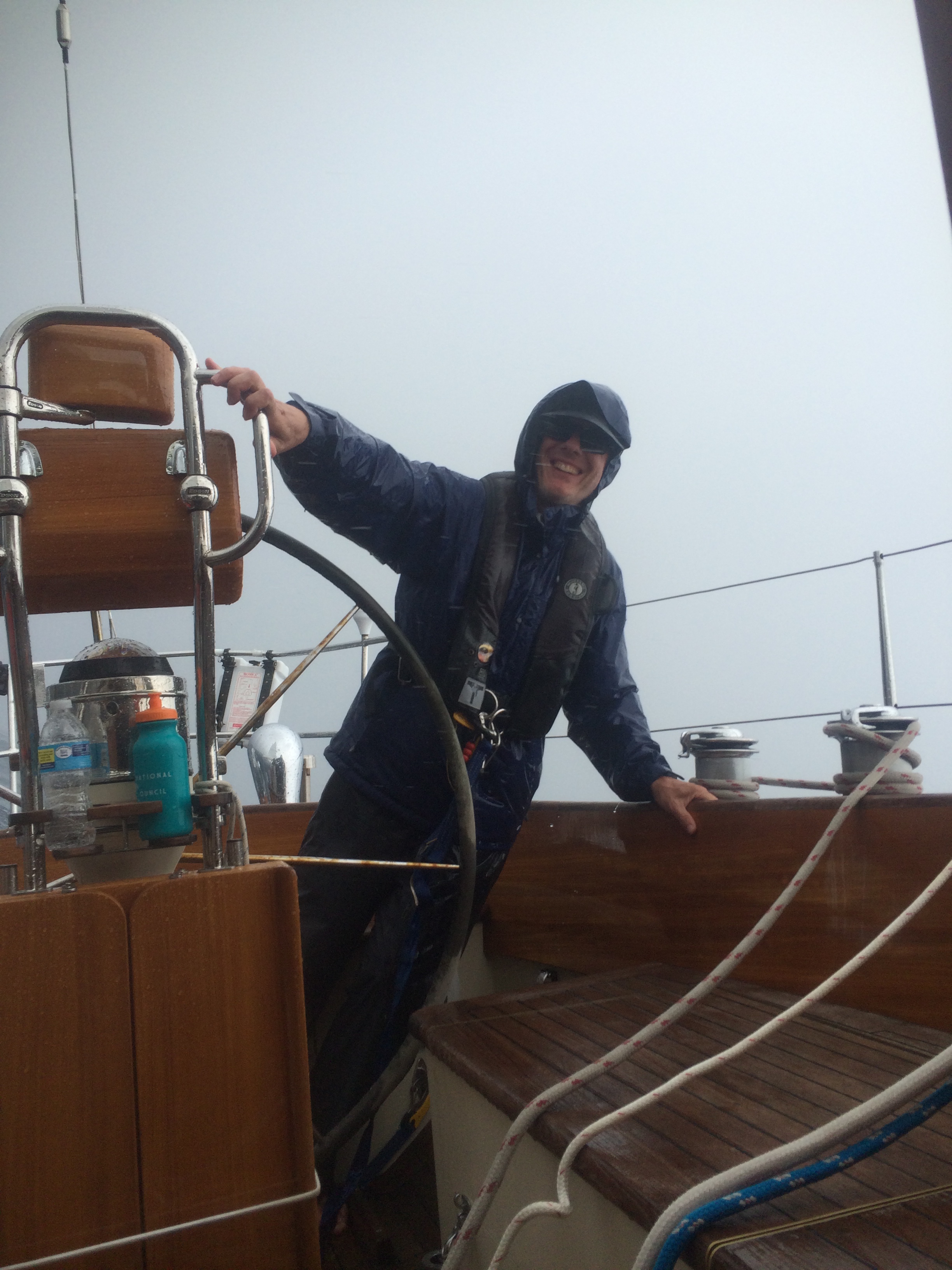
The seas were growing rougher. The once-distant line of squalls was now directly above us and seemed in no hurry to move on. Heavy rains fell, waves surged to 12 feet, and winds were gusting to 40 knots. George was on the radio trying to notify the Coast Guard and locate any nearby boats. David and Dave, whose mechanical aptitudes had them speaking in what to me appeared to be tongues, devised ever-more-ingenious efforts to stabilize the rudder, all of which failed. And the cook went below. Fifteen minutes later he reappeared with a platter of sandwiches.

“We might as well eat,” he said.

Rescue at Sea (5th in a Series)

Part 5. “For me, when everything goes wrong – that’s when adventure starts.* It was a little past noon on the fourth day when the steering went. We were 142 nautical miles from shore, with only a distant line of squalls to get past, after which we expected clear sailing until we reached Newport the following afternoon. We had navigated through the Gulf Stream’s heavy weather and come out into this morning’s clear, sunny skies and the quietest seas we’d experienced so far. Near the end of my watch (no, I wasn’t allowed up there by myself), a pod of young dolphins swam exuberantly around the boat.

I had just gone below to get some sleep, leaving the others on deck to discuss lunch, when without warning, the wheel, which was on autopilot, holding steadily to our north-by-northwest course, began rotating wildly. All efforts to steer manually failed, and we found ourselves adrift on an empty sea – 140 miles from the closest dry land and several thousand feet above the ocean’s floor. We hadn’t seen another boat in 72 hours.

Restive proved her mettle by neatly heaving to into the wind, while the collective brainpower tried to figure out what to do. Clearly, the problem was the rudder, and so Dave descended into the bowels of the boat to have a look.

“I’ve found the problem,” he called up from below, and as he scrambled back on deck, the once-distant squalls were closing in, the waves had swelled to over eight feet, and the wind was now blowing 20-30 knots.

“We have,” Dave said, “a major structural failure.”

*Yvon Chouinard

Rescue at Sea (4th in a Series)

Part 4. Cast and Crew We were five aboard Restive, four old friends, the fifth picked up from an Internet site, a seafarers’ match.com where captains look for crew and sailors look for boats.

  • George: the captain. A veteran sailor with years at the helm and many Bermuda races in his topsiders. Had lovingly overseen every aspect of Restive’s design, construction and launching in 2006. Calm, focused, confident, a skipper’s traits, and ones that had enabled him to build the boat in the first place. Born: 1945. Friends since 1955.
  • David: a Marine combat engineer in Vietnam who spent his subsequent career with a large construction company. A keen mechanical aptitude and a fascination with deciphering how things work. An unruffled sailor, he innately grasped Restive’s nuts and bolts. An indifferent swimmer. Born: 1945. Friends since 1958.
  • Fred: a man of remarkable physical strength and unflagging good humor (except when reading my blog). A tough and fearless seaman – also the cook, although rough seas limited his culinary creativity. Born: 1945. DaveFriends since 1963.
  • Dave: an MIT-trained engineer. Built his first boat from a kit at the age of nine and has been sailing ever since. A genius at determining what was wrong and fixing it. A generation younger. Friends since the night before we sailed.
  • Your scribe: a rookie. Born: 1945.
  • Restive: A wooden 48-foot sloop, both seaworthy and beautiful. Built more perhaps for seafaring than comfort. But, hey, we were ancient mariners.restive052108BARN-4035

As we set off, we little knew how critical these attributes would soon prove – especially the personal ones.


Rescue at Sea (3rd in a Series)

Part 3. Evening Star We sailed out into the Atlantic under sunny skies, watching the water change from the aquamarine of Bermuda’s coastline to a deep, rich blue. A strong wind blew out of the southwest (as several of you pointed out), and in the first two days we covered 352.5 of our 635-nautical-mile trip, a record 48-hour distance for Restive.

Ocean sailing consists of long periods of boredom, accompanied by discomfort and interspersed with moments of terror, all taking place in a tiny capsule bobbing on an endless sea. There are those who love it – the hoisting and lowering of sails to adjust to changing winds, charting a course in an ocean without markers, scanning the skies for approaching storms and, my favorite, hanging out with friends, swapping stories.

For me, night was a special time – the sky filled with millions of distant lights as we sailed beneath the Big Dipper, the North Star directly above our mast. It was around the time of the Jupiter-Venus conjunction, when the tiny evening star seems to pull the fiery torch of Jupiter across the night sky.

After the first night we never saw another boat. There was nothing in any direction but water, all the way to the horizon. I thought of the prayer that reminds us that “a horizon is nothing save the limit of our sight.”

It’s amazing to be at once so cut off from the world and so connected to the universe, “alone,” as the ancient mariner said “on a wide, wide sea.”


Rescue at Sea (2nd in a series)

Part 2. At Sea We were five aboard Restive as, with the captain recovered, we headed out of Hamilton Harbor and onto the open sea, destined for Newport, R.I. 635 nautical miles to the northwest, with nothing between us but salt water. We had clear skies and a strong southwest wind, which, if it did not change, meant we could sail straight to Newport without turning – or, as we salts like to say, on a single port tack. It also meant high seas, which made stomachs dyspeptic and turned the simplest tasks into physical challenges. For example, you didn’t walk to the toilet (“head”), you grabbed onto whatever was handy and hauled yourself painfully forward. Once safely there, you faced a whole new set of challenges.At Sea

A few days earlier, with a different crew (we were the B team), Restive had completed the Marion-to-Bermuda race. It had been quite a trip. Early on, the thing that furls the jib had broken during a storm, which forced the crew to spend several perilous hours wrestling the huge sail onto the deck. Then the toilet broke.

IMG_1406

But Restive sailed on undaunted, navigating only by the stars, a class she had won twice before. This time, however, for some yet-unexplained reason she veered to the northeast and missed Bermuda entirely. This is not an insignificant miscalculation, as the island is a lonely collection of rocks in an otherwise empty ocean – Cape Hatteras, the nearest dry land, is 580 nautical miles away.

Glad I wasn’t on that trip.

Rescue at Sea (1st in a Series)

Part 1. Setting Off. Like Ishmael, “I thought I would sail about a little and see the watery part of the world,” and so for some unfathomable reason I accepted the invitation of an old friend to sail on the return leg of this year’s Marion (Mass.)-Bermuda race. I had never been on a small boat miles from any land before, and I looked forward to the opportunity to get away, to learn whatever I might and to have, perhaps, a bit of an adventure.

In Bermuda

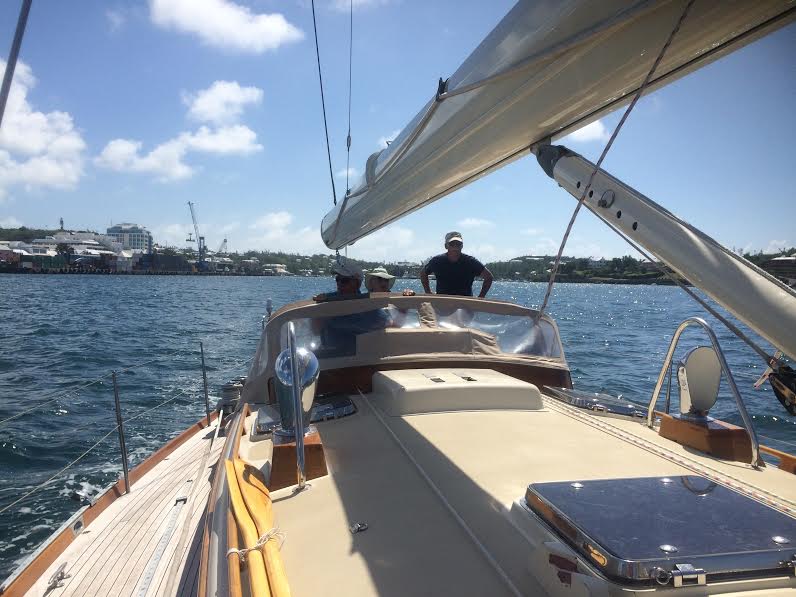
It was hot and humid the morning of Sunday, June 28th when five of us set sail on Restive, a lovely 49’ wooden sloop, a rarity in an age of fiberglass. With a forecast of clear skies and a favorable southwest wind, we were bound for Newport, R.I. 635 nautical miles away. (A nautical mile, I learned, is not a precise distance as humans measure, but a fraction of Earth’s circumference, which is divided into 360 degrees. Each degree is further divided into 60 minutes, and a nautical mile is equal to one minute of the Earth’s arc – approximately 1.1508 miles.)

Leaving Bermuda

We had just pulled away from the dock when I inexplicably tripped over the cockpit rail and found myself fully airborne and heading straight for the back of our unsuspecting captain, who was intently maneuvering us into Hamilton Harbor. It was a clean hit, and the full force of my body drove the startled skipper into the wheel and firmly wedged his Adam’s apple against one of its spokes, rendering him momentarily unable either to steer or to breathe.

We were off.

Five

My granddaughter Calliope turned five yesterday, which was a huge deal for her. It had taken her her whole life to get there, and you could feel the excitement building throughout June (“my birthday month!”). At my age birthdays have a more bittersweet taste, reminders of how quickly the numbers have added up. It seems but a moment since Callie was born, and I wonder much of this extraordinary child’s life I will get to watch unfold. As we seek simultaneously to shield our children from the dangers of the world and to expose them to life’s wonders, we overlook at times how connected the two are. As I grow older I become increasingly aware of how little power I have to change the world; but I do have the choice of how I experience it. I can focus, as I often do, on a world hurtling toward catastrophe – a world of global warming and ISIS, of desperate migrants and mass murders and depleted aquifers. I can also focus on a world of possibility – of human ingenuity and natural beauty, of small kindnesses and enduring friendships, a world in which my granddaughter’s uncontrollable tears turn suddenly to bright laughter.

I believe that Calliope knows plenty about the sadness and capriciousness of life, but she wakes up each morning alive to its sparkle. And while it may not come as naturally any more, so can I. Because before we can solve the world’s problems, we must embrace life’s possibilities.

I won’t be posting next week, as I won't have access to the Internet.

The Glock

Now that we’re making progress on the flag issue, let’s turn to the gun: a .45-caliber Glock, probably the Glock 37, which “delivers power-packed performance in a standard framed handgun.” It’s one of 300 million guns in America, the world’s most heavily armed nation. Dylann Roof, who would have been carded for cigarettes or alcohol, had no trouble getting a Glock. But the political outcry against the Confederate battle flag has had no counterpart in guns. Indeed, as an NRA board member pointed out, there weren’t enough guns in that church. "Eight of [Clementa Pinckney’s] church members who might be alive if he had expressly allowed members to carry handguns in church,” wrote Charles Cotton, “are dead." That pastor has blood on his hands.

This is the same NRA, Steven Rosenfeld wrote, that, before it got hijacked by fanatical absolutists, not only supported rational gun regulations but actually helped write them. I can’t be sure because unlike Justice Scalia I wasn’t there at the time, but it’s hard to imagine that today’s gun-brandishing vigilantes are the founding fathers’ idea of “a well regulated militia.”

In his absurdly hilarious video, Jim Jefferies, the Australian comic, noted that, after the 1996 massacre at Port Arthur, which left 35 dead and 23 wounded, his government got serious about gun control. Before Port Arthur, there had been a mass killing every year for a decade. There haven't been any since.

But our politicians aren’t afraid of guns; they're scared of the gun lobby. So they’re keeping their heads down.

Romney, Thomas and a Flag

Mitt Romney’s tweet was unequivocal: “Take down the #ConfederateFlag at the SC Capitol. To many, it is a symbol of racial hatred. Remove it now to honor #Charleston victims.” Meanwhile, over the state capitol the American and South Carolina flags were at half-staff, while the Confederate battle flag flew nearby fully raised, forbidden by state law to be lowered for any reason. Romney isn't running for president, and most of those who are took a spineless pass, insisting that this was an issue for South Carolina to decide. “I’m not a South Carolinian,” said Rick Santorum. We don’t need “people from outside of the state coming in and dictating how they should resolve it,” said Ted Cruz.

Of course. It’s a states rights issue – that same hypocritical lament used to defend the “peculiar institution” of human bondage, to launch the deadliest war in American history, to justify 100 years of brutal apartheid – Ted Cruz eerily echoing Bull Connor.

And the flag, of course, is the symbol that honors those who fought and died defending states rights. So argued the defendants in Walker vs. Sons of Confederate Veterans. But the Supreme Court disagreed last week, upholding the Texas decision to ban the flag from its license plates, with Clarence Thomas abandoning both his customary allies and traditional principles to cast the deciding vote. Thomas hasn’t said why, but perhaps it's because the flag is not for him, as it is for Lindsey Graham, “part of who we are.”

Friday’s Questions

I woke up yesterday morning excited to read the Pope’s encyclical on environmental justice, but the headline I read crushed my spirit. Why is it that young white men who commit massacres with guns are deranged loners, but young black gunmen are products of a culture of thuggery and the breakdown of civil society?

• Come to think of it, how many mass murders have African Americans committed?

• Why have we long noted the power of social media to recruit young, disaffected jihadists but are only waking up to its power on young disaffected white supremacists?

• How many of the 170 bikers arrested for the murderous shoot-out in the Twin Peaks parking lot were raised in homes with no fathers? Did anybody ask?

• Why did California Governor Ronald Reagan enthusiastically sign the Mulford Act, a Republican-sponsored gun-control bill, in May 1967 (saying “there is no reason why  . . . a citizen should be carrying loaded weapons”)?

• Could it have been related to the fact that armed Black Panthers had just marched on the state capitol demanding their second-amendment rights?

• In fact, why did the National Rifle Association reverse 100 years of support for gun control (its president testified in 1938, “I do not believe in the general promiscuous toting of guns”) around the time of Reagan’s election in 1980?

• Why did Clarence Thomas break with his conservative allies to support the Texas Department of Motor Vehicles' ban of the confederate flag on state license plates?

• Should we be concentrating on nation building here at home?

No answers this week. Only questions.

Breast Man

Annie Leibovitz’s instantly iconic photo of Caitlyn Jenner on the cover of Vanity Fair has made bosoms a popular, if controversial, subject once again. It’s easy to see why, as Jenner, wearing a white onesie, strikes a full-frontal pose that enhances her ample cleavage. It’s a startling look, unsettling to many women, such as one who wrote on Facebook, “I fully support Caitlyn Jenner, but I wish she hadn’t chosen to come out as a sex babe.” Caitlyn

And it’s not just women. As I walked home from town yesterday, I caught a glimpse in a store window of a blue T-shirt with what appeared to be two half eggshells sticking out. I looked around and, satisfied I was alone, turned furtively back to my reflection in the window. The T-shirt was mine, and so, therefore, were the two protuberances. I slunk home, horrified. Are these what I parade around town every day?

“You, sir,” I muttered to myself, “are no Caitlyn Jenner.”

For while we tend to think of Jenner as having recently stepped, like Aphrodite, another Olympic goddess, fully formed into the world, her body is 65 years old – and there’s not an ounce of fat on it. Later, as I headed for the shower I glanced at the mirror: where Jenner still has a six-pack, I have jug handles. Why does she make growing old look so easy?

Next, I’ll discuss strategies for how older men can put their pants on without having to sit down and whether the stomach's preferred placement is above or below the belt.