Rescue at Sea (4th in a Series)

Part 4. Cast and Crew We were five aboard Restive, four old friends, the fifth picked up from an Internet site, a seafarers’ match.com where captains look for crew and sailors look for boats.

  • George: the captain. A veteran sailor with years at the helm and many Bermuda races in his topsiders. Had lovingly overseen every aspect of Restive’s design, construction and launching in 2006. Calm, focused, confident, a skipper’s traits, and ones that had enabled him to build the boat in the first place. Born: 1945. Friends since 1955.
  • David: a Marine combat engineer in Vietnam who spent his subsequent career with a large construction company. A keen mechanical aptitude and a fascination with deciphering how things work. An unruffled sailor, he innately grasped Restive’s nuts and bolts. An indifferent swimmer. Born: 1945. Friends since 1958.
  • Fred: a man of remarkable physical strength and unflagging good humor (except when reading my blog). A tough and fearless seaman – also the cook, although rough seas limited his culinary creativity. Born: 1945. DaveFriends since 1963.
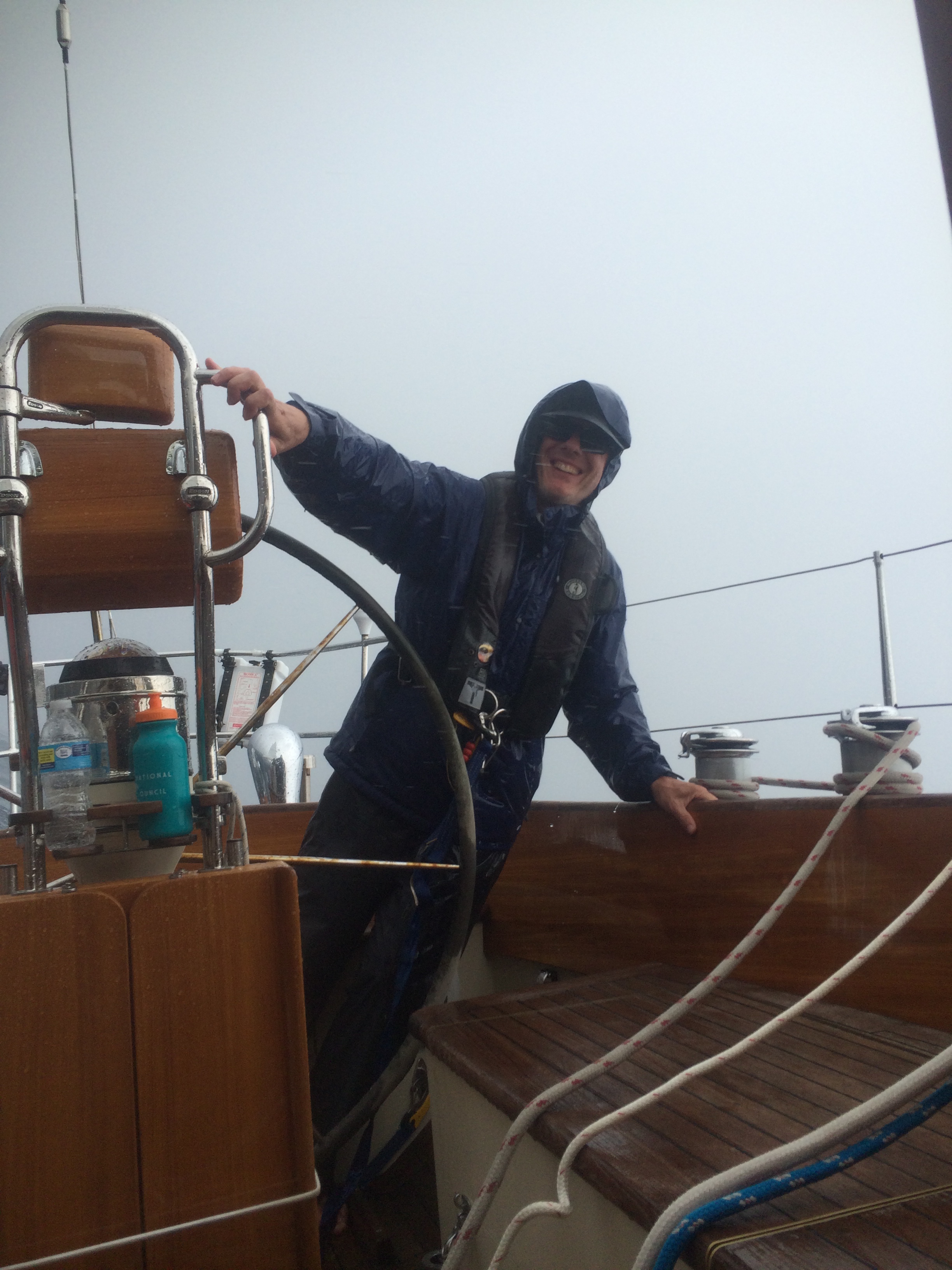
  • Dave: an MIT-trained engineer. Built his first boat from a kit at the age of nine and has been sailing ever since. A genius at determining what was wrong and fixing it. A generation younger. Friends since the night before we sailed.
  • Your scribe: a rookie. Born: 1945.
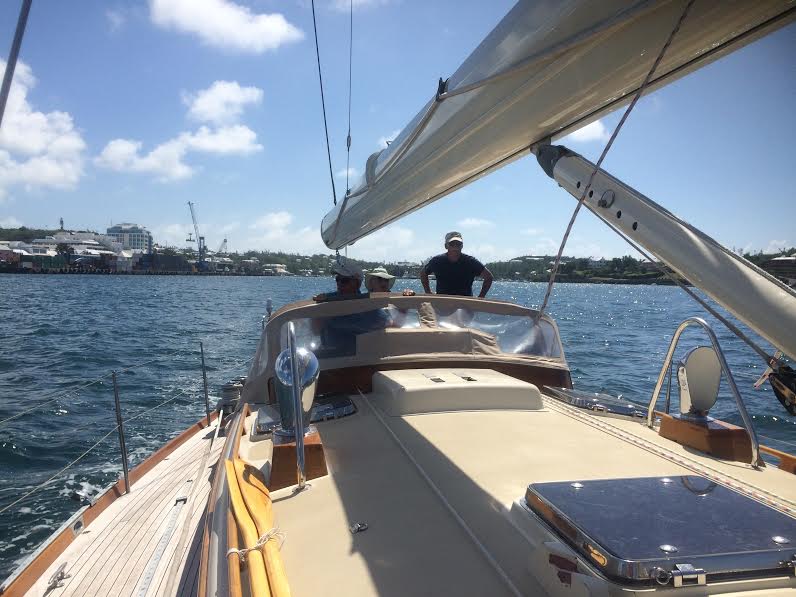
  • Restive: A wooden 48-foot sloop, both seaworthy and beautiful. Built more perhaps for seafaring than comfort. But, hey, we were ancient mariners.restive052108BARN-4035

As we set off, we little knew how critical these attributes would soon prove – especially the personal ones.


Rescue at Sea (3rd in a Series)

Part 3. Evening Star We sailed out into the Atlantic under sunny skies, watching the water change from the aquamarine of Bermuda’s coastline to a deep, rich blue. A strong wind blew out of the southwest (as several of you pointed out), and in the first two days we covered 352.5 of our 635-nautical-mile trip, a record 48-hour distance for Restive.

Ocean sailing consists of long periods of boredom, accompanied by discomfort and interspersed with moments of terror, all taking place in a tiny capsule bobbing on an endless sea. There are those who love it – the hoisting and lowering of sails to adjust to changing winds, charting a course in an ocean without markers, scanning the skies for approaching storms and, my favorite, hanging out with friends, swapping stories.

For me, night was a special time – the sky filled with millions of distant lights as we sailed beneath the Big Dipper, the North Star directly above our mast. It was around the time of the Jupiter-Venus conjunction, when the tiny evening star seems to pull the fiery torch of Jupiter across the night sky.

After the first night we never saw another boat. There was nothing in any direction but water, all the way to the horizon. I thought of the prayer that reminds us that “a horizon is nothing save the limit of our sight.”

It’s amazing to be at once so cut off from the world and so connected to the universe, “alone,” as the ancient mariner said “on a wide, wide sea.”


Rescue at Sea (2nd in a series)

Part 2. At Sea We were five aboard Restive as, with the captain recovered, we headed out of Hamilton Harbor and onto the open sea, destined for Newport, R.I. 635 nautical miles to the northwest, with nothing between us but salt water. We had clear skies and a strong southwest wind, which, if it did not change, meant we could sail straight to Newport without turning – or, as we salts like to say, on a single port tack. It also meant high seas, which made stomachs dyspeptic and turned the simplest tasks into physical challenges. For example, you didn’t walk to the toilet (“head”), you grabbed onto whatever was handy and hauled yourself painfully forward. Once safely there, you faced a whole new set of challenges.At Sea

A few days earlier, with a different crew (we were the B team), Restive had completed the Marion-to-Bermuda race. It had been quite a trip. Early on, the thing that furls the jib had broken during a storm, which forced the crew to spend several perilous hours wrestling the huge sail onto the deck. Then the toilet broke.

IMG_1406

But Restive sailed on undaunted, navigating only by the stars, a class she had won twice before. This time, however, for some yet-unexplained reason she veered to the northeast and missed Bermuda entirely. This is not an insignificant miscalculation, as the island is a lonely collection of rocks in an otherwise empty ocean – Cape Hatteras, the nearest dry land, is 580 nautical miles away.

Glad I wasn’t on that trip.

Rescue at Sea (1st in a Series)

Part 1. Setting Off. Like Ishmael, “I thought I would sail about a little and see the watery part of the world,” and so for some unfathomable reason I accepted the invitation of an old friend to sail on the return leg of this year’s Marion (Mass.)-Bermuda race. I had never been on a small boat miles from any land before, and I looked forward to the opportunity to get away, to learn whatever I might and to have, perhaps, a bit of an adventure.

In Bermuda

It was hot and humid the morning of Sunday, June 28th when five of us set sail on Restive, a lovely 49’ wooden sloop, a rarity in an age of fiberglass. With a forecast of clear skies and a favorable southwest wind, we were bound for Newport, R.I. 635 nautical miles away. (A nautical mile, I learned, is not a precise distance as humans measure, but a fraction of Earth’s circumference, which is divided into 360 degrees. Each degree is further divided into 60 minutes, and a nautical mile is equal to one minute of the Earth’s arc – approximately 1.1508 miles.)

Leaving Bermuda

We had just pulled away from the dock when I inexplicably tripped over the cockpit rail and found myself fully airborne and heading straight for the back of our unsuspecting captain, who was intently maneuvering us into Hamilton Harbor. It was a clean hit, and the full force of my body drove the startled skipper into the wheel and firmly wedged his Adam’s apple against one of its spokes, rendering him momentarily unable either to steer or to breathe.

We were off.

Five

My granddaughter Calliope turned five yesterday, which was a huge deal for her. It had taken her her whole life to get there, and you could feel the excitement building throughout June (“my birthday month!”). At my age birthdays have a more bittersweet taste, reminders of how quickly the numbers have added up. It seems but a moment since Callie was born, and I wonder much of this extraordinary child’s life I will get to watch unfold. As we seek simultaneously to shield our children from the dangers of the world and to expose them to life’s wonders, we overlook at times how connected the two are. As I grow older I become increasingly aware of how little power I have to change the world; but I do have the choice of how I experience it. I can focus, as I often do, on a world hurtling toward catastrophe – a world of global warming and ISIS, of desperate migrants and mass murders and depleted aquifers. I can also focus on a world of possibility – of human ingenuity and natural beauty, of small kindnesses and enduring friendships, a world in which my granddaughter’s uncontrollable tears turn suddenly to bright laughter.

I believe that Calliope knows plenty about the sadness and capriciousness of life, but she wakes up each morning alive to its sparkle. And while it may not come as naturally any more, so can I. Because before we can solve the world’s problems, we must embrace life’s possibilities.

I won’t be posting next week, as I won't have access to the Internet.

The Glock

Now that we’re making progress on the flag issue, let’s turn to the gun: a .45-caliber Glock, probably the Glock 37, which “delivers power-packed performance in a standard framed handgun.” It’s one of 300 million guns in America, the world’s most heavily armed nation. Dylann Roof, who would have been carded for cigarettes or alcohol, had no trouble getting a Glock. But the political outcry against the Confederate battle flag has had no counterpart in guns. Indeed, as an NRA board member pointed out, there weren’t enough guns in that church. "Eight of [Clementa Pinckney’s] church members who might be alive if he had expressly allowed members to carry handguns in church,” wrote Charles Cotton, “are dead." That pastor has blood on his hands.

This is the same NRA, Steven Rosenfeld wrote, that, before it got hijacked by fanatical absolutists, not only supported rational gun regulations but actually helped write them. I can’t be sure because unlike Justice Scalia I wasn’t there at the time, but it’s hard to imagine that today’s gun-brandishing vigilantes are the founding fathers’ idea of “a well regulated militia.”

In his absurdly hilarious video, Jim Jefferies, the Australian comic, noted that, after the 1996 massacre at Port Arthur, which left 35 dead and 23 wounded, his government got serious about gun control. Before Port Arthur, there had been a mass killing every year for a decade. There haven't been any since.

But our politicians aren’t afraid of guns; they're scared of the gun lobby. So they’re keeping their heads down.

Romney, Thomas and a Flag

Mitt Romney’s tweet was unequivocal: “Take down the #ConfederateFlag at the SC Capitol. To many, it is a symbol of racial hatred. Remove it now to honor #Charleston victims.” Meanwhile, over the state capitol the American and South Carolina flags were at half-staff, while the Confederate battle flag flew nearby fully raised, forbidden by state law to be lowered for any reason. Romney isn't running for president, and most of those who are took a spineless pass, insisting that this was an issue for South Carolina to decide. “I’m not a South Carolinian,” said Rick Santorum. We don’t need “people from outside of the state coming in and dictating how they should resolve it,” said Ted Cruz.

Of course. It’s a states rights issue – that same hypocritical lament used to defend the “peculiar institution” of human bondage, to launch the deadliest war in American history, to justify 100 years of brutal apartheid – Ted Cruz eerily echoing Bull Connor.

And the flag, of course, is the symbol that honors those who fought and died defending states rights. So argued the defendants in Walker vs. Sons of Confederate Veterans. But the Supreme Court disagreed last week, upholding the Texas decision to ban the flag from its license plates, with Clarence Thomas abandoning both his customary allies and traditional principles to cast the deciding vote. Thomas hasn’t said why, but perhaps it's because the flag is not for him, as it is for Lindsey Graham, “part of who we are.”

Friday’s Questions

I woke up yesterday morning excited to read the Pope’s encyclical on environmental justice, but the headline I read crushed my spirit. Why is it that young white men who commit massacres with guns are deranged loners, but young black gunmen are products of a culture of thuggery and the breakdown of civil society?

• Come to think of it, how many mass murders have African Americans committed?

• Why have we long noted the power of social media to recruit young, disaffected jihadists but are only waking up to its power on young disaffected white supremacists?

• How many of the 170 bikers arrested for the murderous shoot-out in the Twin Peaks parking lot were raised in homes with no fathers? Did anybody ask?

• Why did California Governor Ronald Reagan enthusiastically sign the Mulford Act, a Republican-sponsored gun-control bill, in May 1967 (saying “there is no reason why  . . . a citizen should be carrying loaded weapons”)?

• Could it have been related to the fact that armed Black Panthers had just marched on the state capitol demanding their second-amendment rights?

• In fact, why did the National Rifle Association reverse 100 years of support for gun control (its president testified in 1938, “I do not believe in the general promiscuous toting of guns”) around the time of Reagan’s election in 1980?

• Why did Clarence Thomas break with his conservative allies to support the Texas Department of Motor Vehicles' ban of the confederate flag on state license plates?

• Should we be concentrating on nation building here at home?

No answers this week. Only questions.

Breast Man

Annie Leibovitz’s instantly iconic photo of Caitlyn Jenner on the cover of Vanity Fair has made bosoms a popular, if controversial, subject once again. It’s easy to see why, as Jenner, wearing a white onesie, strikes a full-frontal pose that enhances her ample cleavage. It’s a startling look, unsettling to many women, such as one who wrote on Facebook, “I fully support Caitlyn Jenner, but I wish she hadn’t chosen to come out as a sex babe.” Caitlyn

And it’s not just women. As I walked home from town yesterday, I caught a glimpse in a store window of a blue T-shirt with what appeared to be two half eggshells sticking out. I looked around and, satisfied I was alone, turned furtively back to my reflection in the window. The T-shirt was mine, and so, therefore, were the two protuberances. I slunk home, horrified. Are these what I parade around town every day?

“You, sir,” I muttered to myself, “are no Caitlyn Jenner.”

For while we tend to think of Jenner as having recently stepped, like Aphrodite, another Olympic goddess, fully formed into the world, her body is 65 years old – and there’s not an ounce of fat on it. Later, as I headed for the shower I glanced at the mirror: where Jenner still has a six-pack, I have jug handles. Why does she make growing old look so easy?

Next, I’ll discuss strategies for how older men can put their pants on without having to sit down and whether the stomach's preferred placement is above or below the belt.

In Praise of the Much Maligned Market Place

I’m excited by the possibilities of the marketplace to unleash economic creativity that can work for the public good as well as for personal enrichment. “Impact investing” – which seeks out people and companies whose goal is to make a positive social and environmental impact as well as a good return – is a still-small but growing movement. It operates at all levels, from large corporations to small garages, and it is predicated on the belief that the best long-term investments will be those that are driven by more than money. For me the excitement comes from someone like Shiv Rajendran, who is converting used electric-car batteries into sources of power for India’s rural schools; from a company like Oliberte in Addis Ababa, the world’s first fair-trade-certified shoe company, creating “a sustainable brand supporting workers’ rights in sub-Saharan Africa”; a community lender like the Contact Fund, “built on a vision that private capital can be leveraged to make high-impact community investments in New York City” – and the hundreds of mostly young people now in Detroit (which is trying to become “the Silicon Valley for entrepreneurs”) who are teeming with ideas that will help revitalize the city. Some of these ideas will flourish. Most will fail. But the real question is whether collectively they can build a more inclusive and less exploitive system of capitalism. It’s a long shot. But I’m betting they can.

(Full disclosure: I’m a very small investor in Oliberte and Contact Fund.)

Correction: Friday’s post inadvertently listed the Koch Brothers’ net worth as $85.8 million. It is, of course, $85.8 billion. I apologize for the three-zeros rounding error.

Friday’s Quiz

1. Which of the following does not rank in the top five states for gun violence? (a) Louisiana  (b) Mississippi  (c) New York  (d) Alaska  (e) Alabama

2. Which college recently canceled a performance of “The Vagina Monologues”?

(a) University of Mississippi  (b) Dartmouth  (c) Oral Roberts  (d) Mount Holyoke  (e) Liberty University

3. Which state is not among the top five in single-parent families?

(a) New Jersey  (b) Mississippi  (c) Arkansas  (d) Louisiana  (e) Alabama

4. Who is the richest man in the world?

(a) Carlos Slim, Mexico  (b) Bill Gates, U.S.  (c) Vladimir Putin, Russia  (d) Prince Alwaleed Bin Talal Alsaud, Saudi Arabia  (e) Charles David Koch, U.S.

Answers

1. (c) New York is third from lowest (behind Massachusetts and Hawaii). Alaska, Louisiana, Alabama, Mississippi rank 1-4, Alaska’s death rate almost five times New York's. New York is the only one of the five to require a handgun permit. Suicides account for 60% of gun fatalities.

2. (d) Mount Holyoke, the 178-year-old women’s college, canceled the feminist play in January because of its “extremely narrow perspective on what it means to be a woman.”

3. (a) New Jersey has the fourth-lowest rate of single-parent families; Mississippi, Louisiana, Arkansas and Alabama the four highest.

4. Trick question. Forbes lists Gates #1 ($79 billion), closely followed by Slim ($77 billion), who owns 40% of the wealth on the Mexico stock exchange. Prince Alwaleed, the world’s richest royal has a mere $30 billion. Adding fuel to the Democrats' obsession, the Koch Brothers combined worth of $85.8 billion outdoes all the others. Except, insists Bill Browder, for Vladimir Putin, who's worth $200 billion. Author of the chilling Red Notice and Russia’s largest single investor until his assets were stolen, his lawyer murdered and he was forced to leave, Browder ought to know.

Creepy thought: According to Forbes Putin is also the most powerful man in the world.

Free Enterprise and the Commons

Once upon a time, before corporations had become persons, they were legal entities that offered ordinary people the chance to own shares in the nation’s economy, an opportunity until-then reserved primarily to industrial titans and robber barons. It hasn’t turned out that way: far more families own cats than shares of stock, and 10% of Americans own 81% of all stocks. This has exacerbated the wealth gap, centralized corporate decision-making, and provided lots of money to influence politics – a 21st-century version of the “military-industrial complex” Eisenhower warned against. With congressional approval ratings remaining abysmally low, many Americans feel shut out of the economy and unrepresented by their elected officials. In a democracy, this is not a good thing. The current system has privatized the commons, polluted it, extracted its public goods at a fraction of their value – and created a class of politicians beholden to special interests.

Yet I believe that the free-enterprise system itself provides fertile ground for change, and I see many people planting seeds of hope: shareholder initiatives demanding changes in corporate environmental and social policies; signs of recognition that the best long-term returns will come from companies that operate sustainably and mindfully; social networks and crowdfunding that are democratizing investment opportunities and financing young entrepreneurs. Their collective effort is to create a free-enterprise system that is open to ordinary people, that exists not just for private gain but for public good and that seeks not to destroy the commons but to revive it.

Dennis (Allegedly)

The very weird case of J. Dennis Hastert, the former Speaker indicted for perjury and illegal bank withdrawals for payments he apparently made to someone who was purportedly blackmailing him for alleged sexual abuse when he was a high school wrestling coach. My thesaurus is exhausted. And so we have the all-too-depressingly-familiar accusations of sexual misconduct by a man who (a) was in a position of power and trust over vulnerable young men and (b) had spent his career in the helping professions.

We also have another story of a less personal – and more common – kind of abuse. When Hastert left Congress he became a lobbyist, and however you dress up the role of a lobbyist, it is essentially to sell access – something that former House speakers have lots of. After a sluggish start, Hastert’s business began picking up around the time he needed money to make large payments to the still-unidentified blackmailer. (I wonder what would have happened if these demands had arisen while Hastert was still in Congress, with access not just to people but to classified information.)

There is much more to be learned about the personal case of Dennis Hastert, whose sudden fall from grace caught his many admirers by surprise. But how many more stories do we need to read about the cozy connections between those who purport to serve the public good and those who only want to line their own pockets before we get serious about political and financial reform?

Let Them All Run

It used to be said that anybody (well, any boy) could grow up to be president, and clearly the dozens of Republican candidates frantically trying to get noticed took that civics lesson to heart. But how can you be president if you can’t even make the cut for the televised debates – which Fox and CNN will limit to the 10 highest-rated candidates in current polls The grousing has begun. Which polls? How current? With what margin of error? “If you’re a United States senator, if you’re a governor, if you’re a woman who ran a Fortune 500 company,” said former Senator Rick Santorum, who in 2012 went from 0% to Romney’s runner-up – and is back again to 0%, “then you should have a right to be on stage.” Santorum is right (a sentence I never thought I’d write). The thing stinks.

Will it be a circus to have 18 or 20 candidates, including Donald Trump, interrupting each other? Isn’t that why we watch, waiting for a gaffe or putdown? But what’s happening now is even more demeaning, as candidates try to claw their way into the top 10 with all the dignity of reality show contestants.

Since when do broadcast companies and ever-changing polls, which together have done so much to dumb down our elections, get to choose the candidates – and, incidentally, provide superPACs one more opportunity to buy advertising? Let’s bring back the excitement and honest corruption of the old conventions, with their horse-trading in non-smoke-filled rooms. In the meantime, let them all run.

Class Acts

For those who are counting, the number of Republican presidential candidates now equals all your fingers and half your toes, while the Democrats are up to three. With all the handwringing over big money in politics, it’s fun to watch everybody publicly distancing themselves from the plutocrats (although not from their money) and pandering to the middle class, which is how 90 percent of Americans have traditionally identified themselves. Hillary has gone a step further and thrown in her lot with “everyday Americans” (notwithstanding the Clintons' reported 16-month earnings of $30 million). The Republicans have jumped to fill the void. “They are the party of privilege,” announced the George Pataki. “We are the party of the middle class.” The myth of the middle class has long been the glue that held America together. It was as much aspirational as real – a belief in opportunity – but as the gap between the rich and everyone else continues to expand, that belief is eroding: almost as many people now identify themselves as lower class as middle class. They are not deluded: a recent report ranks the United States fourth from last among developed nations in income inequality – ahead of only Turkey, Mexico and Chile. And that, a Princeton study concludes, is creating a political system in which “policymaking is dominated by powerful business organizations and a small number of affluent Americans [and] America’s claims to being a democratic society are seriously threatened.”

Maybe that’s why Bernie Sanders is gaining traction in Iowa.

Ireland’s Referendum (Part 3)

Like many nationalist revolutionaries, Éamon de Valera was a deeply conservative man. Born in Brooklyn to an Irish mother, he was a leader for over 60 years of the movement that took Ireland from a British colony to independence, from Civil War to a Republic. It was a violent time, and de Valera sought to mold an Irish identity that would hold the country together after centuries of English oppression. His building blocks were the conservative values of the peasantry, the Irish language and, above all, the Catholic Church. And a gloomy disposition settled over the land, particularly on Sunday mornings. But anyone who enters an Irish pub on Saturday night – and much of Ireland does – learns quickly that gloom is not the default position of the Irish spirit. Here people spar with words and sometimes fists. The lyrical Irish language seems fashioned for poetic jousting – so de Valera made Irish mandatory in the schools and almost nobody speaks it anymore. Then came the revelations of what the church had done, not to young boys only, but to unmarried pregnant girls, and people reacted with the special anger of betrayed believers.

But as the old foundation came down, it seemed to release something deeper than the “us-vs-them” mentality to which Ireland had clung for so long. It's impossible not to be struck by the gaiety that infused last week’s marriage referendum, the sheer joy of reaching out. Memo from Ireland to us: inclusion is good for the soul.

Ireland’s Referendum (Part 2)

I lived for several months in Ireland, much of it with Catherine, her husband Pee and their nine children, in a small farmhouse without plumbing and powered by turf. I also spent time on the road, hitchhiking around Waterford and Cork, and later up the west coast from Dingle Bay to Donegal. Ireland is a small place, just 300 miles long and 170 miles across, and yet its landscape and culture are remarkably varied. I discovered, in my travels, three very different countries: the fertile pastures of the east and south where Anglicans and Catholics lived amicably together; the barren, rock-strewn west to which Cromwell had driven the conquered Irish 300 years earlier – where beneath a thin veneer flourished a pagan world of fairies and leprechauns and mythic giants, where Gaelic was still the language of daily life; and the midlands, Catherine’s Ireland, impoverished, ruled by priests, steadfastly holding to the old ways. Last week, when Ireland’s voters overwhelmingly approved the gay marriage referendum, the single district to vote against it was in the midlands. I wonder what Catherine would have made of it all. She never questioned the Church or the priests who ran her parish as a fiefdom, and yet she was the kindest person I have ever known. And so, when her youngest, beloved daughter, Kathleen, got pregnant as a teenager, Catherine overcame her catechism and opened her heart to her grandchild. And when Kathleen died from cancer a few years later, it could not rock her mother’s faith.

Ireland’s Referendum (Part 1)

I got off the bus at Moyne Cross and followed the one-lane road until, after about a mile, I turned into a narrow lane and walked up a hill toward a stone farmhouse. A woman just coming out of a small barn stopped and looked at the unshorn wanderer walking toward her. It was June 1972 in Longford, a rural county in the center of Ireland, and I had come in search of the woman who had nursed me through rheumatic fever when I was five – and who a few years later, as my own family was falling apart, had returned here to begin a family of her own. I had sent a letter to her maiden name, at the last address my mother had, and set out to find her. I had come to one of the poorest, most remote parts of Ireland, a place of small farms still without plumbing, where families sold milk from their few cows at the nearby creamery and grew potatoes, onions and cabbages in the rocky soil. A place where the Catholic Church and the pub were the centers of communal life, where the parish priest was the unquestioned arbiter of morality and politics, where divorce was prohibited, contraception illegal and ideas sternly censored. A place, I think today, where gay marriage was unimaginable.

But that afternoon I wondered only if, after all the years, she would know me.

“Catherine,” I said as I approached her.

“So it’s you, is it,” she answered.

Phoenix Rising

With three children and one of my closest friends living there, I visit San Francisco often. Walking its steep streets is a cardio workout for an aging heart and a journey back to a time when the city was the capital of an alternative America, where I first heard the Grateful Dead in the summer of 1966. David Talbot’s Season of the Witch tells San Francisco's story from the aromatic innocence of 1967’s “Summer of Love” through the AIDS epidemic that infected over half the city's gay population 20 years later, but which, Talbot argues, “also had a strange power to heal [as] acts of human grace, in the midst of unspeakable anguish, began to help close San Francisco’s deepest wounds” – scars from its harrowing years of bombings, murders, kidnappings and hatred.

I had forgotten many events that had seemed so vivid then, and I hadn’t realized how interconnected the light and darkness had been – never knew, for example, that Jim Jones, who forced 909 followers to drink Kool Aid laced with cyanide in a Guyana jungle, had not long before been a major political force, delivering money, votes and other, more personal favors to the city’s most progressive leaders, including George Moscone, Willie Brown and Harvey Milk – and murdering Congressman Leo Ryan, the one politician who responded to the cult members’ growing cries for help.

It’s a story of how easily we fall victim to Utopian dreams and of what strength we can summon in the face of tragedy.

The Other Side of Justice

If the trial of Dzhokhar Tsarnaev showed our justice system working as it is meant to, what happens when it doesn’t? One result is that innocent people go to prison, and it is very hard to get them out, even when those who sent them away have become convinced of their innocence. With 2.3 million people in jail, America has the world’s highest rates of incarceration (equaled perhaps by North Korea), and for some, it is much easier to get in than to get out. On Sunday Justice Aid sponsored a benefit for two organizations that are dedicated to freeing the wrongly convicted: Mid-Atlantic Innocence Project, which focuses on D.C., Maryland and Virginia; and Innocence Project New Orleans, which covers Louisiana and Mississippi, two states that have more prisoners than any other places on earth. (Full disclosure: Justice Aid was founded by my friend and cousin, Stephen Milliken, a retired judge of the D.C. superior court known for his creative approach to sentencing.)

Between them, MAIP and IPNO have to date helped exonerate 45 people who had served a combined 829 years in prison for crimes they did not commit. We read that most people who are arrested are guilty of something, and perhaps that’s so, but our system of justice isn’t supposed to be about the law of averages; it’s based on the rights of individuals. What struck me about the people we saw on Sunday was not their bitterness at being wrongfully jailed but their infectious joy at being finally free.