Kim Phones Rodman, Changes Country’s Name

In his first press conference ever, North Korea’s Supreme Leader Kim Jong-Un denounced the coverage of “those raggedy little nouveaux” in Africa and the Middle East as “totally not fair. “When I set off a nuclear bomb or have my favorite uncle executed for half-heartedly clapping, I make the front page of The New York Times for like two days,” said a visibly irked Kim. “These guys are page-one for months.”

The reclusive publicity hound then announced changes to get more media “face time.”

First, he has invited Dennis Rodman, the NBA Hall-of-Famer who calls Kim “my friend for life,” back to Pyongyang to coach the national basketball team, because “Americans only pay attention when Dennis shows up and makes an ass of himself." He added, with obvious frustration, "I have called Dennis three times, but so far I’ve only gotten his voicemail.”

Kim has also changed the name of his country to the Democratic Republic from Mars (화성 에서 민주 공화국), “the god, not the planet,” he said, because “using an ancient deity’s name has really worked for ISIS.”

Finally, Kim said he had invited President Obama for a summit on internal security. “When I read about the White House break-in, I knew we could help,” said the leader of the world’s most repressive nation. “My family has run North Korea for 65 years, and nobody has ever even tried to break in.”

After Kim's remarks, a reporter raised his hand to ask a question and was immediately arrested.
“First they came . . .”

For those who wonder what World War III might look like, I think we’re in it. To us who grew up in the early Cold War years, when air-raid drills involved ducking under wooden desks, World War III meant nuclear Armageddon, depicted in books like On the Beach, Nevil Shute’s bestseller about the world’s last survivors awaiting the radioactive cloud in south Australia, and Jonathan Schell's The Fate of the Earth, which describes the “second death” – that of the future of mankind. Now, as the veneer of civilization erodes in many parts of the world, world war looks less like a game of nuclear chicken between superpowers armed to the teeth, and more like the state of terror Thomas Hobbes described long ago, with “no account of time; no arts; no letters; no society; and which is worst of all, continual fear, and danger of violent death; and the life of man, solitary, poor, nasty, brutish, and short.”

It’s a world in which violence seems arbitrary and unpitying – calculated to break any sense of common humanity. It comes in the personalized form of a videoed beheading, the random slaughter of a suicide bomb, the sudden swoop of a drone. Its aim is to scare us to the sidelines of relative safety, to watch in horror as the unlucky suffer, and then go about our business, having forgotten the words of Martin Niemöller, “Then they came for me – and there was no one left to speak for me.”

The Hubris of Humans

We are living, I keep reading, on the edge of the Anthropocene, the sixth massive extinction in the earth's long history, and the first since the age of the dinosaurs. As the name implies, the cause is us. So naturally we have taken it upon ourselves to fix the problem, and in “Building an Ark for the Anthropocene,” Jim Robbins discusses several projects to save endangered species and protect habitat – an effort, however exciting and encouraging, that inevitably involves choices about which species get saved. Even Noah didn’t try to play god at that level. He loaded the ark with his family and two of every other species, figuring, I guess, that he could repeople the earth but needed all the others to survive.

That’s worth remembering. So many of our efforts to save the polar bear or the rainforest or the earth itself pretend that we are doing so for their sake, instead of for our own. But the earth doesn’t care whether we survive or not. As Alan Weisman noted in “Earth Without People,” it would do just fine without us – and if you are open to the Gaia principle that the earth is a single organism, it’s pretty obvious who the cancer cells are.

My daughter, Gayley, got married on Saturday, and it is their future and their children’s that I truly care about, and that’s why it is critical to protect the wondrous diversity on which their lives will depend.

A Necessary Tension

“We had a wonderful discussion about what makes everyone in the world unique, interesting and exciting. Everyone agreed that it is our differences that make the world so fun!” This message came in an email from my granddaughter’s teacher. Callie is in pre-kindergarten at a Quaker school, and I hope this message, so innocent and hopeful, stays with her as she grows into a world that seems intent on obliterating it.

There is an inevitable tension between individualism and community, between the urge to assert our uniqueness and our need to fit in with the group. It’s a healthy tension mostly – until the forces of orthodoxy overwhelm our differences. We see that most terribly now in the murderous brutality of ISIS, but it exists in the enforced conformity of totalitarian societies and the subliminal messages of consumer advertising, in reflexive patriotism and political correctness, in ethnic intolerance and the willful destruction of art.

The health of human communities depends on diversity as much as the natural world does. It is as destructive to crush differences among peoples as it is to eradicate species in nature. Whenever we stifle a voice of dissent, we extinguish a piece of life.

In Excellent Sheep, his new book on the state of higher education in America, William Deresiewicz quotes novelist/philosopher Rebecca Goldstein: “I place my faith in fiction, in its power to make vividly present how different the world feels to each of us.”

That, I think, is what politics must learn from art.

Defining a Nation

It turns out there really is an independence movement in the Shetland Islands. In response to Friday’s post, a reader sent me a Wall Street Journal article on the efforts of the Shetlands, Orkneys and Outer Hebrides, those beautifully wild islands in the North Sea, to hold their own referendum on secession from Scotland. The parliamentarians in Edinburgh, perhaps with an eye to the islanders’ claims to waters rich in fish and oil, denied the request. Which raises a question: Is there an ideal size and composition of a country and what’s the best way to achieve it?

These days, some very bad guys are expanding their borders by naked force. Vladimir Putin feigns innocence as he moves baldly into eastern Europe; ISIS uses terror to extend its caliphate in Mesopotamia. The Scots, by contrast, voted peacefully on independence, lost and went back to work. But secession movements have rarely been so civilized and have almost never been decided by vote. The United States fought the deadliest war in its history to keep the union intact (and force an end to slavery); the bloody “troubles” in Northern Island has been “the longest major campaign in the history of the British Army.”

Nationalism arose to combat the sectarian violence of warring tribes, but it rarely honored the unique cultures of its people, demanding instead capitulation to a centralized state. Whatever your position on last week’s referendum, it was an extraordinary effort to accommodate peacefully the conflicting demands of nationalism and diversity.

Rick Perry “Inspired by Shetlands Vote”

Rick Perry, the former Texas governor and once and future presidential candidate, told reporters this morning that the secession campaign in what he called "the Shetlands" should inspire all Texans, despite the crushing defeat it suffered at the hands of Scottish voters. Perry, who has been suggesting the possibility of Texas secession for years at Tea Party rallies, said he would study yesterday’s referendum in Britain to learn “how we could do it better.

“We tried leaving once before, about 100 years ago if I’m not mistaken,” he said, apparently referring to the Civil War (1861-1865). “But that didn’t work out so well. I didn’t realize until this week that you could just have a vote on it. Boy, that would have made things a lot easier.”

Perry said Scots and Texans have a lot in common, including accents that people are always trying to imitate, lots of oil, and a tradition of resisting British royalty. "The reason that we fought the [American] Revolution in the 16th century,” he said, “was to get away from that kind of onerous crown, if you will."

But the Scots' big mistake was their politics, he said, citing a column by Neil Irwin, who wrote that "Scotland’s grievances are almost the diametrical opposite of those of, say, the Tea Party. . . . They want more social welfare spending rather than less, and have a strongly pro-green, antinuclear environmental streak.”

“That would be a big loser in Texas, for sure,” Perry said, adding that "those fellas should wear pants."

Innocent Blood

In addition to the horrific manner of their murders, the three men beheaded by ISIS shared the status of non-combatants, a status protected by Article 3 of the Geneva Conventions, which prohibits “violence to life and person,” hostage taking, “outrages upon personal dignity” and arbitrary execution. So much for the Geneva Conventions.

Steven Sotloff and James Foley were freelance journalists covering events in Syria. David Haines was bringing humanitarian aid to a Syrian refugee camp. These are dangerous – and critical – roles in war zones, and those who perform them knowingly put themselves at great risk. But to be singled out for torture and public execution is a sign that the rules of war do not apply. It also raises the question of why we have rules for wars which have always brought disproportionate destruction and death to innocents.

ISIS has made a mockery of those rules, and we have hastened their demise with our justification of torture and failure to close Guantanamo.

And now Foley, Sotloff and Haines are being blamed for their own deaths. They had no business being there, we are told, as if they were seeking only their self-aggrandizement. But the world needs, more than ever, men and women who will risk their lives to bring aid to the suffering and report what is happening to the rest of the world. We cannot build walls and turn our backs.

I do not know what motivated the three men, but I admire their courage and their commitment.

A Sobering Thought

Here’s a sobering thought: three reasonably intelligent old men of diverse political views are sailing off the coast of Maine. When the conversation veers from reminiscing about the old days to current foreign policy, not one of them can articulate a coherent plan about what the United States should do in the Middle East. They can’t even quarrel, which is unusual. They agree on two things: the situation, including the cultures and players involved, is too complicated to completely comprehend; and regardless of what we do or don’t do, the U.S. can neither control nor even predict the outcome. I think we are hardly alone in this, not just among ordinary people but among those who represent us in Washington. With so much uncertainty and so little power to affect the outcome, the time seems unripe to rush into frenzied action. And yet the pressure to do something builds unrelentingly, whipped up by pundits at home and the despicable behavior of ISIS – which seems bent on goading us to act – abroad.

President Obama’s announcement that he will send 475 military advisors to the Middle East seems modest and humane, but I came of age with a war that began with military advisors, ended with 55,000 American – and countless more Vietnamese – dead, and spawned books with titles like The Making of a Quagmire. The U.S. didn’t understand the culture then, and it couldn’t control the outcome.

Wearied by sobering thoughts, we poured a drink and changed the subject to Ukraine.

“A Republic, If You Can Keep It”

Today Congress comes back from summer vacation. Perhaps you hadn’t noticed. Perhaps you weren’t even aware that our congresspeople had been away. Well, they're back. And they have much to do. First, there is the ongoing debate about whether to arm the moderates in Syria. Sure, one or two things have changed on the ground, such as whether President Assad’s decision to bomb ISIS positions in northern Syria makes him an American ally and therefore a moderate by definition . . . which just goes to prove John McCain’s point that if we don’t start bombing someone now, pretty soon we won’t know whom to bomb.

We can also look forward to another panel or two on Benghazi, several more votes to repeal Obamacare and finally unholstering the smoking gun that will settle the mystery of the president’s birth. Our representatives need to act fast because all 435 seats in the House are up for grabs in early November – and those who sit in them are in a hurry to get home so they can cut ribbons, kiss babies and get sent right back to Washington.

Which almost all of them will. For despite the high-profile fall of Eric Cantor in Virginia, 91 percent of incumbents continue to win re-election year after year after year. This is particularly astonishing these days when public approval of Congress stands at a whopping 8 percent and a third of the voters don’t even know their congressperson’s name.

So get ready to go out and vote for what’s his name!

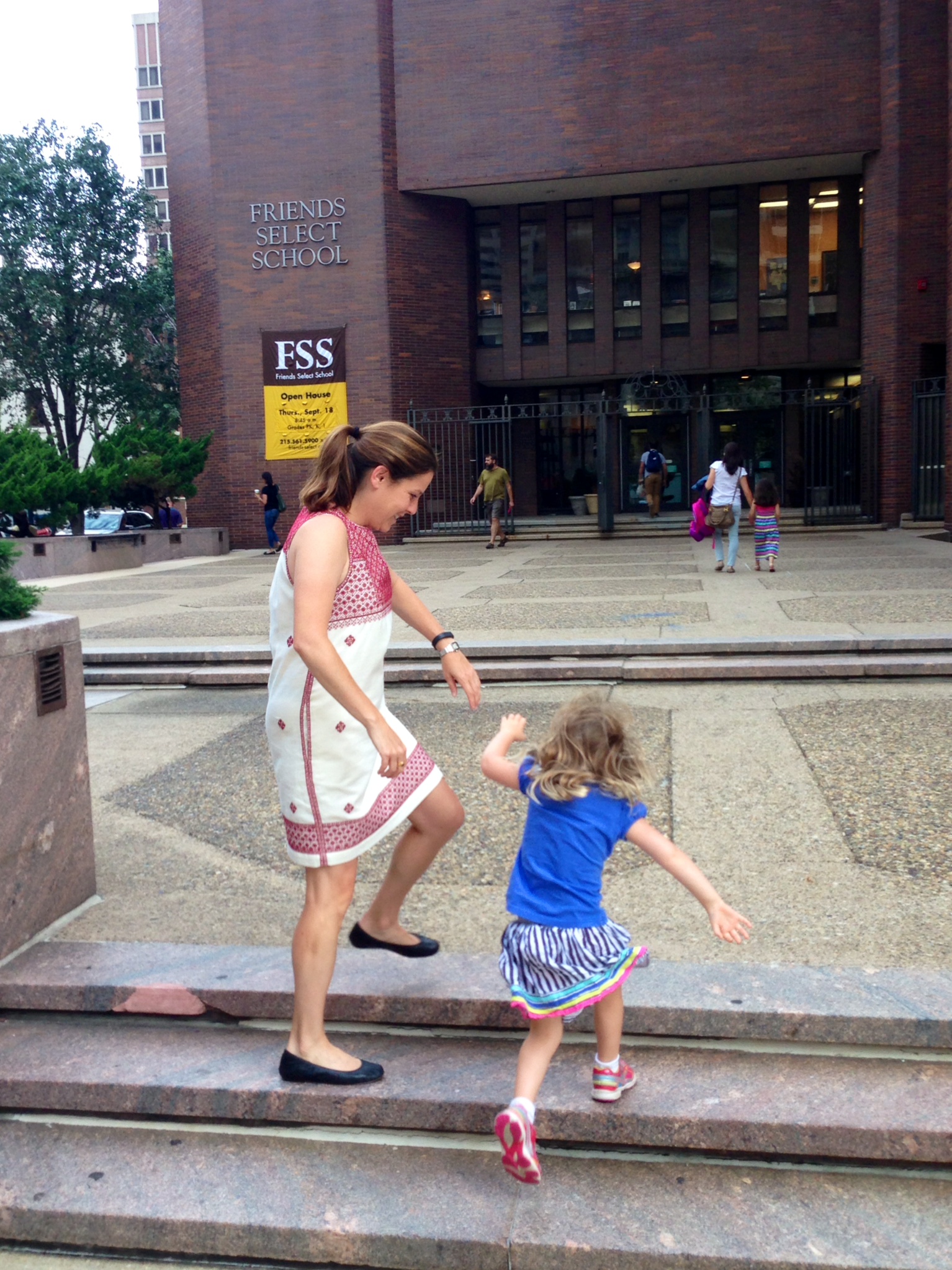
My Muse Goes to School

Calliope is Homer’s muse and also my granddaughter – all wrapped in a single package I sometimes think. She was the wisest of the muses and the most assertive, which seems at least half right about her current reincarnation. She’s in my mind this morning, the end of the first week of a September filled with late summer days when the skies are clear and the crowds have gone home, and loons calling across the calm water bespeak the solitude that has settled on Maine's coast. It’s technically not yet fall, but the cool air has a whiff of the sadness that makes poets write of their impending death, while the more mundane relive the gloomy memories, which the intervening years can’t obliterate, of going back to school.

On Wednesday Calliope started “big girl school,” and although she is only four, it’s quite a step up from “Little Angels,” where she spent her childhood years. Unlike those of us who remember the anxiety of our first days, Callie is unfiltered enthusiasm in a tiny body. She has only one worry: “But Mom, I won’t know the names of my new friends.”

IMG_4585-2

She hasn’t read the reports on bullying (because she can’t read). She’s not desperate to fit in. She doesn’t know she’s starting a long march on which she will be assessed, graded, pigeonholed, sometimes literally disenchanted. She shows hopeful signs of resistance. At four you don’t look back. You look ahead, excited, ready for what Calliope calls “an adventure.”

The Pagan Saint

It’s a small, plain church with whitewashed walls, a table for an altar and a blue shag carpet, wall-to-wall. There are seven or eight rows of comfortable wooden chairs, and were it not for the crucifix hanging behind the altar, you might think you were in a Congregational chapel. Labor Day was the Catholic feast of Saint Giles, who was born in 7th-century Athens but spent most of his life deep in a Provencal forest, the patron saint of childhood fears, mental illness and cripples. Father Sean’s Irish lilt gave the gospel’s language an unexpected grittiness, and his message spoke of humanity and the uncertainty, the fragility of life. “I don’t know if I shall be back,” he said, citing Robert Frost. “None of us know.”

How do I square this with an Irish church convulsed in crisis, still coping with its long history of priests abusing boys, now facing new revelations of unspeakable treatment of young women and their children in Catholic homes for unwed mothers?

I can’t.

But when Father Sean sang, "I danced in the morning when the world begun, and I danced in the moon and the stars and the sun," I thought of St. Giles, a hermit whose only companion was a red deer, and I knew I stood in a different church, where it’s not about being godly, it’s about being human.

And when he said, “I urge you to take communion. I think it’s important. All are welcome here,” I walked forward.

“My Name is Ozymandias, King of Kings”

Calling ISIS a "greater threat than we've seen before," Prime Minister David Cameron raised Britain’s terror level on Friday from “substantial” to “severe.” "The root cause of this threat,” he said, “[is] a poisonous ideology of Islamist extremism that is condemned by all faiths and faith leaders. It believes in using the most brutal form of terrorism to force people to accept a warped world view and to live in an almost medieval state.”

The march of ISIS across Mesopotamia, with its calculated public viciousness and its appalling human suffering, is unbearable to watch.

And yet, as others point out, ISIS is not just a terrorist organization. It has acquired territory, governs an (unrecognized) state and seeks to impose its ideology on the world. There is a word for this – imperialism – which is neither new nor Islamic. It’s what the Romans and – a millennium later – the Roman church did. It was the aim of both Stalin’s Soviet policy and Putin’s Russian expansionism. It propelled Hitler’s “Lebensraum” and Japanese militarism. Lenin called it the Highest Stage of Capitalism, and it was embedded in our own “manifest destiny,” as those in its way well understood. And who should know more about imperialism than Great Britain, which established, with staggering cruelty, an empire on which the sun never set?

It drives the ruthless, in the name of some greater go(o)d, while the rest of us hope only to live our short time here in peace.

Culture of Dependency

“Save your confederate money, boys, the South will rise again.” One-hundred-forty-nine years later, it doesn’t seem likely. And any revival of the old South will be financed, not by Confederate Greybacks (some of which pictured slaves working contentedly in the fields), but by Greenbacks issued by a federal government still reviled across much of the region. For despite the anti-Washington furor reaching its biennial crescendo this political season, southern states remain disproportionately dependent on the United States Treasury. South Carolina, for example, gets almost $8 in federal largesse for every tax dollar it sends north, a list whose top ten includes seven southern states. And despite what its politicians try to tell us, they need every dollar. For on almost any scale – from education to obesity, from household poverty to delinquent debt, from food stamps to unemployment – southern states lag far behind the rest of the nation. Nor does charity begin at home: the tax money they get from the citizens of Connecticut, California and New York is money they don’t have to get from their own citizens, who pay some of the lowest taxes in America.

Despite all this, southern political representatives in Washington, many of whom are the “career politicians” so disdained back home, continue to rail against a government that has become not just their employer but their benefactor. Next April will mark 150 years since Appomattox, and yet America remains both a divided nation and a poorer one because of the continuing sectional hostility.

What’s Up With the Dow?

The Dow-Jones Industrial Average opens today in near-record territory, which seems pretty amazing when you consider the mood of the country and the news of the world: Ebola and AIDS ravage much of Africa. Douglas McAuthur McCain became the first American to die fighting for the ISIS caliphate in Iraq and Syria. Russian troops are in Ukraine, Israeli tanks are in Gaza, California is in a state of emergency, and the Dow keeps going up. If that’s a sign of hope amid the rubble, it seems lost on most Americans, who are in a national funk: 60% believe America is in decline; 71% think we're on the wrong track; 76% think their children will be poorer than their parents. Unemployment is worse than we thought. Yet yesterday the S&P 500 closed above $2,000 for the first time ever.

Am I missing something? Does the surging market represent underlying optimism or complete insanity? Do those who insist America is finished or the world is ending believe they can take it with them?

Naturally, we need someone to blame for all these horrors, and this week, by chance, is “National Impeach Obama Week.” Charges include:

● “Governing by dictatorial fiat”

● “Waging illegal wars”

● “Supporting Al Qaeda and other Jihadist terrorists”

● “Forgery of identification documents”

● “Overall radical and subversive anti-American background”

The president may be ruining America, but not the markets. When Obama entered office, the Dow stood at 7,949 (down from 10,588 at the start of the Bush presidency). Today it opens at 17,107.

Isis of Hope

The news is overloaded with photographs of people forced to kneel to be executed, stories of mutilated bodies hanging from lampposts, reports of public humiliation like the recent spectacle of captured Ukrainian soldiers paraded through streets filled with bloodthirsty crowds. The world seems poised on a new age of savagery in which indiscriminate mass killings make a mockery of individual lives, while we look on horrified, powerless and afraid. Yet, little of this is new. Totalitarian regimes and insurgent fanatics have been using these tactics for millennia. They do it to get rid of people they don’t like. They do it to incite the barbaric passions of their base. They do it to scare the rest of us into silence. The Romans had their crucifixions, the Jim Crow South its lynching parties. Hitler vilified the Jews, Stalin held show trials and built gulags. Today ISIS practices undiluted cruelty. It works. We are cowed.

And yet, no matter how thorough, how brutal or how massive the slaughter, the human spirit finds a way to endure. Hitler killed 20 million people, Stalin 40 million, Mao 70 million, but it was never enough. The spark of opposition survived – in a religion that went underground, in a culture that would not be crushed, in art that subverted the state, in the courage of a few who would not be silent.

We think of Isis as a brutal jihadi army. But we should remember that she is also the Egyptian goddess of nature and rebirth. Of hope.

Nourishing Mother

According to my correspondence from progressive groups and the Democratic Party (of which I get a lot), a sinister syndicate has established a shadow empire in America's heartland. Its name is Koch Industries. Its capital is Wichita, Kansas. And it is characterized by malevolent values, hostile intentions and unlimited resources. While I haven’t yet tired of beating on this straw man, I do think that having an “enemies list” with only one entry may oversimplify the American political landscape – and I urge my radical-chic, tree-hugging, eastern-elite, limousine-liberal fellow travelers to expand their search for corporate scoundrels. For example, here’s a $32-billion corporation whose massive timber operations, according to a Sierra Cub report, “are destroying [Argentina’s] Ibera Wetlands and displacing thousands of farmers.” The corporation’s two wholly-owned subsidiaries have planted a “pine tree monoculture [that] threatens the region's biodiversity and . . . forces people off the land.” Its other natural-resources plays include “dairies in New Zealand, farmland in sub-Saharan Africa, industrial agriculture in the Brazilian cerrado, and vineyards in California.” It may seem odd to buy 10,000 acres in a drought-stricken state to plant a water-intensive wine crop – unless, as some point out, you’re really after “a well-timed water play in light of the region’s worsening groundwater shortage.”

Who is this corporation that seems up to its global eyeballs in environmental skullduggery? Why, it’s Harvard University, my alma mater – my nourishing mother – which in April became the first American university to sign the UN’s Principles of Responsible Investment.

Ferguson, 2014. When Will We Ever Learn?

Our nation is moving toward two societies, one black, one white – separate and unequal. Discrimination and segregation have long permeated much of American life; they now threaten the future of every American.

This deepening racial division is not inevitable. The movement apart can be reversed. Choice is still possible. Our principal task is to define that choice and to press for a national resolution.

To pursue our present course will involve the continuing polarization of the American community and, ultimately, the destruction of basic democratic values.

The alternative is not blind repression or capitulation to lawlessness. It is the realization of common opportunities for all within a single society.

This alternative will require a commitment to national action – compassionate, massive and sustained, backed by the resources of the most powerful and the richest nation on this earth. From every American it will require new attitudes, new understanding, and, above all, new will.

Segregation and poverty have created in the racial ghetto a destructive environment totally unknown to most white Americans.

What white Americans have never fully understood – but what the Negro can never forget – is that white society is deeply implicated in the ghetto. 

It is time now to turn with all the purpose at our command to the major unfinished business of this nation. . . .It is time to make good the promises of American democracy to all citizens – urban and rural, white and black, Spanish-surname, American Indian, and every minority group.

From: Report of the National Advisory Commission on Civil Disorders, February 29, 1968


I Do

Being part of three weddings in three weeks focuses you on the meaning of marriage. Somehow, “a culturally sanctioned union [or legal contract] between spouses that establishes certain rights and obligations between the people, between them and their children, and between them and their in-laws" doesn’t begin to describe what I have witnessed. All three events had much in common, and each lay recognizably within the traditional ceremonies I have attended all my life. But I was struck by the uniqueness of each wedding and how it reflected each couple’s character and aspirations. And that, it seems to me, represents a profound change in how we view the institution itself. Each wedding was outdoors, in a beautiful and carefully chosen place. The vow was a personal statement, a conversation rather than a ritual. God was often optional, and the word “obey” was never uttered.

These are not incidental changes. To me they reflect a belief in marriage as a personal journey, rather than a communal duty or religious rite. Words that are carefully chosen make you think hard about what they mean, about what you are promising to each other. Marriage is a path you have chosen, often after a long courtship, and you have chosen it with care.

The role of the community is no longer to define the legal or cultural arrangements of marriage. Instead, the community is the ceremony itself, in which we have all come together to support two people on the journey they have chosen.

Continuing the Conversation

This week’s posts on water and watersheds brought interesting responses that made me want to continue the conversation this morning: Oil is irreplaceable, water is replaceable when it rains. That doesn’t change your conclusion on better water management.

This is a good point, but it’s not true. Water is renewable in the sense that it moves through the water cycle (precipitation, infiltration and runoff to oceans, evaporation, precipitation), but there is not one drop more water now than there was when the earth was formed 4.5 billion years ago (or 8,000 years ago for my creationist friends). Moreover, other forms of energy (solar, hydro, gas, coal, nuclear, wind) can replace oil, but without clean fresh water, we all die.

I'm concerned about "diverse coalitions to protect them” – “diverse” and “coalitions" are two words fraught with well-meaning intentions that don't go unpunished by corruption/incompetence. We are a republic. We elect fools.

I wasn’t thinking so much in political terms as about all the varied users of rivers – from fishermen to boaters to consumers to farmers to artists – who too often see themselves in conflict instead of as having a common interest in protecting the river and its water.

And when population continues to expand? Perhaps mandatory limits to child bearing? Ebola, Isis, Assad, Putin?

Yes, well, there’s the frightening rub. For while the amount of water hasn’t increased in 4.5 billion (8,000) years, the seven billion people who depend on it have more than doubled since 1960.

It’s all connected.

“Any thoughts on how to share?”

So wrote a reader after Monday’s post. It’s a good question, and the first step is to stop addressing today’s issues with yesterday’s attitudes. Take, for example, water, which we are endlessly told is the oil of the 21st century. It’s not. We are addicted to oil. We are dependent on water, which is finite and irreplaceable. Here are some ideas for thinking differently about it:

  1. Plan in terms of watersheds rather than arbitrary lines on a map, so that water becomes the unifying, rather than the divisive, feature of a community.
  2. Stop thinking of water as commodity – and of rivers as pipes to deliver that commodity. They are ecosystems that sustain all life.
  3. Question grandiose plans to transfer water from one basin to another, such as China’s $79 billion project to reverse the Yangtze (based on Mao’s 1952 idea!); decades-old proposals to divert the Great Lakes into the Mississippi and send water to the arid West; Sitka, Alaska’s, aim to ship bulk water worldwide.
  4. Consider all that rivers provide – drinking water, food, hygiene, transportation, irrigation, hydropower, baptism, recreation, tranquility, beauty – and build diverse coalitions to protect them.
  5. Reform the tangle of conflicting rules and customs governing water use so that upstream dams – as we have built on the Colorado and Turkey intends to build on the Tigris and Euphrates – don’t deprive downstream states of water, and downstream dams don’t flood upstream communities.

We aren’t going to do all this tomorrow. We need to start today.