Ask Not . . .

Of course you cannot visit Sicily without coming across a corpse. We chanced upon ours on our fifth day, as we walked across the beautiful Madonie Mountains high above the town of Castelbuono. Near the end of a four-hour hike that had begun just below the lingering snow – which came as a surprise to those of us who had packed for the tropics – we arrived at a small shepherd’s hut, where carabinieri in crisp blue uniforms and gold braid drove up the wagon path and strode into the nearby woods. The victim was a young man, whose hands and feet were bound, and who had a single bullet hole behind his right ear. There was no sign of a struggle, but his tongue was missing, presumably as warning to potential informers. Or such, at least, was the tale we spun among ourselves. Slowly, more details trickled out. He was not a young man, but elderly, possibly in the early stages of Alzheimer’s, who had wandered off from his home and been missing for seven days. He had walked a long way to die. Perhaps he had feared becoming a burden to his family and so had come to the most beautiful place he knew, ready in the early spring to return to the earth from which he had come. I will never know. But he has become one of countless people whose lives intersect fleetingly with mine, about whom I know nothing and yet whom I cannot forget.
Slight Memories

Often when I travel, I remember the little things – not the images I bring home in a photograph or a postcard, nor the grandeur of antiquity or the self-importance of men – but an unexpected phrase that voices a larger reality or a gilimpse of a passing scene. “I want to ask you,” our 72-year-old driver, Vittorio, says as we sit down to dinner the first evening, “what you think is the difference between life and death.”

As we look out over a broad valley from an amphitheater the Greeks built on a high hill 2,500 years ago, someone asks why the highway below is elevated above the plain. Is it to protect the road from flooding, or an earthquake? “I suppose,” our guide answers with a smile of bemused resignation, “because it costs more.”

As we descend from the ruins of a 14th-century castle, we meet a young couple whose two-year-old son is gathering stones. Someone wonders if he is making a barricade. “We know how to build barricades,” says the mother sorrowfully. “We are from Ukraine.”

In the seaside town of Cefalu, in a small chapel with plain whitewashed walls and stations of the cross hand-carved from dark wood, and on whose ceiling is a simple fresco of Jesus and the words, “Come to me, all who hunger,” a choir of six women and an old man at the organ fill the space with music of incomparable beauty.

From such slight memories come the lasting imprint of my journey.

A Couple of Sicilians

My plane had barely landed in Palermo when I read that Antonin Scalia, one of America’s most infamous Sicilian-Americans, had paved the way for the oligarchs to buy the American government, as the Supreme Court continued to dismantle campaign finance reform in McCutcheon v. Federal Election Commission, a decision, in the words of dissenting Justice Breyer, that effectively makes the limit on individual contributions “the number zero.” That mattered little to Chief Justice Roberts, who wrote, “There is no right in our democracy more basic than the right to participate in electing our political leaders” – ignoring the fact that most of us are now less able to participate in a system that facilitates private conversations between people who have money and want legislation and those who make laws and want money. For an example of how that works, see Republican Congressman Dave Camp’s effort to write a tax-reform bill that was loudly acclaimed by the business lobby – until individual businesses noted parts they didn’t like. Suddenly, tax reform is dead and Camp is leaving Congress. Meanwhile, those of us who don’t want to buy the government will be endlessly pressured for donations to stop those who do.

Here in Sicily, where government is assumed to be a wholly owned subsidiary of La Cosa Nostra, President Rosario Crocetta seeks to eradicate corruption and open the government to the people, despite nonstop threats to kill him. The fact that he is an openly gay Catholic must really drive Scalia nuts.

Sicily's Home Front

Advised that Italy had joined forces with Hitler’s Germany, Churchill allegedly responded, “Seems only fair. We had them in the last war.” We tend to equate valor with military bravery – and overlook the violence just below the surface of our relatively safe and peaceful lives. This is not possible in Sicily, where I am headed today. In anticipation, I read Peter Robb’s Midnight in Sicily, which tells the history of La Cosa Nostra and its intricate ties with the Christian Democrats, Italy’s major political party. It is a frightening tale, guaranteed to cure any visitor’s narcolepsy. Unfortunately, I have insomnia.

Robb shatters the image of a mafia operating in the shadows, imposing a corrupt peace and killing only its own dissidents, describing a “Palermo destroyed like Beirut by a war that’s lasted over forty years, the war of mafia power against the poor,” one that caused 10,000 deaths in a decade, stole billions, and came to America with Lucky Luciano, who left Sicily in 1919 and returned with US forces in 1946.

It has been a war with authentic heroes, men who sought justice knowing they would be killed in its pursuit: Alberto Dalla Chiesa, prefect of Palermo, murdered with his wife; Giovanni Falcone, magistrate, murdered with his wife; Rocco Chinnici, chief prosecutor, murdered; Paolo Borsellino, deputy prosecutor, murdered; Mino Pecorelli, journalist, murdered. These and countless others, including Sicily’s current president, Rosario Crocetta, knew the cost we pay by keeping silent and looking the other way. They are truly brave men.

I will try to report on my trip, but I don’t know if I will be able to, so this may be my last post until I get back in mid-April.

Gladiator U

It all began with the communists. The Soviets and East German women, with their bulging gym shorts and five-o’clock shadows, who won all those Olympic medals in the 1960s weren’t amateurs. They were full-time state employees. The Reds were cheaters. Meanwhile, in the free world, another secretive power was creating a sports empire the capitalist way, as the National Collegiate Athletic Association built a multi-billion-dollar business on the carefully cultivated image of the student-athlete. It seemed like a good deal: colleges got millions, and student-athletes got free educations for playing a game they loved, opportunities for lucrative professional careers, and adulation from fans.

But as the NCAA grew its business beyond expectations, cracks appeared. Management thrived – coaches are often their states’ highest-paid employees. But the laborers, ever bigger and faster, battling in the trenches below thousands of rabid fans, are getting shafted. After working 40-50-hour weeks, 2% of college football players make the NFL, where the average career is under six years and the prognosis is “a dramatically shortened life span.”

This may be changing, Last week, the National Labor Relations Board ruled that Northwestern’s scholarship football players are university employees, eligible to form a union and negotiate for wages and benefits. The NLRB exposed the charade of big-time college athletic programs. But is the remedy to pay professional workers to provide entertainment in college stadiums? Does a university really fulfill its mission by paying its “players” minimum wage so it can cheat them out of a $200,000 education?

If You Can't Beat 'Em

I have had a lot of response to my “Stranded Assets” post, with requests for more information – and a correction: “Exxon is not the worlds largest energy company. The national oil companies of the Persian Gulf all make it look like a peanut.” Some shared stories of token votes overwhelmed by management and expressed wonder that small shareholders could have any impact. But the perception of the almost mythic power of “multinational corporations” – like that of "big government" – overlooks their origins as a democratic concept that made, at least in theory, economic participation available to a broad public. Perhaps it’s time to stop the impotent handwringing and get involved in the process of governance.

And from The Economist: “Exxon Mobil, surely the world’s least tree-hugging company, became the first oil giant to say it would publish details of its ‘stranded assets’ – the value of oil and gas fields that it might not be able to exploit if there were a high carbon price or tough rules on greenhouse-gas emissions. Giant Exxon is not doing this because it has gone mushy or caved in to green activists. Rather, it is heading off a shareholder resolution by Arjuna Capital, a fund manager, demanding explanations and actions on environmental threats to the firm. Exxon’s decision is the biggest step so far in a wider business trend: companies publishing information on their environmental impact and vulnerability to green regulation, to attract or placate investors.”

There is more than one way to occupy Wall Street.

All The News That’s Fitting

When Ben Richardson resigned from Bloomberg News on Monday, he became the third newsperson to quit since the company allegedly squashed an investigative report on big money and politics in China. China plays hardball – as Bloomberg found out in 2012, after it published an article on the staggering wealth accumulated by China’s political elite, and the Chinese government cut off subscriptions to the company’s services. Bloomberg has annual sales of $8.5 billion, and China figures prominently in its future plans. So maybe this gives China some potential leverage over news coverage – as Bloomberg’s Chairman Peter Grauer suggested last week when he said his editors “should have rethought” articles that “wander a little bit away” from the organization’s core business reporting. This is one slippery slope. Yes, the financial stakes are unusually large in China, but news organizations have always had to navigate between commercial needs and editorial integrity, at least in countries that pay lip service to a free press. The press is both a private business and a public trust, and the pressures from the former – to write a puff piece on car dealer, to stop pummeling the bank chairman – have always been relentless. That’s why there was once a “fire wall” between the two sides. But that has eroded as old-fashioned publishers have given way to corporate flacks interested only in profits. It’s easy to beat up on Rupert Murdoch and Roger Ailes, but the deeper threat to press freedom is much more subtle than those guys.

Stranded Assets

They probably found it pretty laughable at headquarters when the resolution arrived, signed by DeWitt Sage and me, asking ExxonMobil to disclose to shareholders its plans for dealing with fossil-fuel reserves in a future when political regulations and market forces could significantly reduce their value. The resolution came swiftly back, rejected. But Sage and Blaine, who were merely agreeable front men for the investment strategists at Arjuna Capital, persisted – and, to our amazement, prevailed. It was an ingenious – and important – argument. We approached ExxonMobil not as tree huggers or monkey wrenchers, but as investors concerned about our investment. Exxon carries its reserves as huge assets on its books – even as studies increasingly show they will lose significant value in a carbon-constrained world. The oil and gas may never even get out of the ground, which would be good for Earth’s future but not for Exxon’s shareholders. What, we asked, is the company’s long-range plan to address the risk to these “stranded assets?”

In case you missed it in The New York Times, Wall Street Journal and Reuters (which headlined a “landmark agreement), I am pleased to announce that Arjuna withdrew our proposal after Exxon agreed to report publicly on its plan to deal with its carbon asset risks. This doesn’t yet mean Exxon will reduce its carbon footprint – there’s also a shareholder proposal on that – but the world’s largest energy company is the first to consent to this unprecedented level of transparency. Thanks to Arjuna.

Both Feet Out of the Grave

Last time, I wrote about the gloomy coincidence of humankind on the verge of discovering the origins of the universe as we race toward Armageddon, as if human existence were in the last act of a Greek morality play. And yet, our quest to unlock the secrets of life is not just the drive to break free of our mortality and become gods. It also manifests our craving to understand the essence of being human. As Satan recognized in the Garden, we have to know because, well, we just have to know. One theory that came out of the recent discoveries I wrote about is that the Big Bang obliterated everything that came before it; and it set in motion a cosmos that will continue to spin off new universes forever. I have no idea if this is true, but it offers us a new way of thinking about the world and our place in it. We’re the only species that strives to separate ourselves from the rest of creation and then subdue it, with the aim of controlling our future. But if these scientists are right, we aren't in control of this journey, and maybe we should rejoice in the gift of our moment here and simply live, doing less harm, seeking more harmony.

Scientists believe there is a yet-undiscovered “fifth force” that complements gravity. Some call it “antigravity.” I like to think of it as “levity.” In a world filled with gravitas, maybe we just need to lighten up.

Hubris and Hope

Scientists have reported detecting the origins of the universe 13.8 billion years ago. Please don't ask me to explain the details, but “less than a trillionth of a second after the Big Bang, the universe expanded faster than the speed of light” to its full size of 28 billion light years. To be sure, the theory has its skeptics, from those who insist the earth is 6,000 years old to those who say it’s impossible to go faster than the speed of light. I had two reactions – three, including incomprehension – wonder and depression. With regard to the last, if we truly are on the edge of unlocking the secrets of the universe, we should hurry, because the closer we get, the closer we seem to come to annihilating ourselves. We can’t say we haven’t been warned: from God’s rebuke of Adam in the Garden to the gods’ punishment of Prometheus, from Marlowe’s Faust to Mary Shelley’s Frankenstein have come dire predictions of the consequences of our hubris – warnings that seem particularly apt at a time when someone simply steals an airliner filled with people, nuclear powers thump their chests, the American Association for the Advancement of Sciences issues a “stark” report on global warming, and manmade water crisis imperils the American West.

It’s easy to get depressed by the gap between our technological might and our human folly, but (as I’ll try to explain in my next post) I believe our unquenchable sense of wonder is our greatest hope.

An Appeal to Reason

It’s only the middle of March, and already the first salvos for November’s elections are hitting both inbox and mailbox. They are the political equivalent of pre-emptive strikes, characterized by bold type, underlining and lots of exclamation points (!!!!!), meant to convey shock and awe to the presumably sympathetic recipient. There is a sickening sameness about them, regardless of ideology or party affiliation – a formula that starts off touting the favored candidate but quickly veers into attack mode, painting the opponent as the most extreme example of degraded ideas and vile behavior imaginable. Our candidate is all that stands between the salvation of the republic and the apocalypse. There is no effort in these missives to replace jargon with thoughtful language because they are not intended to appeal to our reason, but to our prejudices. It is a tested formula, which has made political consultants rich and filled Congress with people who speak in mind-numbing sound bites and seem to have misplaced the art of negotiation. Think not of Plato’s Republic but of Plato’s Retreat.

Not only do these campaigns lower the bar of public discourse, but they lure us into giving our team a pass: “Well, if that’s what it takes to make sure those guys lose . . . .” But each time we say that (and believe me, I do), we erode a little more of the commons – the common ground on which we can discuss diverse ideas and negotiate solutions – which is the foundation of civil society.

Wonder Out Yonder

The day after the Soviet Union launched sputnik on Oct. 4, 1957, Earl Ubell wrote on the front page of The New York Herald Tribune, "Our planet has a new moon tonight,” one of the most haunting leads in newspaper history, which both captures the wonder and hints at the hubris of humankind’s future in space. Sputnik launched the space race, deepening Cold War anxieties that the Russians had beaten us into orbit and driving the American satellite program to make sure that the first flag planted on the moon was our own. Space had become the new frontier, a vast place for American pioneers to explore and a challenge for American technology to conquer. But there was always a deeper element at work, one that all the technocrats could never crush, exemplified by William Pogue, an astronaut who died last week. About halfway through his 84-day stint in space, Pogue led the three-man Skylab crew on strike, protesting the long hours and tedious work. He did not demand increased pay or compensatory time, but, Paul Vitello writes in his obituary, “he and the others just wanted more time to look out the window and think.” The crew on the ground thought he’d gone nuts, but in fact Pogue had become “much more inclined toward humanistic feeling toward other people.” I like to think it is just that urge to understand the human condition and our place in the universe, more than military rivalry and commercial exploitation, that sends humans into space.

Janzen on Diversity

Dan Janzen, MacArthur Fellow and Kyoto Prize winner, divides his time between the University of Pennsylvania, where he teaches biology, and Costa Rica, where he and his wife, Winnie Hallwachs, devote their lives to protecting  Guanacaste Conservation Area, one of the most diverse places on earth. Janzen is a blunt and colorful speaker on the importance of diversity, as shown in this excerpt from an article by Richard Coniff in takepart: [I asked Janzen] about ‘keystone species’ – the ones on which whole ecosystems depend – and the ripple effects when such a species goes extinct. “You tell me what species on the planet is not an important part of the life cycle,” he demanded. “As for so-called keystone species, that simply means a species whose removal happens to create a set of ripples big enough for a two-meter-tall, diurnal, nearly deaf, nearly dumb, nearly odor-incompetent, nearly taste-incompetent, urban invasive species to see, or bother to see, the ripple."

We manage not to care, or we pretend not to notice, that the “extinction of any species will impact the lives of a number of other species.” Humans have been doing that with “the attendant shrug of the shoulders,” since the Pleistocene. “We specialize in the elimination of species to make space for us and our domesticates, and we are now busily polishing off the entire field to zero competition, with very few of ‘them,’ leaving ourselves as the last competitor standing. Kind of obvious how that is going to end.”

Mud

Unlike many of my friends, I thrived this winter on the invigorating air and blinding beauty of bright blue skies and white snow (before plowing). But I am ready for the suggestion of spring now in the air, with its lengthening days and the stirring of life anxious to be born. And then there is the mud, ubiquitous, oozing under foot, forming deep tire ruts in the lane. Mud, the curse of early spring, the stuff sleazy politicians dig up on one another. But mud is but the mixture of soil and water, the two critical ingredients in growing our food – the same ingredients that modern agriculture seems bent on destroying: half the earth’s topsoil has disappeared in the last 150 years and water scarcity is endemic in many parts of the world. So I was interested to read that the new farm bill reflects changing American priorities. It provides unprecedented support to small farmers, organic farming and healthy food, all three of which have received the back of the hand in previous bills written by big agriculture. Passed with bipartisan support (although no Republicans showed up for the signing), the bill reflects changing attitudes in the country more than in Congress, where some are still slinging mud at Michelle Obama’s campaign for healthy eating. But childhood obesity is down by 43%, and small local and organic movements are spreading across the landscape, spurred on by dedicated young farmers and demanding consumers. It is the season of mud -- and of hope.

Justice Denied

On Wednesday the Senate rejected Debo Adegbile as Assistant Attorney General for Civil Rights because of his work at the NAACP Legal and Education Defense Fund. The Fund filed a brief on behalf of Mumia Abu-Jamal, who was convicted of killing a Philadelphia police officer in 1982 in a case that still ignites passions in the region. I thought of Owen Walker, a friend I haven’t seen since college, who was for 25 years the Federal Public Defender for Massachusetts. One of his clients was Richard Reid, who in 2001 tried to blow up an airplane by detonating a bomb in his sneaker. Curious about Owen’s reaction to the Senate vote, I called him and asked whether his defense of Reid means he is soft on shoe bombers. He is not. “In fact,” he said, “my views on criminal justice are very conservative. I am also very proud of the work my office did on behalf of our clients.” To punish Adegbile because of someone he represented, Walker said, is “outrageous”, and he pointed out that John Adams, who defended the British soldiers after the Boston Massacre, “went on to become president of the United States.”

Adegbile, raised by a single mother, has lived what we used to call the American Dream. That dream is not just for the dreamer. It is the mythic glue that holds this country together. I expect Republicans to reflexively vote against Obama nominees. But it took seven Democrats to put politics above the promise of American life.

Words Matter

American politics has always been rough, far more so in the early days of the Republic, when Congressmen routinely carried guns to work and often threatened to use them. Open violence reached its zenith in 1856 with Congressman Preston Brooks’ near-fatal caning of Charles Sumner on the Senate floor, a beating from which Sumner never fully recovered. Still, it’s been a while since a candidate felt he could reach for a gun and, at least rhetorically, threaten the president, as Todd Staples did in his “Come and Take It” ad during his campaign for lieutenant governor of Texas. But then, we’ve never had a black president before. Bigotry is rarely on overt appeal in the increasingly personal attacks on President Obama, but as a friend of mine, who is also a judge, said, “you don’t have to scratch very deep” before you get to the issue of race. Similarly, historians long denied that slavery was the cause of the Civil War, pointing to all kinds of other explanations – from Northern industrial expansion to the South’s embrace of a pastoral way of life to the preservation of the union – in an effort to refute the importance of race in the most critical event in our history. But it’s hard to imagine the war without slavery or to overstate the role of brutal language and imagery in any discussion of race in America. I believe absolutely in free speech, but I find the escalation of violent rhetoric a deeply worrisome thing.

Carpe Diem

The Dow was up again last week, closing just below its all-time high. Meanwhile, Russian troops seized the Crimea; violent protests gripped Venezuela; Uganda passed a law sentencing homosexuals to life imprisonment; sectarian killings remain epidemic in Iraq and Burma; 10,000 have died in the Central African Republic; car bombings killed 90 in Nigeria; violence ripped through Thailand. Here at home, a huge storm brought heavy flooding and mudslides to the West, but no relief from crippling drought; a growing wealth gap continues to erode our belief in opportunity and community; an unrepentant Arizona legislature turns to spot checks of abortion clinics. Each day seems to bring a new crisis from an unexpected quarter. It’s exhausting to feel so helpless in a world beyond our control.

So why would the market gain 49 points on Friday? Is this just more evidence of Wall Street's obliviousness to suffering in the world? Undoubtedly. But I like to think there's another message. The cataclysmic tone of today’s news merely amplifies what people have understood for millennia: we aren’t in control of our destiny. One response is to lock our doors and turn out the lights. In individuals that’s called depression; in nations it's called isolationism. Another is to accept the limits of our power and engage with the world as we find it. Beneath the chilling headlines, people get on with their lives, affirming their resilience and investing in a future they can’t foretell. That's called living. In the face of tragedy, life remains a wonder.

Stumble of the Week

State of Denial. To blacks, gays and immigrants, we must now add business people to the enemies list of Arizona’s dogged silent majority. For it was the Chamber of Commerce that finally persuaded Governor Jan Brewer to veto Senate Bill 1062 – a bill, said Senator Steve Yarborough, aimed at “preventing discrimination against people who are clearly living out their faith.” It proposed to strike this blow for religious freedom by protecting the right of bigots to refuse service to gay people. But gays shouldn’t feel special. Arizona has long been a full-service discriminator. It was denied the 1993 Super Bowl for refusing to recognize Martin Luther King Day, then gained notoriety and lost business revenue when Brewer signed the state’s draconian anti-immigrant bill in 2010. Now the Religious Freedom Act, which another senator defended as “pre-emptive to protect priests”, has been vetoed. Next up? Unwed mothers? The American Dream. According to an Economic Policy Institute report, 1% of the residents of Alaska, Michigan, Nevada and Wyoming have reaped over 100% of their state’s total income gains since 1979. If my math is correct, that means the other 99% actually got poorer.

• Family Seat. John Dingell, the longest-serving Congressman in history, announced that he will not seek reelection for the seat he inherited in 1955 after the death of his father. But fear not, dynasty fans. His wife, Debbie, seeks to extend the family’s eight-decade tenure in the House. So why is the 87-year-old Dingell quitting? “I find serving in the House to be obnoxious.”

Stumble of the Week

Good morning, readers. As I look out the window at a thick fog, which has given the snow-covered landscape an eerie, spectral look, and the Canada geese scratch what they can from the frozen earth, I realize that it is time to take a few days off from my morning musings to recharge my imaginative batteries. I love doing this. It pushes me to try to organize thoughts, feelings, ideas in ways that might, if I am lucky, make others look at the world a little bit differently for a moment. It makes me feel connected. But when I spend two hours trying to connect an English woman who was arrested for assault for throwing a piece of toast at her husband and then smearing butter on his face with Florida’s “stand-your-ground” law, well, I’d say I was overreaching.

Time for a short break. And thank you for reading my offerings. Talk to you soon.

Nor Any Drop to Drink

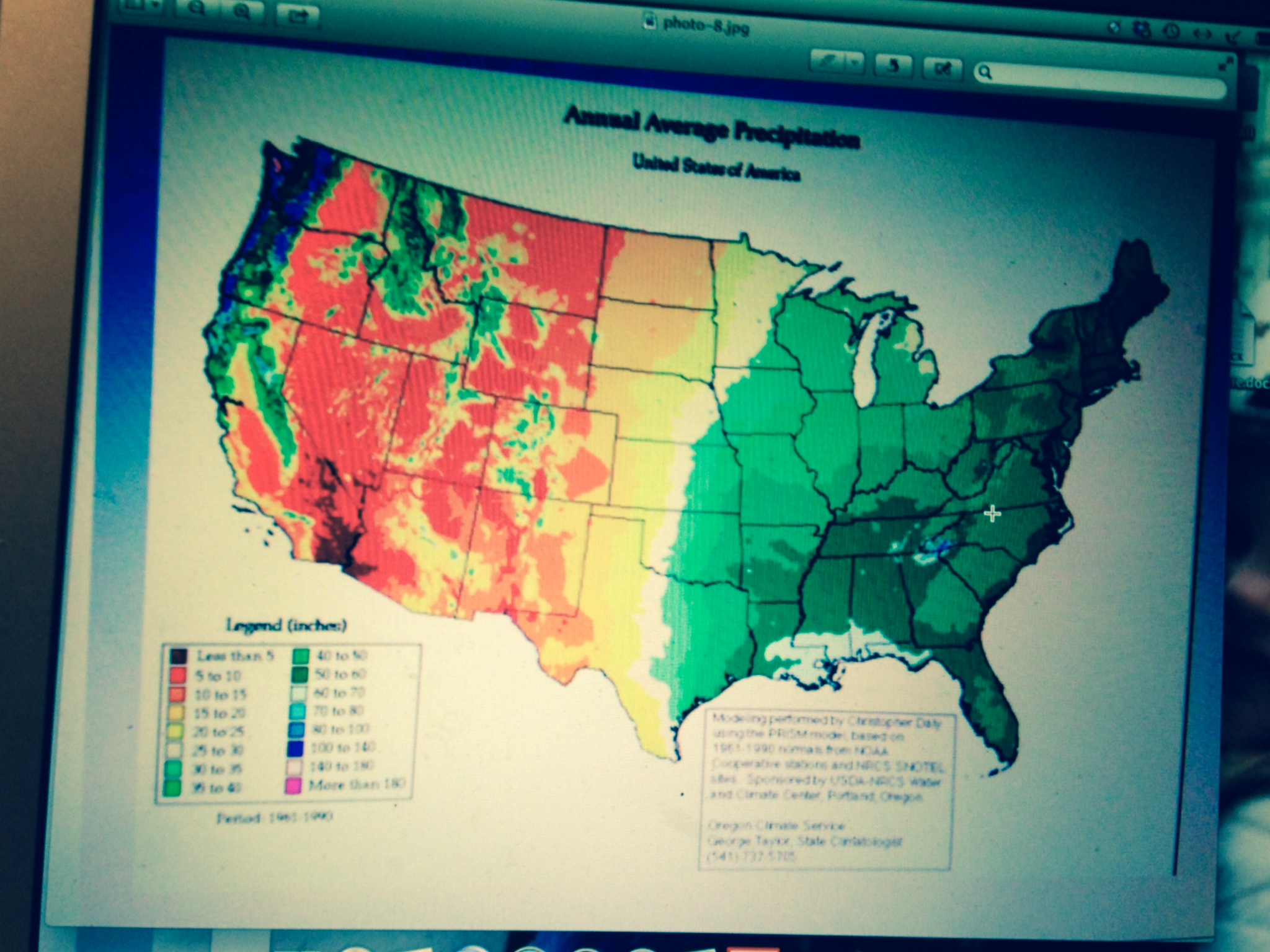
Here is all you really need to know about this winter’s meteorological divide between the inundated East and the parched West: photo-10

The map shows a line just east of the 100th meridian that divides America into a wet half and a dry half, a map that has remained essentially unchanged since Americans began aggressively settling the west 150 years ago. John Wesley Powell, who navigated the Colorado River despite having lost his right arm at Shiloh, argued then that the West was far too dry for intensive development. But his prescient words were drowned out by Charles Dana Wilber’s crackpot theory that “rain follows the plow.”

And so, in southeast Nevada, which gets 4.2 inches of rain a year, we built the sprawling city of Las Vegas, home to two million people and endless fountains. And in California, where the worst drought in memory threatens drinking water supplies and agricultural production, we have created in the desert of the San Joaquin Valley “one of the world’s most productive agricultural regions” by extracting so much groundwater that the land itself is sinking.

Through a long history of damming, drilling, diversions, and water grabs, we have dried up the West’s rivers and extracted its ground water at rates that, it’s now clear, are unsustainable. Over the years, prophets have tried to tell us so – Wallace Stegner in Beyond the Hundredth Meridian (1954), John McPhee in Encounters with the Archdruid (1977), and Marc Reisner in Cadillac Desert (1993) – but we didn’t listen.