A Thought on Taxes

I watched yesterday one of those short “debates” on CNN in which a Democrat and a Republican stand around a table and respond to questions by reciting their party’s talking points. On the “Buffett Rule” – which sets a minimum tax rate of 30 percent for Americans whose incomes exceed $1 million – the Republican talked about the “job creators” who would be discouraged from the heroic role they play, while the Democrat talked about the national need for “fairness.” The journalist talked about polls that show 64 percent of Americans favor the Buffett Rule, named for Warren Buffett who noted that he pays taxes at lower rate than his secretary. The journalist also pointed out that the public is all for slashing spending . . . until people start to talk specifically about what programs to cut. Obviously we need to get real about this issue – about exactly where the cuts will be, about precisely what jobs, other than domestic servants, are created by the personal incomes of the very rich, etc.

Lost in yesterday’s discussion was why we pay taxes at all. A tax has become simply a burden, and therefore the lighter the burden the better. What happened to the notion that a tax is an investment in the country and in ourselves – one whose value we can measure by the return that investment brings? Yes, there is enormous waste that needs to be addressed. But there is so much that needs to be built and that we as a society should be building together.
Easter Morning

Yesterday was as beautiful a day as I have ever seen. The sky was blue and cloudless, the grass a regenerative green. The morning sun warmed the earth, while a northwest breeze took the humidity from the air. I sat with a cup of coffee, trying to take it all in. I was by myself but not alone, for dozens of birds – robins and finches, redwing blackbirds and a northern cardinal, crows and blue jays – flew among the trees and sang from the branches to each other and to me. I felt completely at peace. Early spring. Easter morning. A season of rebirth. A day of resurrection. It might have been on a day like this that Francis of Assisi stopped in the Spoleto Valley to preach to the birds. It is a day that reminds me that religion is not just about transcending our mortality; it is about connecting to life. There is the one we now hear so much about – the one in which Jesus will return to judge us as saints or sinners for eternity. This is the Christianity that tells us the earth is ours to subdue, nature exists for us. This is the gospel of division, exploitation and fear.

I prefer another one – the one in which, as Lynn White wrote 45 years ago, “Francis tried to depose man from his monarchy over creation and set up a democracy of all God's creatures.” But, White continued, that heresy was quickly stamped out.

I wouldn’t bet the farm just yet. I’m pretty sure I experienced it yesterday morning.

Stumble of the Week

Fewer than 48 hours after James Murdoch had resigned as chairman of its parent company, the editor of Sky News announced that he had authorized his reporters to hack into private emails at least twice in the past – one instance involved John Darwin, the “canoe man” who faked his own death and lived for years with his wife on his life insurance payout; the other involved a pedophile. Far from manifesting contrition, John Ryley said, “We stand by these actions as editorially justified and in the public interest,” noting that the satellite news organization had turned the emails over to the police in what turned out to be a successful prosecution of crime.

To suggest that it is a role of the press to gather evidence illegally to aid a police investigation insults all the reporters who have gone to jail or worse for refusing to turn their work into a tool of the state.

Compare Ryley’s comments with those of Anthony Shadid, The New York Times reporter who was memorialized in Cambridge last night. Shadid also broke a law when he entered Syria to cover that country’s carnage. He died there in February. Shadid was an impressive and humble man, who said shortly before his death that he believed some stories were worth risking his life for . . . because they were important to get out to the world and it was his job to do so.

There is a chasm between Shadid’s journalism and Ryley’s.

On a lighter note, this stumble didn’t happen last week but I only discovered it last night: http://www.youtube.com/watch?v=34phsb4e6Eg

Mitts Off

I write this morning about the power of negative thinking and positive cash flow. In the four-and-a-half years that Mitt Romney has been running for president, I have yet to hear him present a positive idea. Instead, his operating style is to tell us why his opponent is so dreadful and assure us that he represents the opposite.

Because Newt Gingrich is the consummate insider, Mitt Romney is the unsullied outsider. Rick Santorum was Mr. Earmark; Romney stands for rectitude. Obama wants to impose “government-centered society;” Romney will offer a non-government-centered society. Once he has defined his opponent, his SuperPAC rolls out the heavy artillery and scorches the earth.

It seems to be working, as Romney is now perceived as the inevitable nominee. Yet the reluctance remains, even in his own party. To date, Romney has won over 50% of the vote in only four states – and he is running against one man (Santorum) who lost his senate seat by 700,000 votes and another (Gingrich) whose party forced him to resign as Speaker of the House.

To present a negative image of others is not enough. At some point a candidate must fill his own empty vessel with substance and augment his attack ads with ideas. After having spent millions of dollars to demonize whomever gets in his way, Romney has given us almost no idea of what he believes in or how he would decide anything should he get the office he so desperately wants.

We Don’t Know

I have always had something of a crush on Aung San Suu Kyi, the leader of the opposition in Myanmar and 1991 Nobel Peace Prize winner, who was overwhelmingly elected to the Burmese parliament on Sunday. A woman whose combination of fragile beauty, steely resolve and quiet dignity has never wavered through a life of more tragedy than triumph, she is to me the personification of Hemingway’s dictum that “courage is grace under pressure.” She has endured much: her father assassinated when she was two; a brother who drowned at their childhood home; long separations from her two sons and from her husband who died of cancer in 1999; almost continual house arrest over the last 20 years.

Nothing in her life has been easy, but it is the life she has chosen. She is the same age as I am, and yet I cannot understand what is going on beneath her always-composed demeanor – other than that her life is a mission for which she has given up almost everything.  And she seems to have embodied the aspirations of her long-subjected people.

Just as we don’t know Suu Kyi from her images, so we don’t know what is really happening in her country either. We think of such totalitarian states as crushing all opposition and using propaganda and mind control to create future generations of automatons. So we thought of Stalin’s Russia and Mao’s China, of South Africa under apartheid. So we think now of North Korea and Iran. And yet somehow these places have never managed to crush the human spirit.

The Power of One

The Supreme Court has been accused of legislating from the bench at least since 1803, when John Marshall outmaneuvered Thomas Jefferson in Marbury v Madison to establish the power of judicial review. But the current Patient Protection and Affordable Care Act Cases represent the first time of which I’m aware that advocates are appealing directly to the politics of the justices – and to one justice in particular. For despite all the parsing of Justice Scalia’s concerns about broccoli, the hitherto inconceivable idea that the Court might actually declare the health care law unconstitutional appears to rest with the pen of one man: Anthony Kennedy. In the conventional wisdom, the court’s even split between ideological conservatives (Roberts, Alito, Scalia, Thomas) and liberals (Ginsburg, Breyer, Sotomayor, Kagan) leaves Kennedy as the decider – and both sides are aiming their arguments at his often fuzzy concept of “liberty.”

Anthony Kennedy decided who should be president in 2000 in Bush v Gore. Having him now decide the future of health care seems a lot of power for one man who has never been elected to any public office. It will also further erode the Court’s image as the neutral arbiter of the law.

Corrections:  Two corrections from Friday’s blog: one a typo (“renewal energy” should have read “renewable energy”); the other an inexcusable slip. The administration’s estimate of the impact of a one-cent rise in the pump price of gasoline is $220 million in increased quarterly profits, not $220 billion. Even in these times, being off by a factor of 10 to the third power is not a rounding error. I am thankful to a reader for questioning the number. He said, and I totally agree, that whatever credibility I have is based on not making sloppy errors. So, please let me know whenever I do.

Stumble of the Week

My old friend. This was my week for old friends, and one of them (who wishes to remain anonymous) got caught in the “grandpa scam” and ended up wiring his “nephew” several thousand dollars to get him out of jail. This telephone scam is apparently both rampant and effective. The callers are smooth, and they prey on both our gullibility and our better natures. Send your money to no one but me. The U. S. Senate. That august body again played games with oil company tax breaks, voting against repeal of the billions of dollars in tax subsidies the proponents of Small Government happily give to the owners of Big Oil. Republicans Susan Collins and Olympia Snowe voted for repeal, while Democrats Mark Begich, Mary Landrieu, Ben Nelson and Jim Webb crossed the other way. According to President Obama, each one-cent increase in the price of gas yields $220 million in increased quarterly profits for the oil companies. His proposal to invest the subsidies in renewable energy research seems a no brainer.

Il Papa. “What does a pope do?” Fidel Castro asked Pope Benedict in one of recent history’s more bizarre meetings. According to an NPR story, one thing he may do is preside over one of the world’s most secretive and corrupt financial empires. This is hardly the first such allegation – 30 years ago a scandal tied the Vatican to international money laundering and the Mafia – and with the ongoing revelations about child abuse, John F. Kennedy’s 1960 speech on the separation of church and state looks a lot more insightful than Rick Santorum’s throw-up on the rug.

Spaghetti Bolognese

After a two-day hiatus, we return to Woody Brock and American Gridlock. It is a fitting time to look at his discussion of the second great issue whose resolution has been lost in the politics of nastiness: entitlements, and in particular, health care, which is currently under discussion before the Anointed Nine. The issue of health care is enormously complicated –Brock calls it the “Spaghetti Bolognese of public policy problems – and his chapter addressing it is one of the book’s best. He is critical of “Obamacare,” but for reasons that have received little public notice – unless we address the supply side of healthcare, particularly by creating conditions that will produce more practitioners, America will end up both broke and rationing services. The logic that takes him there involves a fascinating discussion about the much-misunderstood law of supply and demand, but the essence of his argument is that the need to (1) provide access for 50 million currently uninsured Americans and to (2) control costs as a percentage of GDP are on a collision course unless the supply curve expands faster than the demand curve.

Universal health care is a public good, one in which the government must be involved, and so the focus on the “individual mandate,” which has become the centerpiece of the debate, seems nonsensical to me. We already have universal coverage, unless we are prepared to let the uninsured lie in the streets untended. This debate ought to be about making sure that does not happen.

Obamacare

In the almost two years I have been enrolled in Medicare, I have found it to be by far the best medical insurance plan I have ever had. I once said that to my doctor, who replied, “You know, many of us agree.” In fact, in our long – and so far successful – partnership to keep me alive, we went through a mini-crisis several years ago when he stopped accepting Aetna, which was the “gold plan” I was on at the time. He said he was fed up with the onerous paperwork the company demanded, its niggling oversight of his patient care, and what amounted to interference in his medical practice. Ultimately he had to return to the fold because a small group practice is no match for a huge corporate insurer. And as anyone who has to deal with Verizon can attest, just because you are not the government doesn’t mean you can’t be intractably bureaucratic and provide awful service. Moreover, at least for me, Medicare isn't cheap. I pay reasonable but not insignificant monthly premiums for the parts of the system that are not free.

Despite the constant allusions to the horrors of socialized medicine with its death panels asd rationed care, the United States currently spends more on health care than any other country, and the health of its people is no better as a result. The current law under scrutiny by the Supreme Court Nine is the first national effort to seek fair and full access to health care. It’s not perfect, but it’s a long overdue first step.

Due Process

Forty years ago a friend was staying with me, and as we went by a “Neighborhood Watch” sign, he said, “I know what that means. It means, ‘We have no police.’” Today it appears to mean, “Armed vigilantes on patrol.” Woody Brock must wait for a day. I need to try to understand what happened to Trayvon Martin, the unarmed black 17-year-old whom a neighborhood watch captain shot and killed last month in Sanford, Florida.

Here is what I know:

  • The young man’s death is a complete and needless tragedy, and a parent’s worst nightmare.
  • Florida’s seven-year old “Stand Your Ground” law, which was pushed by the National Rifle Association and opposed by police groups, is an abomination – one that is in effect in 21 states and needs to be repealed in all of them.
  • The police department’s response to the shooting is inexplicable.
  • The New Black Panthers’ bounty offer of $10,000 for the capture of George Zimmerman is repellent.

Here is what I don’t know: What happened the evening of Feb. 26th that led to Martin’s death.

Here is what I fear: That we will never know and that justice will never be done.

Trayvon Martin’s death has become a cause in which the pressure to take sides has overpowered the search for truth – and the rush to either canonization or demonization has displaced the humanity of victim and shooter.

These days, it seems, if you want your voice to be heard, your mind must be closed.

And that, too, is a tragedy.


Dr. Brock

I have known Woody Brock since we were six years old, and he has recently published a thoughtful book, American Gridlock, Commonsense 101 Solutions to the Economic Crisis. Since he is neither bashful about his cognitive abilities nor modest in his ambition, he has subtitled his book, “Why the Right and the Left are Both Wrong.” In line with that aspiration, he takes on five of the most contentious and important issues of the day – issues, he argues, that now seem intractable because (1) the public conversation has become a “dialogue of the deaf” and (2) unbending ideologues “cherry pick” data which they use to fortify their intellectual redoubts. “Gotcha,” he writes, “has become the game of our times.”

Brock calls for a return to a rigorous logic in which win-win solutions are deduced from first premises. A discussion of this method is perhaps the most interesting part of the book. Over the next couple of posts I will briefly present each of the issues raised in Brock’s book.

The Deficit. Brock, a serious mathematician, engages in simple math to distinguish between “good” and “bad” deficits. There is a huge difference, he argues, between spending and investing: a government’s negative cash flow is not a deficit if the borrowed money is invested in human capital and infrastructure improvements that will earn a positive return in the future.

“We eclipse all other nations,” he writes, “spending a whopping 71% of GDP on consumption.” In doing so we have created what John Kenneth Galbraith predicted over 50 years ago: an Affluent Society of “private splendor and public squalor.”

Next up: Entitlements; Preventing Perfect Financial Storms; China and Bargaining Theory; Distributive Justice.

Stumble of the Week

  • Mitt Romney. If he’s the candidate, said Rick Santorum, “we might as well stay with what we have instead of taking a risk with what may be the Etch A Sketch candidate of the future."
  • Rick Santorum. “[I]t is clear,” wrote Romney’s political director, “that he is becoming the most valuable player on President Obama's team."

Silver Lining. Etch A Sketch’s stock price nearly tripled in yesterday’s trading.

  • Georgia. In a report published by the Center for Public Integrity that ranked the most corrupt states, Georgia came in dead last. The other states receiving failing grades: South Dakota, Wyoming, Virginia, Maine, South Carolina, North Dakota and Michigan.

Silver Lining. The top two states were #2 Connecticut and #1 New Jersey. Huh? Apparently the horrendous ethical histories of both states (Connecticut supreme court justices, state officials and governors have been indicted for abuse of power; in the last decade in New Jersey, “at least five state legislators were convicted on corruption charges.”) led to such public outrage that the voters have demanded – and instituted – significant reforms.

  • Young and minority voters. When Virginia’s pending Voter ID bill becomes law, 13 states, with 189 electoral votes (70% of a majority) will have new laws that (take your pick) reduce voter fraud or disenfranchise voters, almost all in states with Republican legislative majorities. But the real problem is not that too many people vote in this country, but too few. In the 2010 elections, 37.8% of those eligible voted. Two years earlier, the figure was 56.8%, the highest since 1968. Question: why would groups who did better in 2010 want to dampen the turnout we saw in 2008?

Readers Write

Today some comments from readers (two from a public official who follows state activities and two from friends):

  • A resolution calling the UN program encouraging sustainable development as a dark scheme to crush people’s property rights through “extreme environmentalism” goes to the Tennessee House for a vote today.
  • The Missouri legislature has considered legislation to require equal treatment of global warming and evolution denial positions in a K-12 curriculum being created by the Heartland Institute. "[It] will be a nice counterweight to the many, many materials distributed that present an overtly political and alarmist message in regards to climate change. . . ," said James M. Taylor of Heartland. "By contrast, our materials would be based on sound science and fact."  Mark McCaffrey of the National Center for Science Education said the curriculum creates a debate where none exists. A 2010 study in the Proceedings of the National Academy of Sciences found that about 98 percent of active climate scientists believe human activities hasten climate change.
  • On yesterday’s blog: A little one sided.  Obama's abandonment of Simpson Bowles, a committee he had set up, is equally as egregious as Mitt’s flip flops, which can be somewhat forgiven considering the audience he has to appeal to. Obama had a chance to set our country on a different path and failed miserably, in my opinion.
  • Asked what surprises him most, the Dalai Lama said, "modern man:" "He works so hard for money and ruins his life in the process, then he uses the money he worked for to try to recover his life without getting it back where it was. Then he spends all his present preparing for the future and in the process dies without living in the future while he never lived in the present either.”

The White Ladies

Since when is a joke like the one Robert De Niro told at an Obama fundraiser (“Now do you really think our country is ready for a white First Lady?") the equivalent of Rush Limbaugh calling a Georgetown law student, who had testified on health insurance and contraception, a slut? Since Newt Gingrich said so: "If people on the left want to talk about radio talk show hosts, then everybody in the country ought to hold the president accountable when somebody at his event says something as utterly, totally unacceptable as Robert De Niro said last night.”

And how did the White House react? The Democrats are the midwives of political correctness; the White House agreed with Gingrich.

If we can’t make distinctions between silly jokes and offensive attacks, we will become a society without a sense of humor, a nation without nuance – which is two ways of saying the same thing.

Actually, leaving the ladies aside for the moment, I don’t think our country is ready for a white president . . . at least not:

  • One who whittles his core principles to fit his current audiences.
  • One who has affairs when his wives are sick and then says it’s OK because he has made peace with God? We all know it’s OK with Newt. Only Newt knows it’s also OK with God.

The sanctimony is pretty galling.

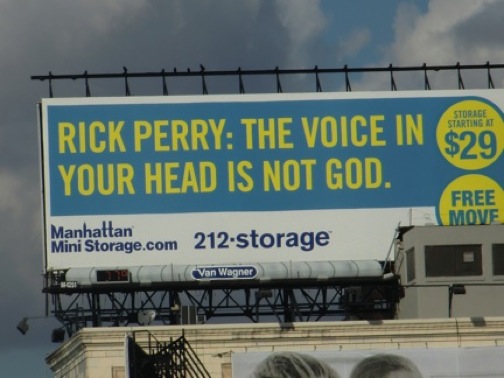
Rick Perry may be gone, but God, it seems, has settled into other candidates’ heads.

Light Fare

With all that is happening in the world, it seems almost frivolous to discuss the Republican primary (yes, it is still going on . . . Illinois today), but the ultimate winner could end up president of the United States, so it is a contest with a significant trophy. Ironically, Sunday was not a good day for Rick Santorum.The candidate, who has developed a Romney-like penchant for inept phrasing (“I don’t care what the unemployment rate’s going to be. Doesn’t matter to me.”), may also have his own Jeremiah Wright problem. At a morning service at Greenwell Springs Baptist Church, Rev. Dennis Terry blessed Santorum . . . and repeated the “I don’t care” mantra. “I don’t care what the liberals say, I don’t care what the naysayers say, this nation was founded as a Christian nation. . . . If you don’t love America, if you don’t like the way we do things, I have one thing to say — get out!”

Later in the day Romney trounced Santorum in the primary in Puerto Rico (or Rich Port), partly perhaps because the latter announced that the “Spanish speaking country” must adopt English before it can be considered for statehood. (I have been unable to confirm rumors that he has called on California to rename its major cities Saint Francis and The Angels.)

Actually, this is more than a joke. The public hostility toward immigrants, particularly those from Latin America, disfigure the history of a nation whose west was settled by indigenous peoples and then – 500 years ago – by Spaniards and retains a rich heritage from both.

Remembrance

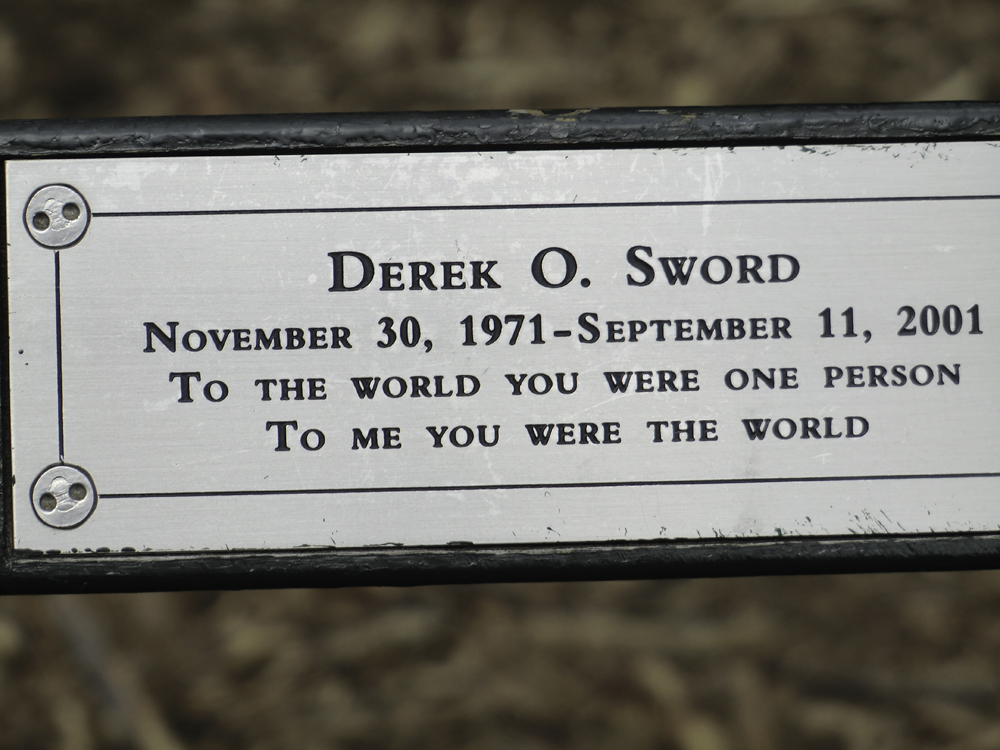
I have taken to reading . . . and beginning to chronicle . . . the plaques on New York City’s park benches. There are thousands of stories on these small bronzes, and there is probably, too, one huge story about a city and its people. Several of the plaques are in memory of victims of World Trade Center victims, such as this one to Derek Sword, so poignant in its aching simplicity.

I had intended to write about Sergeant Robert Bales and the killing of 16 people, mostly children in the village of Panjwai, Afghanistan, having as little insight to shed as others. The story became even more difficult with this morning’s news that a gunman had killed four people, three of them children, outside a Jewish school in Toulouse, France.

I have no generalizations to offer, other than we don’t need generalizations. For days, the U.S. government did not identify Sgt. Bales, which seemed such a contrast to the almost immediate release of the name of Major Nidal Malik Hasan, who killed 13 people at Fort Hood in 2009. With the identification of Sgt. Bales has come an effort to humanize him, to wonder how he could have committed such an atrocity. This is a consideration we must extend to Maj. Hasan.

For the perpetrators and the victims are people, not members of a group, Abdal Samad lost his wife, four young daughters and four young sons at the hands of Sgt. Bales. A father and his two children were killed in Toulouse.

We need to look through the categories and see the people. And we must not, as Kate Wenner wrote yesterday, “lose our memory when it comes to the consequences of wars fought far from home.”

Stumble of the Week

Five things I stumbled onto this week:

  1. 54% believe that presidents can do “a lot” to control gas prices
  2. Tea Party support is at 22%
  3. Women prefer Rick Santorum over Mitt Romney by a 3-2 margin
  4. Women are split on whether health insurance should cover contraception
  • “Modern mega-slums like Kibera (Nairobi) and Citi-Soleil (Port-au-Prince) have achieved densities comparable to cattle feedlots” (Mike Davis, Planet of Slums, p. 92).
  • Rick Santorum’s remark in Cape Girardeau, Missouri, that “it’s good to be in the hometown of Rush Limbaugh, which some  people see as a trip to Mecca" came not long after he told a Bates College audience that Islam " is stuck in the 7th century ."

        •   Two countries have not ratified the Convention on the Rights of the Child, which the Reagan administration helped draft: Somalia and the United States.

Polls for Everyone

Several polls were published this week to determine who will be elected president eight months from now. They cleared up a lot of confusion. “The Republican party has a big problem. Huge!” writes The New York Times’ liberal columnist Charles Blow in “Obama-mentum.” Blow dissects a recent poll by the Pew Research Center, which begins, “Mitt Romney has retaken a significant lead nationally in the race for the Republican presidential nomination, even as he has fallen further behind Barack Obama in a general election matchup.”

“For the Republicans,” writes Blow, “there is no way to put a positive spin on these trends.”

Well, maybe for that poll.

In “The Vulnerable President,” the Times’ conservative columnist, Ross Douthat, cites other polls – Times/CBS (“President Obama is heading into the general election season on treacherous political ground”) and ABC/Washington Post (“Four bucks a gallon gas is taking its toll”) to dissect the president’s ratings drop: “Obama’s political position is tenuous enough that it doesn’t take all that much bad news – particularly on the economy — for his approval ratings to go negative.”

So take heart, there is a poll to suit everybody’s tastes . . . . and many more on the way.

Are the polls worthless? I think they tell us that a lot of people are unsettled about the future, and they are hoping someone will speak honestly to their concerns – and their hopes – instead of robotically reciting talking points. I believe that is what made Obama a special candidate in 2008. And I think it is heartening news that people want to look through a candidate's carefully manicured image to the person himself.

Tell it to a Plant

The dangers of carbon dioxide? Tell that to a plant, how dangerous carbon dioxide is."

Rick Santorum, Biloxi, Mississippi, March 13, 2012

Of all the tripe to which we have been subjected in the never-ending Republican primary, this is the most ignorant. Partly because it was uttered with such willful hubris – and pride, if I remember my confirmation classes, is not just one of the seven deadly sins, it is the first of them. Moreover, the statement makes no sense, and it wouldn’t even if Santorum actually talks to plants. Plants, of course, depend on carbon dioxide, and we humans increasingly depend on plants to remove the escalating levels of carbon dioxide from the atmosphere.

For contrary to the pontifications of Santorum, Rush Limbaugh, et. al., the question of global climate change – and the role of humans in accelerating it – are no longer matters of serious scientific debate. I am not a scientist, but I have spent a lot of time with them, and I recently talked to one who studies carbon movement and climate change. Not only is the evidence “irrefutable,” he said, but as researchers refine the models, the message gets more dire. The good news, however, is that, if we get serious about addressing the issue, we can prevent the worst excesses of global warming.

If Santorum is going to dismiss something this important as “a hoax,” he should at least tell us why “liberal America” is perpetrating it – something more informative than “in Washington, blocking the American dream has become political sport.”

I hate to sound like a curmudgeon on such a beautiful day, so I am heading outside to enjoy the weather.

Collateral Damage

Yesterday I saw a bumper sticker that read: “I’m already against the next war.” Not to mention the current undeclared ones.

The latest tragedy in Afghanistan – in which an army sergeant, trained as a sniper, left his base at night, walked a mile south and killed 16 people, including nine children in their homes – has raised again the questions: Why are we there? What are we trying to accomplish? Why don’t we leave these people alone?

This is by far the most awful of a series of recent incidents that have incensed Afghanis and ought to incense us – Marines urinating on dead insurgents’ bodies; burning sacks of Korans; NATO helicopters inadvertently shooting civilians while on a mission to flush out Taliban fighters; a group of soldiers killing for sport.

Everyone decries the most recent tragedy, but even the contrition demonstrates how the language of war threatens our sense of decency.

"This is tragic and will be investigated, and that soldier will be held accountable," said Senator Lindsey Graham. "Unfortunately, these things happen in war."

“These things” are the methodical murders of women and children in their own homes.

Newt Gingrich, who pummeled President Obama over the Koran burning for apologizing “to people who are in the process of killing young Americans,” said the U.S. should offer “condolences” and perhaps “compensation” to the families – as if the children were somehow fungible, their lives replaceable.

A random act by a deranged individual – but as Senator Graham said, “These things happen in war.”

For better or worse, this is now Barack Obama’s war, and it is time to end it.