The White Ladies

Since when is a joke like the one Robert De Niro told at an Obama fundraiser (“Now do you really think our country is ready for a white First Lady?") the equivalent of Rush Limbaugh calling a Georgetown law student, who had testified on health insurance and contraception, a slut? Since Newt Gingrich said so: "If people on the left want to talk about radio talk show hosts, then everybody in the country ought to hold the president accountable when somebody at his event says something as utterly, totally unacceptable as Robert De Niro said last night.”

And how did the White House react? The Democrats are the midwives of political correctness; the White House agreed with Gingrich.

If we can’t make distinctions between silly jokes and offensive attacks, we will become a society without a sense of humor, a nation without nuance – which is two ways of saying the same thing.

Actually, leaving the ladies aside for the moment, I don’t think our country is ready for a white president . . . at least not:

  • One who whittles his core principles to fit his current audiences.
  • One who has affairs when his wives are sick and then says it’s OK because he has made peace with God? We all know it’s OK with Newt. Only Newt knows it’s also OK with God.

The sanctimony is pretty galling.

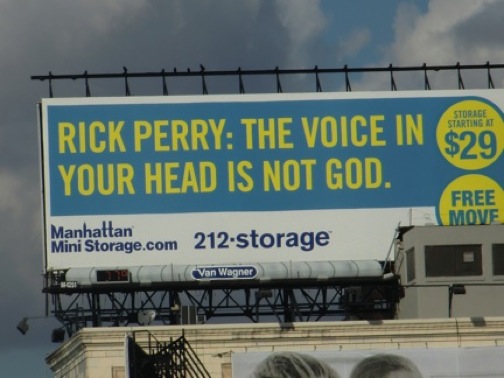
Rick Perry may be gone, but God, it seems, has settled into other candidates’ heads.
Light Fare

With all that is happening in the world, it seems almost frivolous to discuss the Republican primary (yes, it is still going on . . . Illinois today), but the ultimate winner could end up president of the United States, so it is a contest with a significant trophy. Ironically, Sunday was not a good day for Rick Santorum.The candidate, who has developed a Romney-like penchant for inept phrasing (“I don’t care what the unemployment rate’s going to be. Doesn’t matter to me.”), may also have his own Jeremiah Wright problem. At a morning service at Greenwell Springs Baptist Church, Rev. Dennis Terry blessed Santorum . . . and repeated the “I don’t care” mantra. “I don’t care what the liberals say, I don’t care what the naysayers say, this nation was founded as a Christian nation. . . . If you don’t love America, if you don’t like the way we do things, I have one thing to say — get out!”

Later in the day Romney trounced Santorum in the primary in Puerto Rico (or Rich Port), partly perhaps because the latter announced that the “Spanish speaking country” must adopt English before it can be considered for statehood. (I have been unable to confirm rumors that he has called on California to rename its major cities Saint Francis and The Angels.)

Actually, this is more than a joke. The public hostility toward immigrants, particularly those from Latin America, disfigure the history of a nation whose west was settled by indigenous peoples and then – 500 years ago – by Spaniards and retains a rich heritage from both.

Remembrance

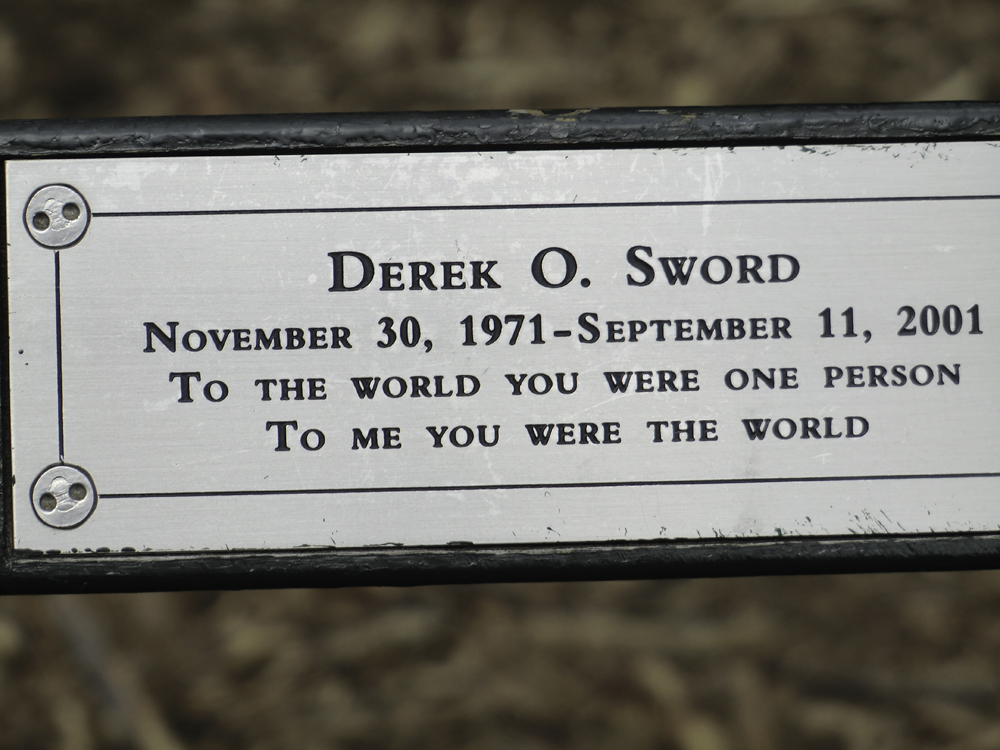
I have taken to reading . . . and beginning to chronicle . . . the plaques on New York City’s park benches. There are thousands of stories on these small bronzes, and there is probably, too, one huge story about a city and its people. Several of the plaques are in memory of victims of World Trade Center victims, such as this one to Derek Sword, so poignant in its aching simplicity.

I had intended to write about Sergeant Robert Bales and the killing of 16 people, mostly children in the village of Panjwai, Afghanistan, having as little insight to shed as others. The story became even more difficult with this morning’s news that a gunman had killed four people, three of them children, outside a Jewish school in Toulouse, France.

I have no generalizations to offer, other than we don’t need generalizations. For days, the U.S. government did not identify Sgt. Bales, which seemed such a contrast to the almost immediate release of the name of Major Nidal Malik Hasan, who killed 13 people at Fort Hood in 2009. With the identification of Sgt. Bales has come an effort to humanize him, to wonder how he could have committed such an atrocity. This is a consideration we must extend to Maj. Hasan.

For the perpetrators and the victims are people, not members of a group, Abdal Samad lost his wife, four young daughters and four young sons at the hands of Sgt. Bales. A father and his two children were killed in Toulouse.

We need to look through the categories and see the people. And we must not, as Kate Wenner wrote yesterday, “lose our memory when it comes to the consequences of wars fought far from home.”

Stumble of the Week

Five things I stumbled onto this week:

  1. 54% believe that presidents can do “a lot” to control gas prices
  2. Tea Party support is at 22%
  3. Women prefer Rick Santorum over Mitt Romney by a 3-2 margin
  4. Women are split on whether health insurance should cover contraception
  • “Modern mega-slums like Kibera (Nairobi) and Citi-Soleil (Port-au-Prince) have achieved densities comparable to cattle feedlots” (Mike Davis, Planet of Slums, p. 92).
  • Rick Santorum’s remark in Cape Girardeau, Missouri, that “it’s good to be in the hometown of Rush Limbaugh, which some  people see as a trip to Mecca" came not long after he told a Bates College audience that Islam " is stuck in the 7th century ."

        •   Two countries have not ratified the Convention on the Rights of the Child, which the Reagan administration helped draft: Somalia and the United States.

Polls for Everyone

Several polls were published this week to determine who will be elected president eight months from now. They cleared up a lot of confusion. “The Republican party has a big problem. Huge!” writes The New York Times’ liberal columnist Charles Blow in “Obama-mentum.” Blow dissects a recent poll by the Pew Research Center, which begins, “Mitt Romney has retaken a significant lead nationally in the race for the Republican presidential nomination, even as he has fallen further behind Barack Obama in a general election matchup.”

“For the Republicans,” writes Blow, “there is no way to put a positive spin on these trends.”

Well, maybe for that poll.

In “The Vulnerable President,” the Times’ conservative columnist, Ross Douthat, cites other polls – Times/CBS (“President Obama is heading into the general election season on treacherous political ground”) and ABC/Washington Post (“Four bucks a gallon gas is taking its toll”) to dissect the president’s ratings drop: “Obama’s political position is tenuous enough that it doesn’t take all that much bad news – particularly on the economy — for his approval ratings to go negative.”

So take heart, there is a poll to suit everybody’s tastes . . . . and many more on the way.

Are the polls worthless? I think they tell us that a lot of people are unsettled about the future, and they are hoping someone will speak honestly to their concerns – and their hopes – instead of robotically reciting talking points. I believe that is what made Obama a special candidate in 2008. And I think it is heartening news that people want to look through a candidate's carefully manicured image to the person himself.

Tell it to a Plant

The dangers of carbon dioxide? Tell that to a plant, how dangerous carbon dioxide is."

Rick Santorum, Biloxi, Mississippi, March 13, 2012

Of all the tripe to which we have been subjected in the never-ending Republican primary, this is the most ignorant. Partly because it was uttered with such willful hubris – and pride, if I remember my confirmation classes, is not just one of the seven deadly sins, it is the first of them. Moreover, the statement makes no sense, and it wouldn’t even if Santorum actually talks to plants. Plants, of course, depend on carbon dioxide, and we humans increasingly depend on plants to remove the escalating levels of carbon dioxide from the atmosphere.

For contrary to the pontifications of Santorum, Rush Limbaugh, et. al., the question of global climate change – and the role of humans in accelerating it – are no longer matters of serious scientific debate. I am not a scientist, but I have spent a lot of time with them, and I recently talked to one who studies carbon movement and climate change. Not only is the evidence “irrefutable,” he said, but as researchers refine the models, the message gets more dire. The good news, however, is that, if we get serious about addressing the issue, we can prevent the worst excesses of global warming.

If Santorum is going to dismiss something this important as “a hoax,” he should at least tell us why “liberal America” is perpetrating it – something more informative than “in Washington, blocking the American dream has become political sport.”

I hate to sound like a curmudgeon on such a beautiful day, so I am heading outside to enjoy the weather.

Collateral Damage

Yesterday I saw a bumper sticker that read: “I’m already against the next war.” Not to mention the current undeclared ones.

The latest tragedy in Afghanistan – in which an army sergeant, trained as a sniper, left his base at night, walked a mile south and killed 16 people, including nine children in their homes – has raised again the questions: Why are we there? What are we trying to accomplish? Why don’t we leave these people alone?

This is by far the most awful of a series of recent incidents that have incensed Afghanis and ought to incense us – Marines urinating on dead insurgents’ bodies; burning sacks of Korans; NATO helicopters inadvertently shooting civilians while on a mission to flush out Taliban fighters; a group of soldiers killing for sport.

Everyone decries the most recent tragedy, but even the contrition demonstrates how the language of war threatens our sense of decency.

"This is tragic and will be investigated, and that soldier will be held accountable," said Senator Lindsey Graham. "Unfortunately, these things happen in war."

“These things” are the methodical murders of women and children in their own homes.

Newt Gingrich, who pummeled President Obama over the Koran burning for apologizing “to people who are in the process of killing young Americans,” said the U.S. should offer “condolences” and perhaps “compensation” to the families – as if the children were somehow fungible, their lives replaceable.

A random act by a deranged individual – but as Senator Graham said, “These things happen in war.”

For better or worse, this is now Barack Obama’s war, and it is time to end it.

Shrinking Commons

In Behind the Beautiful Forevers: Life, Death, and Hope in a Mumbai Undercity, Katherine Boo, writes, “Rich Indians typically tried to work around a dysfunctional government. Private security was hired, city water was filtered, private school tuitions were paid. Such choices had evolved over the years into a principle: The best government is the one that gets out of the way. . . .While independent India had been founded by high-born well-educated men, by the 21st century few such types stood for elections or voted in them, since the wealthy had extra-democratic means of securing their social and economic interests. Across India, the poor people were the ones who took the vote seriously. It was the only real power they had" (pp 216-7). But in Boo’s portrait of the lives of the poor, living in a fetid slum by Mumbai’s gleaming airport, the vote brings no secure power. It brings promises and celebrations at election time; it offers the possibility of individual access to the system through the corrupt political machines that exchange petty patronage for loyalty and eschew any change that might undermine their inconsequential power. The real power lies with the police, courts and government bureaucracy that set the poor against each other and supply “justice” for bribes.

The privatization of public space extends across the economic spectrum in India, just as it does in the rest of a world increasingly characterized by gated communities, private security guards, the dismantling of public education, the shredding of the social safety net, and proxy armies fighting off-budget wars.

The solution to the tragedy of the commons is not to privatize it, as Garrett Hardin suggested in his 1968 essay. It is to reclaim it for the common good.

Stumble of the Week

3rd Runner-up Amanda Clayton, whose food stamps were cut off by Michigan’s Department of Human Services after it was revealed that she had won $1 million on the “Make Me Rich" lottery game show. Clayton, who is unemployed, had continued to collect the public payments because, among other things, “I have two houses.” 2nd Runner-up The graceful concession speech took a hit this week when idiosyncratic Democratic Congressman Dennis Kucinich said, after losing the primary for a redistricted Ohio seat to fellow Democratic Congresswoman Marcy Kaptur: “I would like to be able to congratulate Congresswoman Kaptur, but I do have to say that she ran a campaign in the Cleveland media market that was utterly lacking in integrity.”

1st Runner-up Iraq seems to have stumbled off the list of countries that John McCain wants to bomb. It is not clear how long it can remain out of his sights, since it is firmly nestled between prime targets Syria and Iran. Other reported countries on his long list include Venezuela, Sweden and northern California.

This Week’s Winner Japan’s nuclear program has virtually shut down, with the last of its 54 reactors scheduled to go off-line next month. The country has responded to the aftermath of the Fukushima disaster with a combination of stringent conservation policies and increased dependence on imported fossil fuels – and the Japanese people have also, in the words of poet Madoka Mayazumi, begun to ask “some basic questions [about] the constant pursuit of more. . . . An aesthetic of reduction can be one way to reframe our lifestyle.”

Growth?

Third in a (sort of) series     In a world in which one in seven people is undernourished, it seems unconscionable to talk about policies that slow economic growth. In a world in which we use the equivalent of 1.5 planets to provide our resources and absorb our waste, it seems unconscionable not to.

This, I think, is the great – and often unspoken – divide in progressive politics today. The United States has long equated the nation’s well-being with its median standard of living, and we use economic growth to measure human progress. For the last 70 or 80 years, the Gross Domestic Product has been the measuring stick of America’s prosperity . . . and even of its people’s personal happiness.

That whole notion is under attack – from Joseph Stiglitz’s Mismeasuring Our Lives to Woody Tasch’s Slow Money to Bill McKibben’s Eaarth. And yet, when a hard choice must be made, we continue to treat environmental issues as a luxury to be addressed after we have solved the more immediate economic problems.

Everyone’s mantra in this election is “jobs.” And while Republicans attack environmentalists as job killers, Democrats bring them to the table to discuss “green jobs” and to figure out how to build future growth on alternative energy and better management of ecosystem services.

That’s all fine. But the deeper question is whether the model of economic growth, in whatever form, is viable any more. That question – as we are already beginning to see in issues such as the Keystone pipeline and “fracking” – threatens to divide the current Democratic coalition.

A Goldwater Liberal

At a talk she gave last week, Gloria Steinem referred to Barry Goldwater as a moderate Republican. I almost fell out of my chair.

But consider this. Goldwater:

  • Accused Pat Robertson of trying to turn the Republican Party into a religious organization (“If that ever happens, kiss politics goodbye”).
  • Supported gays in the military ("You don't have to be straight to be in the military; you just have to be able to shoot straight").
  • Endorsed medical marijuana, defended Roe v. Wade, and believed in the separation of church and state.
  • Delivered the word to Richard Nixon that he must resign.
  • And lamented that a “bunch of kooks” had taken over the GOP, telling Bob Dole in 1996, "We're the new liberals of the Republican Party. Can you imagine that?"

Before we get too carried away, Goldwater also opposed the Civil Right Act (as, by the way, did Al Gore Sr.), was one of eight senators to vote against the Equal Rights Amendment,declined to censure Joe McCarthy, discussed nuclear defoliation of Vietcong supply routes, and suggested the United Nations move to Moscow or Beijing.

Still, while we think of America as a more conservative society in the 1950s and 1960s than it is today, in some ways its politics were not. When he ran for president in 1964, Goldwater’s views on religion, gay rights and abortion were simply not issues, and the Republican party paid little attention to the cultural conservatives in its ranks. Now they have taken over the party, and they are gunning not just for Barack Obama but for Mitt Romney . . . who is standing there in his new blue jeans desperately hoping to get picked by their team.

Stay tuned. I’m trying to figure this out myself.

The Wars Within

It has become an axiom in today’s politics that Washington is increasingly, intolerably and perhaps permanently polarized, that the two major parties are moving toward their ideological extremes, and that the result is legislative paralysis and really ugly politics. There is a lot of truth in that sentence.

But it misses a critical internal debate in which dissenting groups in each party are challenging that party’s economic orthodoxy. I’ll outline those changes in this post, and look more closely at each in the days ahead. I welcome your thoughts.

On the Republican side, the tendency to lump together Tea Partiers and cultural conservatives – while dismissing Ron Paul as a libertarian outlier – has shed insufficient light on what is driving bitter rivals to pummel Mitt Romney as much for his persona as his politics. One clue lies in the success of Richard Nixon’s “southern strategy,” which attracted to the GOP millions of disaffected Democrats, They were not simply nostalgic for the Jim Crow south or fed up with the 1960s. They were also heirs to an agrarian, and often angry, economic populism, which meshed with similar beliefs held by generations of western and midwestern Republicans. One result was to vastly expand the wing of the party that detested “Wall Street” and its bankers, financiers and internationalist worldview.

Meanwhile, the reigning Democratic ideology equates social justice with economic growth, a position that resonates with the party’s dominant interests – labor unions, entitlement recipients and minorities seeking opportunity. Environmentalists, however, are increasingly raising fundamental questions about both the possibility and the desirability of unlimited growth.

Stumble of the Week

Civility took another step backward with Olympia Snowe’s announcement that she will not seek re-election to her Maine senate seat. Snowe, one of the few remaining moderates in the GOP, cited the atmosphere in Washington as a reason for her retirement: “I do find it frustrating that an atmosphere of polarization and ‘my way or the highway’ ideologies has become pervasive in campaigns and in our governing institutions.” Shortly after her announcement, she became the only Republican to vote against the Blunt Amendment. Ordinary People. While the Blunt Amendment failed by three votes, the arguments of its supporters that the issue was First Amendment rights for employers and institutions it ignores the needs and desires of the people who actually have the insurance policy or need the services. But don’t forget, corporations are people, too. Mitt Romney’s flip flop on the issue is only news because he took little more than an hour to do so.

Gut Instincts. In 2001 George W. Bush looked Vladimir in the eye and said, "I was able to get a sense of his soul.” Masha Gessen’s new book, The Man Without a Face: The Unlikely Rise of Vladimir Putin, “is the chilling account of how a low-level, small-minded KGB operative ascended to the Russian presidency and . . . made his country once more a threat to her own people and to the world.”

Inhumanity. Asked about the boy who had killed her son Demetrius Hewlin at Chardon High School, Phyllis Ferguson showed the nature of true humanity: “You have to forgive because if you don’t forgive you hold that in your heart. It’s still in your memory of your child. You got that hatred in your heart.”

“On March the 8th, which will be Demetrius’ birthday next Thursday, I appreciate if everybody will light a candle for him. He would be 17 years old.”


Blunt Instrument

Several organizations are reported to be moving quickly to take advantage of the Blunt Amendment, which is not to be confused with Virginia’s blunt instrument (Feb 27th post). Its aim is to amend current health care law to enable those with “religious or moral objections to specific items or services to decline providing them.” In a way that makes sense only in Washington, Senator Roy Blunt of Missouri has attached his legislation to Senate Bill 1813, whose purpose is to reauthorize Federal aid to highway construction programs.

The amendment, which has attracted 23 co-signers, could redefine health-care delivery:

  • The First Church of Christ, Scientist could open a chain of hospitals across the country that, to comply with its religious beliefs, will offer no medical services whatsoever. They will, however, accept Medicare and Medicaid.
  • To expedite its program of posthumous baptisms (Feb. 24th post), the Mormon Church could install baptismal pools adjacent to wards for the terminally ill.
  • While the Archdiocese of Philadelphia will provide no contraceptives in its pedophilia treatment centers, it could install large shredders to ensure confidentiality (http://articles.philly.com/2012-02-25/news/31098596_1_church-lawyers-abuse-complaints-priests).
  • The Shriners, however, would seem to have an issue. Although the organization has operated outstanding children’s hospitals for decades, some believe that any group whose members wear a red fez and worship in a temple must be Muslims – the one religion to which the Blunt Amendment probably does not extend. I mean, look at the logo.

And the organization’s name change from the Ancient Arabic Order of the Nobles of the Mystic Shrine to Shriners International will probably not fool the senators – who know that international is just another word for un-American.


Food for Sport

This just in. MSG apologizes for name, considers change. In the wake of publicity surrounding recent gaffes over Jeremy Lin, the scrawny looking, Chinese-American, Harvard graduate who has become one of the greatest sensations in the history of the National Basketball Association, the board of MSG Sports, owners of the New York Knicks and Rangers, has called an emergency board meeting to address the company’s name.

Lin, who plays point guard for the Knicks, has unleashed an outburst of “Linsanity” across the land and a corresponding outbreak of apologies for insensitive names and boorish behaviors. Most recently, Ben & Jerry’s Boston Scoop Shops apologized for its "Taste the Lin-Sanity" flavored ice cream, whose recipe included pieces of fortune cookies (http://www.latimes.com/sports/sportsnow/la-sp-sn-jeremy-lin-yogurt-20120227,0,1130363.story). Earlier Jason Whitlock of Fox Sports had apologized for a stunningly offensive tweet, which for some reason did not get him fired, and ESPN has suspended one employee and fired another for verbal incidents.

The latest fireworks, according to an unidentified source, arose when the parent company appeared to be caught off guard when a reporter asked about its name. An anonymous spokes “person” later issued a statement: “We should have been more aware,” it said. “We were a big corporation before we realized we were an ingredient in Chinese food. We apologize for our insensitivity.”

In related news:

Several delicatessens in Brooklyn have stopped offering the “Reuben;” McDonald’s will no longer refer to the things on which it serves its “meat” as “buns;” and the Episcopal church has disassociated itself from white bread.


The Pappy State

This is not about abortion. It’s about arrogance, paternalism and the abuse of power. But let’s begin with abortion – which I am hesitant to do because it is, in almost every instance I can imagine, none of my business. And it is certainly not the business of the state legislature, the U.S. Congress or presidential candidates. But Friday’s post on Virginia Senate Bill 484, requiring “transvaginal ultrasounds” for pregnant women, elicited some strong responses, one of which included a news story about Pennsylvania’s House Bill 1077. Incongruously known as “the Women’s Right to Know Act,” HB 1077 mandates ultrasounds for pregnant women contemplating abortion. The bill’s name plays off the real right-to-know law, whose purpose is to assure transparency in state government. Until a concerted effort, led by the Pennsylvania Newspaper Association, pushed through an improved law in 2008, Pennsylvania had the worst right-to-know law in the United States. (Full disclosure: the PNA hired me to write a blog in support of that campaign.)

A disturbing pattern emerges in the Virginia and Pennsylvania bills:

  • Both were introduced by women who seemed sort of clueless – Pa. Rep. Kathy Rapp said she had “never heard of” a transvaginal ultrasound, while Va. Sen. Jill Vogel said she would withdraw her bill . . . after it had already passed.
  • Then the paternalists took over – “It's really just to help women make a good and informed decision.” Anything I can do that would help better educate a woman.” Blah, blah, blah.
  • The bills humiliate women – the Pennsylvania bill, for example, stipulates where the screen must be placed in front of the woman and even the typeface of the statement she must sign (bold).

Both bills are off the table at the moment . . . but remember that the Virginia bill did pass the Senate, while the Pennsylvania bill had 112 co-sponsors in a legislature that currently has 197 members.

For more:

http://www.publicopiniononline.com/ci_20033700?source=most_viewed

http://www.legis.state.pa.us/cfdocs/billinfo/billinfo.cfm?syear=2011&sind=0&body=H&type=B&BN=1077

http://www2.wsls.com/news/2012/feb/01/va-senate-approves-abortion-ultrasound-requirement-ar-1656051

Stumble of the Week

Runner-up The Virginia Senate. A lot of people these days talk about getting the government off our backs, which raises the question of where they would like us to put it. The majority of the Virginia Senate gave their answer earlier this month in Senate Bill 484 (http://www2.wsls.com/news/2012/feb/01/va-senate-approves-abortion-ultrasound-requirement-ar-1656051), which requires pregnant women even considering an abortion to have a “vaginal ultrasound,” a procedure that is as invasive as it sounds, particularly when mandated by the state. (Has it been that long since groups like those who backed this bill denounced ultrasounds for healthy women as a form of social engineering?) Gov. Bob McDonnell, who had sponsored a similar bill when he was a legislator and was initially a strong supporter of the Senate bill – but who also has national ambitions – made a U-turn, saying that “mandating an invasive procedure in order to give informed consent is not a proper role for the state.” The House of Delegates, which had been poised to approve the Senate bill, instead passed a bill removing the mandatory provision. (http://www.nytimes.com/2012/02/23/us/governor-of-virginia-calls-for-changes-in-abortion-bill.html?ref=us) This Week’s Winner: The Mormon Church, which apologized profusely for having baptized – posthumously and without the family’s knowledge – the parents of . . . I kid you not . . . Simon Wiesenthal, the famed Nazi hunter and Holocaust survivor, who died in 2005. Simon’s father, Asher Wiesenthal, was killed in action on the Eastern Front in 1917; his mother, Rosa, died at the Belzec concentration camp in Poland in 1942. A spokesman for the Mormon church called the baptisms “a serious breach of protocol.” (http://www.bbc.co.uk/news/world-us-canada-17036046)

Courage

In little more than a week, three journalists have died in Syria, and a fourth lies in a makeshift hospital in the city of Homs, teetering between life and death. I want to pay homage to them simply by noting the courage it takes to do the work that they have done – and the importance of that work to all of us. They carry, not guns, but only pens, pads and cameras to record the stories of war’s victims. Not long ago, my friend Bob Caputo, who spent years as a photojournalist covering wars across the African continent, described trying to get into Mogadishu in the early 1990s to cover the Civil War in Somalia. His only way in was to hitch a ride on a plane from Nairobi that was carrying relief supplies to the war’s thousands of victims. Bob is a big man. With his equipment he probably weighed 250 pounds, which meant, he said, that if he were to get on the plane, 250 pounds of supplies would have to come off. And that raised the question: is what I am doing valuable enough to displace what that food and medicine could do? It was a moral gut check, and he concluded that the story of what was happening in Somalia had to be told to the world. When Bob finished talking, his cheeks were wet with his tears.

Anthony Shadid died last week, apparently of an asthma attack suffered while he was reporting from somewhere inside Syria. Two days ago, Marie Colvin, the one-eyed American war correspondent for The Sunday Times of London, and Rémi Ochlik, a young French photographer, were killed by rocket fire. French journalist Edith Bouvier may not make it out.

For more on Shadid, Colvin, Ochlik and Bouvier:

http://www.nytimes.com/2012/02/17/world/middleeast/anthony-shadid-reporter-in-the-middle-east-dies-at-43.html?ref=obituaries

http://www.nytimes.com/2012/02/23/world/middleeast/marie-colvin-and-remi-ochlik-journalists-killed-in-syria.html?hp

http://thelede.blogs.nytimes.com/2012/02/22/american-reporter-marie-colvins-final-dispatches-from-homs/?ref=world

What is happening to us?

Sometimes, if I take the news seriously, I wonder if we will bomb ourselves back to the 12th century or just elect a president from the 12th century. I take the news seriously

I have no particular light to shed on the escalating saber rattling by all sides over Iran, except to think that a proxy attack by Israel does not seem like the lesson we should have taken from Iraq and Afghanistan – and that a political campaign already filled with vitriol is not a good venue for conducting foreign policy.

The Crusades mentality has penetrated to the core of the presidential debate, as religion has become its latest – and perhaps most dangerous – flashpoint.  In the last few days, Newt Gingrich has blasted the Obama administration’s “war against religion;” Rick Santorum has railed against Obama’s “phony theology” (although he said he was talking about the president’s environmental policies, not his personal faith); and Mitt Romney has accused the president’s team of having “fought against religion.”

Some of you wrote to compare Martin Luther King’s praise of extremism in the last post with the extremism we are witnessing today. It is worth noting that King went on to write: “Will we be extremists for hate or for love . . . for the preservation of injustice or the extension of justice?” And then he invoked the same god that has been turned into a political battering ram: “Jesus Christ,” he wrote, “was an extremist for love, truth, and goodness.”

“My feets is tired . . .

. . . but my soul is rested.' So said Mother Pollard, a 72-year-old elder in Martin Luther King Jr.’s church, after several weeks of participating in the 1955 Montgomery bus boycott. King quotes her in his “Letter from Birmingham Jail,” which I reread in honor of Black History month. Written in 1963, the letter is addressed to white clergymen who were supporters of civil rights but put off by King’s tactics of non-violent direct action, civil disobedience and willingness to break what he believed “unjust laws” – for which he was fully prepared to go to jail.

It is interesting to read the letter now, in light of current upheavals around the world, particularly the uprisings in the Middle East almost all of which began as peaceful protests and ended with horrendous violence precipitated by the state. Many of us have forgotten the repressive violence from threatened governments that confronted our own civil rights movement two generations ago. The demands for freedom and justice seem little different in Libya than they were in Little Rock; and the worries about whether long-repressed Arab peoples are ready for self-government seem a lot like those voiced by the well-meaning white moderates who prefer, wrote King, “a negative peace, which is the absence of tension, to a positive peace, which is the presence of justice.”

And in a time when the word extremist is hurled about willy-nilly, it is worth remembering King’s response: “the question is not whether we will be extremists, but what kind of extremists we will be.”